


Higher Ground


As we pass another landmark milestone for this republic, many are sincerely wondering, where are we heading? What is left of worth? What is our duty as citizens in the present moment?
No, the Forneys are not going to Canada, though having ancestors from that wonderful maple leaf land, we are now eligible for citizenship. No, we’re staying put. The work to be done is here.
So, what might we celebrate this Fourth? My mind goes to the natural beauty of the land.
When in college two friends and I would head to Yosemite as soon as summer began. One of us, Bill, would usually have a job lined up at the lodge washing dishes. The deal with his supervisor, if the other two of us pitched in, Bill could get released early by midmorning.
John Muir in his nature writings has a marvelous piece on how to spend one day in Yosemite, if all you have is only one day. Yes, head for the Vernal Falls.[1] Give yourself an hour there to take it all in.
We’d soon be hitting the trail to Vernal Falls and beyond. One summer we went rock climbing up the Thumb of Mount Hoffman. Bill was the expert and had all the equipment – ropes, carabiners, pitons – the whole kit.
Earlier the day before, we newcomers to the sport, Ron and I practiced rappelling down some steep cliff faces. We learned the correct way to tighten our harnesses, hook in the rope so we could gently lower ourselves down a 150-foot cliff. I soon got the hang of it, or thought I had until we got to the real thing the next day.
The Thumb is the highest rock spire on the peak of that mountain. It offers spectacular views in all 360 directions. And it is only accessible by circling around from the path leading to it to the 1500-foot cliff on the other side. Yes, it was a long, long, very long way straight down. Vertigo was a real possibility.
We pounded pitons into the cracks of that sheer face, hooked in our carabiners and our ropes with loops tied in for our feet to begin the climb straight up. No, don’t look down. Definitely, don’t look down.
Well, I finally made it to the top with Bill giving me some extra pull at the end of the ordeal – he was the belay man. And, yes, the view was spectacular. To celebrate, we had taken a flask of Wild Turkey whiskey. Just a few sips – we wanted to be stone-cold sober for the climb down. I made it down okay, which was quite a bit easier, made it safely down. I’m still here, am I not?
That venture was definitely to “higher ground.” And spiritually, it was. The majesty filled the soul.
That is the grandeur I celebrate this Fourth, as other memories come flooding back – Grand Canyon at sunrise, the Aurora Borealis at night in the wilds of Alaska, that immense golden eagle soaring only a couple feet over my head when on a float trip down one of Alaska’s wild rivers.
I will celebrate the grandeur of our heritage through the words and legacy of those who are part of the warp and woof of the fabric of this republic. I am brought to those like Frederick Douglass and Sandra Cisneros[2] who through adversity and persistent witness kept the hope of America alive. I celebrate those who speak to our generous spirit. Those abolitionists and suffragists like my great ancestor Julia Ward Howe. Yes, she made it onto the cover of this July issue of the Atlantic magazine – “The Battle Hymn of the Republic.”
The Spirit moving through countless witness to our common humanity is derivative from the one same Spirit flowing through our lessons for this morning.
Hear the Spirit speaking in Matthew’s Gospel:
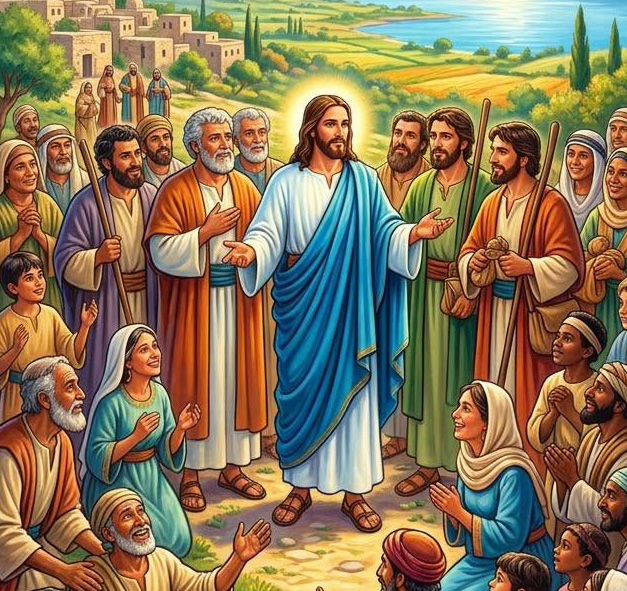
“You have heard that it was said, ‘You shall love your neighbor and hate your enemy.’ But I say to you, Love your enemies and pray for those who persecute you, so that you may be children of your Father who is in heaven. For he makes the sun rise on the evil and on the good, and sends rain on the just and unjust. For if you love those who love you, what reward do you have? Do not even the tax collectors do the same?”
From time to time this generosity has erupted forth from us, even for our former enemies. Having learned the disastrous lesson of the punitive Treaty of Versailles, (signed on June 28, 1919), we rebuilt West Germany, Italy and Japan. The Marshal Plan even went further to rebuild much of Europe.
After the Cold War, in many ways we bent over backward to assist Russia in recovering from the economic disaster left by the downfall of Communism.
Through USAID and the Peace Corps we have sent emissaries of good will through the world, sometimes in the most dangerous and neglected places with food aid, economic assistance, medicines for HIV and common childhood diseases. That is until the current administration had totally destroyed this signature humanitarian work leaving already over 500,000 children to die. The American spirit enshrined in those past years of benevolent aid. Yes, not always completely altruistic, but then what of our human motives are completely pure? Search your conscience on this.
The nonprofits in America have also reflected the same Spirit. Rotary, begun in America in February 23, 1905 by the businessman Paul Harris, has through its world-wide campaign against polio, virtually wiped out that dreaded disease. Their workers are often the only outsiders accepted in places often unaccepting of westerners – Afghanistan, Pakistan, Myanmar. This campaign of Rotary International has led to a historic, global campaign to eradicate polio since 1985.
As a founding core partner of the Global Polio Eradication Initiative (GPEI), Rotary’s PolioPlus program has helped immunize over 3 billion children and contributed more than $2.9 billion toward global eradication. It has led through international partners to a 99.9% reduction of cases for this dread disease.
This is the America I celebrate this Fourth. An expansive version of Rotary’s motto: “Service beyond self.” This is the volunteerism that Alexis de Tocqueville celebrated in his book, Democracy in America, in 1835. Higher ground indeed! For such I will toss back a cold one this Fourth.
This Fourth I celebrate those liberties and rights enshrined in the Bill of Rights, the first amendments to our Constitution – the right to peaceable assemble in protest especially.
With this current mendacious and corrupt administration, we have not only the right but the duty to be the Gospel Resistance to the evil they do. Yes, we do ask our blessing every Sunday on “those we must resist,” but resist we must with all the soul force at our command.
Resistance is Higher Ground. In the streets, in the editorial pages of our papers, in our daily prayers and charitable and political contributions.
Just as we will join in the effort to assist in Venezuela after this horrendous earthquake. Much of Caracas looks like Gaza after the Israeli genocidal war there. We at St. Francis will play our part. Check out Episcopal Relief and Development or the denominational agencies of your own church. Most denominational agencies get well over 90% of your money to the targeted need. Higher Ground!
For us Episcopalians, the site is www.episcoaplrelief.org. Once you’re there, an immediate popup will direct you to: Earthquake Relief for Venezuela.[3] BTW, I tried it out and found that it works easily. Your receipt will say, directed to International Disaster Fund, the international agency through which we are working for earthquake relief there.
The very same Spirit manifested in your gift is to be found in Torah Righteousness – pure Grace. Hear this witness from our Torah heritage:
“For the Lord your God is God of gods and Lord of lords, the great God, mighty and awesome, who shows no partiality and accepts no bribes. He defends the cause of the fatherless and the widow, and loves the foreigner residing among you, giving them food and clothing. And you are to love those who are foreigners, for you yourselves were foreigners in Egypt.” Higher Ground.
The plan of those who would rule over us, Project 2025, continues to roll over our laws, the Constitution and common human decency. Rolling on, reducing voting rights, cutting off food stamps to 700,000 children as of last week. Throwing folks off their health care. Their toadies on the Supreme Court in rejecting the protection given to Hattians and Syrian migrants opens the door for some 400,000 to be immediately deported to the worst hell-hole places on the planet. Deportations to war-torn places, gang-infested countries. Certain death for many. Resist we must. America is better than this.
We have much Higher ground to celebrate this Fourth. The fact that we can be out in the streets that day, loud and proud, proclaiming with our bodies that America means ALL – gay and straight, black, brown, white and all the other colors of our mélange of this big disparate assemblage we label “e pluribus unum.” A street party welcoming the “huddled masses” still yearning to be free.
That’s a beauty the greedy grifters can’t deny. It will be “Youuuuugggge” as Senator Bernie Sanders would bellow. My prayer that day is for over ten millin in the streets all across this great nation. Yes, our marching feet are our prayers. And those marching feet are the greatness of America we celebrate that day.
I close with the admonition from one whose feet were often weary, that tireless suffragist, Susan B. Anthony
“It was we, the people; not we, the white male citizens; nor yet we, the male citizens; but we, the whole people, who formed the Union. And we formed it not to give the blessings of liberty, but to secure them; not to the half of ourselves and the half of our posterity, but to the whole people – women as well as men.”[4]
Yes, All means All on this Higher Ground. And we’re still struggling to make it a reality for the whole of this republic. Onward to Higher Ground. Can I get an Amen here?
[1] John Muir, Selected Writings (New York: Everyman’s Library, 2017) 461 ff.
[2] Sandra Cisneros, The House on Mango Street (New York: Knopf, 1984).
[3] ERD mailing address is: P.O. Box 5121, Boone, IA, 50950-0121. Make checks out to Episcopal Relief and Development and in the memo line put Venezuela Earthquake Relief.
[4] Susan B. Anthony, from a speech at New York 1873. From The Patriot’s Bible: A Bicentennial Anthology of Love and Justice, John Eagleson and Philip Scharper, eds. (Maryknoll, New York: Orbis Books, 1975), 76-77.
July 5, 2026 – Pentecost 5
Independence Day Propers
“Higher Ground”
The Rev. Dr. John C. Forney
Deuteronomy 10:17-21; Psalm 145:1-9;
A Reading from Baldwin; Gospel: Matthew 5:43-48
We Must Cry Out


As our 250th birthday approaches we are seduced into an orgy of nostalgia and kitsch. The banality of the recent cage fight on the White House lawn being the least of what’s to come.
In preparation for the events around the 4th of July, the racists at 1200 Pennsylvania Ave. in D.C. have released an 85-page document rewriting black history. How “white” of them.[1]
In this sanitized version, “slavery” and “slave” each only appear once. “Racism” not at all. These folks have long failed to reckon with America’s divided history. The journey down nostalgia lane ignores the sordid legacy of slavery and Jim Crow – only one of America’s original sins.
As we celebrate Juneteenth, the date the proclamation of freedom belatedly reached those held in bondage in Galveston, Texas, June 19, 1865.
The Juneteenth celebration marks the delayed arrival of the proclamation of freedom from slavery for those held on bondage when Federal agents arrived in Galveston, Texas, June 19, 1865, after local officials failed to share word of the national end of slavery.
Despite Emancipation, America yet remains mired in this tragic history that blighted the lives of millions – and continues to do so.
Point! Secretary of Defense (War?) Hegseth has twice summarily stripped promotion rolls of black and women senior officers simply because of race and sex. Twice — with no explanation to Congress or the American public.
Point! With the efforts to eliminate programs promoting diversity, equity, and inclusion (DEI), this racist administration has corrupted our civil service, our military, our universities. They blatantly don’t want to include half my family in the dream. Not back to the separate water fountains of the old Jim Crow era, but back to a not-so-subtle newer version of exclusion. Just as covert and pernicious as it was under President Wilson when the KKK virtually ran the Democratic Party.
Point! Growing up in a privileged white family, I remained oblivious to much of this history through my teen years and into young adulthood. Oh, there were a few instances when the curtain was pulled back on this ugly underbelly of our history.
I remember the Mexican American boy in my third-grade class in Compton, California. The only person of color in our class. My parents gave me explicit instructions not to play with him. He was dirty. He would give us a disease. He was not nice. End of story. I don’t think he had many friends in our class because I suspect other white parents gave their children the same message.
What puzzled me was the disparity of what I was learning in my Sunday school class taught by my mom and what my family was teaching. This attitude did not comport with the song we sang about Jesus loving all the little children.
Jesus loves the little children
All the children of the world
Red, brown, yellow
Black and white
They are precious in His sight
Jesus loves the little children
Of the world
This double mindedness of our history on race is a grotesque distortion of the promises of the Declaration of Independence and the guarantees enshrined in the Constitution (as revised by the 14th, 15th, 16th and 19th amendments). The oppression of people of color came into full view when I was in junior high.
A Black dentist and his family had moved into our neighborhood. While they were on vacation our “nice” white Christian neighbors ran a hose into the second story of their house and turned on the water. When they returned a couple weeks later, the house was virtually destroyed, and most of everything in it. What the water didn’t ruin, the mold did.
And my church uttered not a peep. That began my estrangement from my faith, my class, my family. Finally reaching a peak during the Vietnam War when my father and I did not speak to each other for almost 8 years.
Jeremiah, in the face of national corruption and faithlessness, is assaulted by the Word of Justice implanted in his heart. He cannot resist it. Fire in his bones.
“O Lord, you have enticed me, and I was enticed, you have overpowered me, and you have prevailed.”
Given this unpopular prophecy to deliver, he has become a pariah.
“I have become a laughingstock all day long; everyone mocks me. For whenever I speak, I must cry out, I must shout, “Violence and destruction.”
And in these fraught times of societal breakdown and chaos we must cry out. While we mint new trillionaires and scads of new billionaires leaving us common folk in the dust – we must cry out! Only the apostate will remain silent.
You might say we’re sometimes impolite. We violate the norms of decorum. I say, there is no longer any decorum when voting rights of the poor and minorities are fed wholesale into the woodchipper. Politeness does a disservice to the Word of God, to the Gospel of Jesus Christ. What we presently are doing to “the least of these” is most impolite.
Now the disaster that daily befalls our nation is not just a matter of corrupt politics. With the inclusion of a wonderful, new addition of an African-American daughter-in-law and a brand-new biracial grandson Luther it’s existential. No longer an abstract concept of fairness and equity, but a matter of survival, belonging and thriving.
And as it’s said in West Virginia, you mess with one of us and you’re messing with all of us. “All of us,” with the enlargement of my family, has taken on a whole new meaning. Yeah, Trump, you and your GOP apologists — you’re messing with all of us now.
Like I felt upon hearing of what had happened to our Black neighbors down the street in my early teens, a smoldering fire had begun burning in my bones.
We need clergy enticed and assaulted by this burning Word in their bones. Lay folks also virulently infected with this living Word – for in it is our salvation. In it is the open door to any sort of life worth living – our only alternative to being just a dumb, senseless part on the Darwinian food chain.
And sometimes such impolite outbursts are pure Grace. They open the door to God’s Justice and Peace. Even open the door to repentance.
I remember my friend Charlie Clark, the pastor of a Lutheran church in Temple City when I ran my ecumenical fair-housing project.
When it came to Tough Grace, Charlie was extraordinary.
Pastor Clark used to fulminate against those in his church who had no vision. “Do not quench the Spirit,” he would demand, voice raised. That church had had five pastors in six years before he had arrived.
There was a reason he was well into his seventh year when I knew him. He had no tolerance for cynical nay-sayers, the faithless who had no vision. “Do not quench the Spirit.” He gave as good as he got for Gospel Righteousness’s sake.
I’m still not sure how he kept from being fired, but under his leadership that congregation was a part of our fair housing effort, Project Understanding – though many there absolutely refused to understand that “Good Neighbors Come in All Colors.” God’s demand for Justice was shut up in Charlie’s bones, and he would not be quiet.
I still remember his secretary telling me of one Sunday, when Pastor Clark was putting out our Project Understanding newsletter in the literature rack. One of the nay-sayers of stunted charity passed through the narthex and noticed this: “Pastor, how long do we have to have this crap in our church?” he whined.
Charlie wheeled about on him, bellowing, “Don’t ever let me hear you call the Gospel of Jesus Christ CRAP!” And his contract was renewed for another year. Truly, like Jeremiah, he had committed his cause to the Lord.
Such indomitable strength of character lies as a possibility within each one of us. This Torah decency and sense of justice is shut up in all of us, but that we only excavate our souls to discover it. We each hold the possibility of having the decency and courage to follow its lead.
It’s not just about my immediate family anymore. This malignant administration is messing with all of America. All of us!
Yet, through persistence. Gentle and otherwise, the Word of God finds a way where there was no way. That’s our doing.
The other day at our “beer summit” at Back Abbey my friend told me this story of his family and the growth to Gospel Inclusion.
Dick’s father was a rock-ribbed conservative Presbyterian in Palo Alto. When it came to his church, he was a stalwart participating member. But his understanding of the Gospel of Jesus Christ was somewhat limited when it came to what he saw as his personal prerogatives.
Case in point. A California ballot proposition to repeal our fair housing laws, the Rumsfield Fair Housing Act, was on the ballot one year. Dick and his father were on opposite sides of the issue. Vociferously so. They argued back and forth. “I don’t want the government telling me what to do with MY property,” was the father’s objection. Even on the way to the voting location the disagreement raged.
After each had cast his ballot and they were back in the car, there was absolute silence as they began the drive back home. Finally, Dick’s father spoke. “I just couldn’t do it. I couldn’t vote for repeal.”
No, the government hadn’t told him what to do with his property. The guidance of the Gospel of Jesus Christ did. Through the persistence and witness of his son. Now that’s pure, unadulterated Grace in action. Such Grace is our only hope. Only such Tough and Gentle Grace can overcome our divisive history of race, class and partisan politics as we approach our 250th birthday. It is our final and only hope.
Time to scrap the impulse to mesmerizing nostalgia for the “good ol’ days” because, in reality, they weren’t so good for many of us. Time for a reality check.
It’s the witness of courageous Republicans who are true conservatives upholding our Constitution and the ethic of the Declaration. Time for Republicans that value their soul more than their ephemeral jobs. Time for upholding the notion that in America we all have of right to be self-determining and enjoy the benefits of the nation we have created. Republicans who are willing to fight for “All means All.”
It’s the witness of Democrats who refuse to continue their acquiescence to the unconstitutional illegality of this administration. Who will stand up to the worst of the worst of their self-serving policies. Democrats who will welcome into the discussion and join with those on the other side of the aisle of good will.
It’s the witness of average citizens who will be out in the streets all across this republic for the largest “No Kings” demonstration in history. It’s those willing to risk malicious prosecution as conspirators for demonstrating against ICE raids and their cesspool detention centers.
It’s about us of the Jesus Movement boldly proclaiming in word and deed the Gospel Goodness we hold dear – ALL MEANS ALL! This Grace will indeed lead us home.
We must cry out.
Time for Tough Grace, Costly Grace. Time for telling it like it is. Only in such boldness is our hope, is the wide-open door to eternity to be entered. As I’m wont to say, “that’s my story and I’m sticking to it.” Because it’s grounded in the much larger story of God’s love for all of us. Full of Grace and full of Glory. Amen.
[1] Nathalie Baptiste, “Trump is Completely Rewriting Black History – With Devastating Consequences,” Huffpost, June 18, 2026.
June 21, 2026 – Pentecost 4, Proper 7
“We Must Cry Out”
The Rev. Dr. John C. Forney
Jeremiah 20:7-13; Psalm 69:8-11, 18-20;
Romans 6:1b-11; Matthew 10:24-39
Power from On High and Deep Within

This past week Jai and I celebrated our 60th wedding anniversary. I racked my brain for an appropriate gift to celebrate this auspicious occasion. Finally, in a flash of inspiration I thought of helping her celebrate our Dear Leader’s birthday by getting her a ticket to the cage match on the White House Lawn.
Sure, isn’t this spectacle something all our wives would want? Two guys beat each other bloody in a no-holds-barred gladiatorial contest. And like the leader’s buddies, maybe make millions on advertising and wagering the outcome of the event. Step right up, folks, place your bets. Who will first get the bloody nose? Who will be first to lose an eye? Broken bones? All bets must be placed one hour to the bell-ring. Advertising space will be sold.
Refs? No need. It’s like a knife fight – there are no rules. At the sound of the bell, go at it, fellows. May the most ruthless win.
Such kitsch! Beyond the pale.
Can you imagine our fore-mothers and fore-fathers observing from the Great Beyond? Madison would be saying, “This is exactly why I didn’t trust the unwashed mob of the hoi polloi with this republic.”
The leaders of our First Peoples would, scratching their heads, be in deep mourning. “We lost our tribal lands for this? These folks really are the ‘white devils’ our elders warned us of.”
Along with Eddie Glaude, looking at this travesty, I too can say, “I do not love America.” There are bits and pieces of it I deeply cherish, places gone and places remembered. There are traditions and rituals I revere. It used to be going in person to cast my vote when I was better able to get around.
We have an artistic heritage second to none. To celebrate our 250th anniversary I have been dipping into some of the readings from the Library of America. Compared to this incompetent and immoral administration, these are people of substance.
In our bathroom reading room I have next to me the writings of Abigal Adams. The tender solicitude she holds for her husband John, the longing in his absence, the concern for his labors to bring about a new nation birthed in liberty. – It often brings tears to my eyes when I think of the mediocracy and mendacity of today’s rule by greed and lies. And our supine political class.
This heritage do I love and treasure. I draw hope from its substance.
But love America? Considering how most of white Americans are dismissive of half my family? Of my new grandson? Love? No. I can only join with those who presently engage to resist such racist lies. I can only take up the struggle against those who would senselessly seek to diminish the opportunities of my little grandson Luther. On this I will go to the mat.
It’s time for telling it like it is. As we said in the 60s, “Let it all hang out.”
Moses comes down off the Mount of Revelation with a similar warning and an austere promise. Wisdom from on high. And also dredging up wisdom from our depths of memory.
Moses has received from The Almighty on those heights a message of solicitude and deliverance. “You have seen what I did to the Egyptians, and how I bore you up on eagles’ wings and brought you to myself.”
In your journey I will be with you if you obey my voice and keep my covenant, you shall be my treasured possession of all the peoples. Indeed, the whole earth is mine.”
Hundreds of years later, the prophet Jesus would expand upon this covenantal understanding. All means all. We are all God’s treasured possession. Let’s honor it with being in Solidarity with one another, creation and God. He sends us out two by two to broadcast that Good News – a renewed Kin-dom of Love is being birthed among you.
Wisdom from on high. Peak moments of revelation wherein we find purpose, meaning and our connection with our brothers and sisters – with all creation. And the One who left us here and gave us the brains, insight and Grace to figure it out.
But this revelation is also wisdom from deep within. Moses pulls out of his people the cherished memories of God’s saving actions. Our deliverance from slavery to liberation from oppression.
Would that these saving memories instruct the descendants of those ancient desert pilgrims that they behave accordingly to the wisdom Moses delivers — in Gaza, Lebanon, and with their Palestinian neighbors. Would their hearts be broken by the genocide they presently inflict. A racist, ethnic cage match. No holds bared. No rules.
That we still have courageous journalists who will shed the Light of Truth on what we do to one another, gives me hope. That courage of our free press I do love in this nation. At least the part that hasn’t been bought out by gazillionaires.
That our society should produce a new Moses in the leadership of Pope Leo XIV is testimony to the democratic heritage we have received and still maintain. The Gospel tradition we have received. Wisdom from the heights of compassion to the depths of malignant power. On war, the Pope has given the warmongers no quarter.
Like many others, I was the victim on an internet spoof. A fabricated confrontation between Pope Leo XIV and Franklin Graham, a spokesperson for White Christian Nationalism, was concocted out of whole cloth.
This never happened, yet how we might wish. I’ll adjust the sermon to indicate a hypothetical, and hoped for exchange of our dreams. This is what needs to happen.
Here is the hypothetical exchange that needs to happen. As the Native American storyteller would say, “This never happened but if it did, this is how it happened.
The fantasy begins as Pope Leo XIV engaged Franklin Graham, self-appointed spokesman for the racist Christian Nationalist movement. The headlines of that encounter reverberated around the globe. Electricity rippled through the internet. “SIT DOWN — YOU DON’T SPEAK FOR THE WORLD.”
What began as a routine televised discussion turned into one of the most talked-about moments of the year — a rare, unscripted clash between Pope Leo XIV and Franklin Graham that instantly ignited debate across religious and political circles.
It started with a pointed remark.
Graham, speaking with confidence, leaned into a familiar argument — that spiritual leaders should remain within the boundaries of faith and avoid entangling themselves in political discourse. He framed it as a matter of clarity, of purpose… even of responsibility.
For a brief second, it seemed like just another televised exchange.
Then everything changed.
Pope Leo XIV didn’t interrupt.
He didn’t react emotionally.
He simply waited.
Calm. Still. Unshaken.
Then, with a measured breath, he lifted his gaze — not just toward Graham, but directly into the camera, as if addressing something far beyond the room.
And when he spoke, every word landed with precision.
“You assume your voice carries for all,” he said quietly. “It does not.”
Silence.
Not the kind of silence that fills time — but the kind that stops it.
Graham shifted slightly in his seat, his posture tightening. The audience, sensing the shift, held their breath. No one moved. No one spoke.
But the moment wasn’t over.
The Pope leaned forward — not aggressively, but with unmistakable intent. His tone remained low, controlled… yet impossible to ignore.
“You speak from proximity to power,” he continued, his voice steady. “From alignment. From influence shaped alongside figures like Donald Trump. But influence is not the same as representation.”
The words didn’t come fast.
They didn’t need to.
Each sentence carried weight — not as an attack, but as a correction.
“A leader,” the Pope added, “is not defined by who they stand beside… but by who they are willing to stand for — especially when it is difficult.”
At that point, Graham opened his mouth slightly, preparing to respond.
He never got the chance.
Because that’s when Pope Leo XIV delivered the line that would ripple across the internet within minutes:
“Sit down. Listen carefully. The future cannot afford loyalty without understanding.”
The reaction was immediate.
A wave of murmurs swept through the studio — some stunned, some impressed, some visibly uncomfortable. A few scattered claps broke through the tension, quickly spreading as the weight of the moment settled in.
On live television… no raised voices.
No chaos. No theatrics. Just control. Clarity. And consequence.
Within minutes, in this story, clips of the exchange flooded social media. Millions watched. Then rewatched. Then shared. (And of course, they did share this conjured conversation).
The post included Imagined commentators from every side weighing in.
Some might call it bold. Others, necessary. For most, simply unforgettable.
But what would stand out wasn’t just what was said. It was how it was said.
In this fantasy, Pope Leo XIV never raised his voice. He never resorted to insults. He didn’t attempt to overpower — only to reframe. And in doing so, he shifted the entire conversation.
One viral post would sum it up perfectly:
“He didn’t silence Franklin Graham. He forced everyone to think beyond him.”
That distinction mattered. Because this wasn’t just a clash between two figures.
In this telling, it was a deeper confrontation — between influence and responsibility… between alignment and accountability… between speaking for people, and actually understanding them.
And perhaps that’s why the moment resonated so widely.
Not because it was loud. But because it was clear.
In a world driven by reactions, this was something different. A pause.
A challenge. A line drawn — not in anger, but in conviction.
And whether people would agree or disagree, one thing would become undeniable:
That night, on live television, Pope Leo XIV didn’t just respond. He redefined the conversation. We need to redefine this critical conversation.
That America could raise up such a Prophet of Light, that I do cherish and love. Even if this telling is only wishful thinking. The fact is, America has produced a stalwart and courageous champion for Gospel Truth. A sign that the promise of America yet continues forth. This would be the necessary rebuttal to the insane racist nonsense emanating from 1600 Pennsylvania Avenue, D.C.
That’s the task before each of us. “We are the leaders we’ve been waiting for.”
By the way, Jai and I are not going to a cage match to celebrate our anniversary. Christopher and Alexis took us to Pasadena on the 11th for three wonderful surprises: our favorite bookstore, Vroman’s; a most delicious Italian dinner; and to top it off, the play “Brigadoon” at the Pasadena Playhouse. It was a great show. And for the occasion, a touching romance. And in July, we’ll be in San Francisco to celebrate some more. We lived there the first year of our marriage. Yeah, left my heart (and also my wallet). For such national delights, I treasure and give thanks.
For all this, even this imaginative fantasy, as we approach our 250th national birthday, I do love and give thanks. And will continue to work my butt off to ensure that everyone else can partake in its opportunity and freedom. And to that I say – a Big Amen!
June 14, 2026
Pentecost 3, Proper 6
“Power from On High and Deep Within”
The Rev. Dr. John C. Forney
Exodus 19:2-8a; Psalm 100
Romans’ 5:1-8; Matthew 9:35-10:8
An Empty Pit God Alone Fills

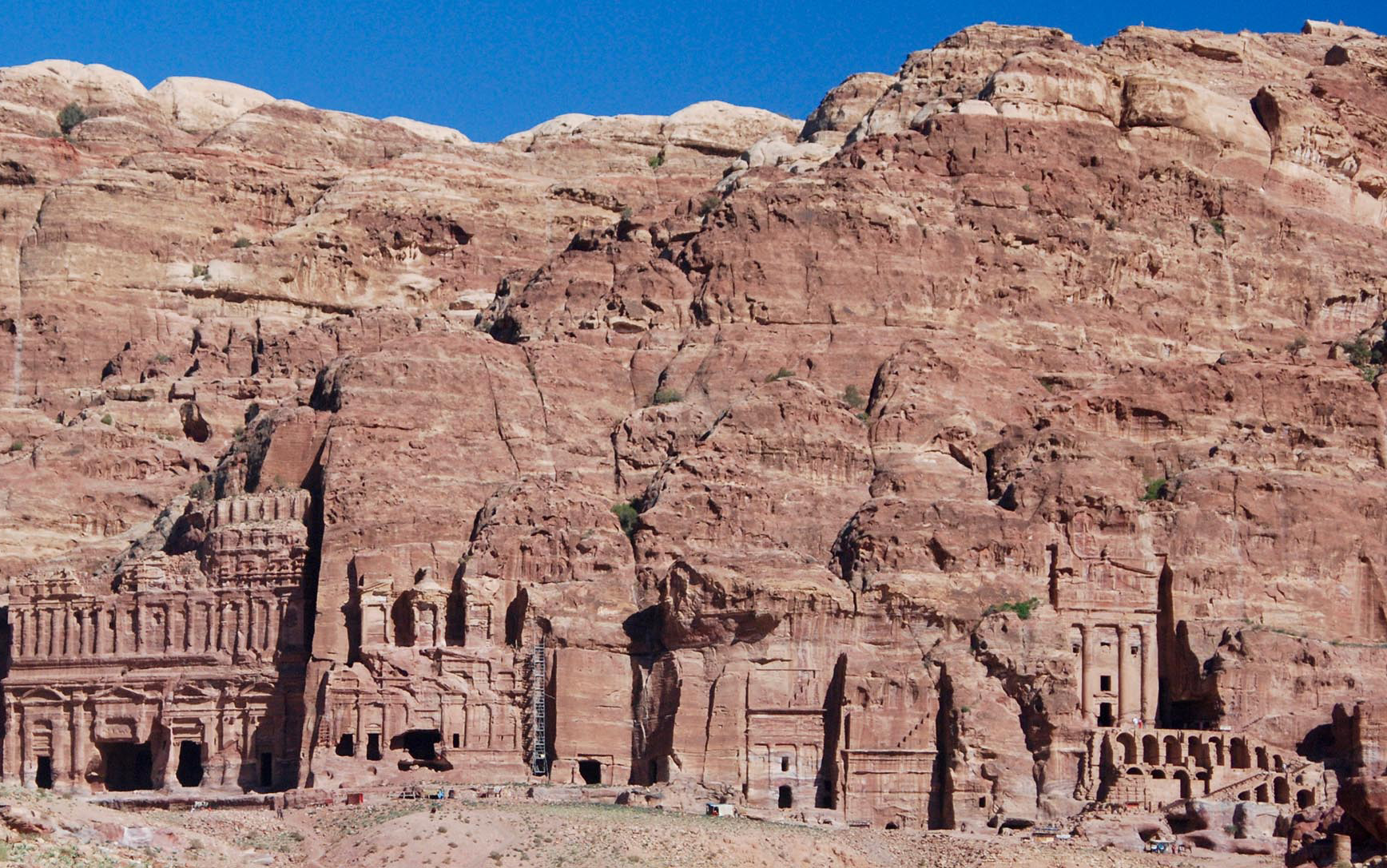
One of my favorite film series are the Indiana Jones movies. I especially like “The Last Crusade,” filmed in the Petra National Archeological Park of Jordan. Why? Because our family got to visit that site.[1]
You buy your tickets at a kiosk which would entitle you to admission but also to a camel ride.
I remember trekking along that narrow pathway between towering basalt cliffs, a path not wider than four or five feet in some places. Talk about camels and the eye of a needle.
Finally, one arrives upon an open scene of what looks like various buildings carved in to basalt cliffs about one or two thousand feet distant facing you. Of course, there is the fabled Treasury Building, the site where the sought after Holy Grail, the Chalace of Christ, was to be found – at least in the film.
Indiana Jones has to solve a number of riddles to secure entrance to the room where this precious cup is located in order to bring back healing wine to his dying father. If the cup is given to another, it grants healing, not immortality.
As he makes entrance a pushy woman who has been trailing him rushes in, holding Jones hostage with her pistol. She seeks immortality.
There on a stone platform is an assemblage of chalices guarded by a spectral knight who supposedly has been guarding the room for some two thousand years.
Whoever chooses the correct chalice among the several dozen cups will live forever. This specter urges a wise choice. A wrong choice will lead to disaster.
This arrogant, self-absorbed woman, assuming that Christ’s standards for choosing such a cup would be hers, grabs the gaudy, ornate jewel-encrusted gold cup and swallows the liquid in one gulp. Immediately she begins to dissolve in shrieks of horror as her face slowly slides off her skull.
The guardian knight drolly remarks, “She chose poorly.”
For the rest, rent the movie. It’s a delight.
We walked around, looking at the many amazing edifices carved into the stone cliffs. And we actually got to go into the one used in the film. But the mystery of the place was ruined by the many stalls selling food and folks with carts selling souvenir trinkets.
We figured that there would be food when we got back to the entrance so we passed on the food stalls there in the middle of the park. Wrong. When we got to the entrance there was absolutely no food or water to be had. We were famished. My stomach was a deep rumbling pit.
Then came along a young fellow selling bags of cashews and bottles of water. We bought a huge bag of those nuts and never had anything tasted so good.
The empty, aching pit in my stomach, like the empty void in that woman’s soul who grabbed up the wrong chalice in the Indiana Jones film can be understood as that empty God-shaped hole St. Augustine talks about. He says that all humans are born with a God-shaped hole that nothing will satisfactorily fill but God alone. We try to fill it with many other things – things far less than God.
The Psalmist talks about this hunger. And God’s hunger.
“If I were hungry, I would not tell you, for the whole world is mine and all that is in it. Do you think I eat the flesh of bulls or drink the blood of goats? Offer to God a sacrifice of thanksgiving and make good your vows to the Most High.”[2]
God seeks in us Righteousness. That is God’s hunger for humanity. It is all about “An Attitude of Gratitude,” as the saying goes in the 12-step movements.
Back in the day when Jesus became a rock star with the musical, “Jesus Christ Superstar,” there appeared bumper stickers proclaiming, “Honk if you love Jesus.” A group of progressives put out an alternative, “Tithe If you love Jesus. Any fool can honk.”
Acts of Righteousness. Now about that old fashioned word, righteousness. My Old Testament professor Dr. Rolf Knierim, said the best modern equivalent would be Solidarity.
Solidarity with God, with one another and with all creation. Exactly as the God force is in solidarity with us and the rest of creation.
And to make good our vows to the Most High, what is required is faithfulness on our part. As God might say, “How about giving me a little help here.”
The Letter of James urges, “What good is it, my brothers and sisters, if you say you have faith but do not have works? Can faith save you? If a brother or sister is naked and lacks daily food, and one of you says to them, ‘Go in peace; keep warm and eat your fill,’ and yet you do not supply their bodily needs, what is the good of that? So faith by itself, if it has no works, is dead.”[3]
Right now, next to the White House there lies a huge, ugly gaping hole. As empty as that pit was in my stomach. The current occupant, seeking to satisfy an endless hunger in his soul has planned on building a gaudy, ornate monstrous ballroom. An edifice to what he presumes to be the grandeur of his personality and importance. Kitsch to the max.
That cavernous hole is a testament to the God-shaped hole in a soul that seeks to fill with adulation, gold trinkets and ersatz accomplishments – endless wars, cruelty to deportees and a grift beyond all imagining. All artificial, desperate gestures.
My prayer for him. That he might fill his soul with true deeds of Righteousness, deeds of Solidarity. As might we all. Yes, don’t just honk.
It begins with moments of prayer. What I call Holy Daydreaming. Allowing myself to be open through the Spirit to need. Listening. Listening to my true needs within, the needs of others. Personally, I don’t need my name in big gold letters on any of my accomplishments. And in reality, neither does Trump.
This spiritual awakening follows with choosing what nourishes the soul. Read a good novel. Moral fiction awakens the reader to what builds and binds us together in fellowship, in sisterhood. Tony Morrison, Alice Walker, James Baldwin, Colson Whitehead, Sandra Cisneros, Claude Brown, Ralph Ellison, Louise Erdrich. Erdrich’s novel, The Last Report on the Miracles of Little No Horse,[4] is a heartwarming delight. Wendel Berry’s Jayber Crow[5] is the one of the few post-apocalyptic novels with a most satisfying ending. It reeks of humanity.
Dip into the Book of Common Prayer for one of the various daily prayers. Try the poetry of Emily Dickenson, Walt Whitman, e.e. cummings, or Langston Hughes.
Read some good autobiographies or collections of writers: Frederick Douglass, Abraham Lincoln’s collection by the American Library. The American Library has a great collection of several hundred titles of our most noted American authors, essayists, novelists, naturalists and historians
Read a science book to get the real low-down on what we’re doing to the planet. Spiritual growth means STAYING AWAKE. Read of the Thwaites Glacier disintegration, now threatening a sea-rise of some three meters. That’s right, folks. Nine feet. Trump’s new anthem at Mar-a-Lago won’t be “America the Beautiful.” No, it will be “We All Live in a Yellow Submarine.” Yeah, we did this. Spiritual growth is grounded in reality.
Spiritual growth can be measured by our willingness to confront the worst within us, the evil of which we are capable. Would that that Orange Felon at 1600 Pennsylvania might dare to look at the devastation he and his buddy Netanyahu have wrought in Gaza and Lebanon – would that they might be willing to let that carnage of mangled bodies sear their hearts like hot coals – would that the pictures of this destruction force them to their knees, force us to our kneels – there might be a smidgen of hope for their souls, for our souls. Perhaps then some of that the vacuity of this God-shaped hole might be filled with something truer than fluff and self-delusion.
Finally, get out in nature. If it’s only sitting in a chair in one’s backyard and taking in the delight of a warm spring day. Delight in the refreshment of a local city park or a hike in a nature preserve.
Oh, one more thing essential to fill any spiritual void – SHOW UP. Show up with friends and neighbors. Show up with folks in civic organizations. And might I suggest, show up at your place of worship. We all need the support, correction and infectious joy of a congregation. We need others who will share our woes and disappointments, our struggles. And we, through our support and empathy need to offer our true selves to the others. A gift to others, a gift to ourselves.
Yes, don’t just honk. Let your works of Solidarity refresh your soul and the souls of others. This is the door to Paradise, that bountiful reality that would even now fill the hearts of all seekers.
One of my friends, after hearing me recite a maxim on follow-through, responded that I was just full of all sorts of sayings. I replied that is because they have served me well. I close with this, again from the Letter of James:
“But be ye doers of the word, and not hearers only, deluding your own selves.”[6] It will serve you well and just might pry open the door to Eternity. Good in season and out of season.
Amen.
[1] “The Last Crusade,” 1989. Released by Paramount Pictures, directed by Steven Spielberg.
[2] Psalm 50:12-14, NRSV.
[3] James 2:14-17. NRSV.
[4] Louise Erdrich, The Last Report on the Miracles of Little No Horse (New York: Harper Collins, 2001).
[5] Wendell Berry, Jayber Crow (New York: Counterpoint Press, 2000). Both these are available through Good Reads.
[6] James 1:22-25. New King James Version.
June 7, 2026
“An Empty Pit God Alone Fills”
The Rev. Dr. John C. Forney
Hosea 5:15-6:6; Psalm 50:7-15
Romans’ 4:13-25; Matthew 9:9-13, 18-26
I Bind Unto Myself Today
We are living in a fearful time. Not the fear of one but of many. We are closer to Great Power conflict than at any other time since WW I. The current level of mistrust and perceived threat resembles the world that existed prior to that conflict which consumed 40 million casualties, military and civilian. Just from July to November 1916 the Battle of the Somme resulted in one million casualties. The cemeteries of the Somme Valley hold over 72,000 British soldiers whose bodies were never identified. The first day of that battle alone resulted in nearly 70,000 casualties.[1]
Global conflicts rage, like those leading to 1916, conflicts that could spiral out of control: Ukraine, Gaza and Lebanon, Iran, Sudan, the tension between North and South Korea, the tension between the U.S. and China over Tawain and trade policies, conflict between India and China over Himalayan water resources as its glaciers continue to melt under global warming. A fear that in the not-too-distant future our planet could be consumed by the chaos of armed conflict among the many Great Powers – chaos resulting in one of the greatest migrations of desperate refugees that the world has yet seen.
Europe is experiencing the highest temperatures ever recorded, wildfires rage.
Kenya and Uganda are consumed by Ebola and Marburg diseases, highly severe and often fatal viral hemorrhagic fever ailments. Let the “America First” crowd remember that what happens in Africa no longer stays in Africa. Time to renew our membership in the World Health Organization, ya think?
Our youth, no matter how well prepared for the future, are struggling with futile job searches. In part brought on by this insane Iran conflict and by A.I.
Just one young man, Soban Ali, was hoping to begin his life away from the Washington where he had been raised. Now living in New York City, he, after being released from his federal job as a government contractor, was into a seven-month job search.[2]
After applying to over 450 openings, he had landed only 10 interviews and still has no full-time work.
He feels guilty, not being able to join his friends at dinner or a beer out. He would like to start a family but sighs, “I can’t even afford myself, so how am I going to afford someone else?” He ponders his prospects for the future. In five years will he have a good, livable income? “Or am I going to be flipping burgers?” He now makes $18 per hour as an aide in an after-school program – a dollar an hour over minimum wage. Yes, he wonders, will he be consigned to flipping burgers for the rest of his productive life? Or will an A.I. robot take over that job too.
Mirko Mormile, 27, a graduate of Brooklyn College, is still living with his grandfather. He studied business, not his first choice, in the hopes of landing something. After applying to over 1000 jobs, he now is a digital content creator, but still does not bring in enough to live on his own.
The current financial chaos is a blight on an entire generation seeking to enter the job market. The worst since the coronavirus pandemic.
We presently live in a chaotic world. The existential fear not of one but of many is palpable.
In the Book of Genesis, the supreme Act of Grace is the subduing of chaos. Order is brought into creation, beginning with, “Let there be Light.” Night and day are ordered. The boundaries of the sea are set. The living world of plants and animals unfolds in order.
Would that some act of creative energy subdue the chaos we inflict upon nature and upon one another?
God brings order into creation as Ruah, the Spirit, blows over it all The Book of Proverbs defines this power of creation as Wisdom. She was there in the beginning delighting God as she worked to bring all into being as a master worker with God.[3]
Today we celebrate the Doctrine of the Trinity. However, this doctrine is nowhere explicitly to be found in scripture. It was an accretion of experience over the years, that was finally formulated as an article of faith for Christians in the 300s.
Today hapless preachers will stumble from one heresy to another in an attempt to define and make sense of the Trinity. Just as numerous early church councils in conclave after conclave failed to come to a satisfactory formulation.
So, I say, let’s ride loose in the saddle, remembering that all theological language is figurative, metaphorical. Paul Tillich warns that our minds are idol factories. The moment we think we have a literal description of the Divine, we have created something less in our minds, far, far less. Literalism only begets an idol. That’s why Jesus spoke in parables and similes. The Kingdom is like…such and such — not far off but within.
The Almighty connects with humanity in many guises. Traditionally, we have perceived the workings of the Creator through the beauty and order of our world. Through the Love binding human relationships. Yes, God is Love and those who abide in Love abide in God and God in them.[4]
We have known this force of Love through the person Jesus. For Christians, that revelation is primary and determinative.
We know that from time to time the Spirit touches our imaginations, bringing to remembrance acts of courageous love, of self-sacrifice. Enlightening in the way of Truth and Life. Wisdom being her hallmark.
As Episcopalians, we have a generous understanding of this Holy Trinity, working ever to bring us to the full mark of humanness. Working ever to restore that original garden of harmonious subsistence.
By the way, given our egregious failures as Episcopalians, in our support of slavery, in our complicity with the genocide of our First Peoples — right from America’s founding, our support of Jim Crow laws in the South and silence about racial injustice in the North, with our murderous persecution of those of other faiths — we have fallen far, far short of the Original Vision that ordered creation out of chaos. We have been agents of disorder.
As I oft say, “Why, given our sordid track record, would God be so stupid to put all the eggs in a basket called Episcopal?” Yet, led by the Spirit, we have become open to that generous Spirit of Charity that works through those of other faiths, and sometimes through no declared faith.
Given our present world, we need the assurance of a strong faith to bind us to Life and Truth. We need such a resilient faith to pass on to our children that they can bear the hatred the world throws at them. Sometimes just because of the color of their skin or accent. A faith to which they can bind their futures, their dreams and their hopes.
So let me tell stories of that Divine Love known through our ongoing creation, through the legacy of Christ emptied out in the humanistic values that guide our world, in the moments of Spirit-filled inspiration that open up new vistas for life to flourish, for the renewal of all Creation.
Creator God, Redeemer God, Sustaining God – who am I, a simple parish priest, to sort it all out. But I will eternally give thanks for all who have carried forth this saving legacy of Eternity. To that heritage do bind unto myself today.
Genisis begins the first act of unmerited Grace. The simple fact that there is Something and not Nothing. And when we behold creation in all its splendor, our breath is sucked right out of us. From sunflower to humming bird. From the majesty of Half Dome to the rugged Mojave Desert with its Joshua Trees. Sucked right out of us it is.
So, I close with a story of this heritage in my life. In our downtown church in Los Angeles, Temple United Methodist Church, there was a family notorious for both their gifts and their disruptive children, especially Billy and Bobby.
Barbara — the mother, an upper-class white had an incredible soprano voice and she would sing in the choir if someone would babysit her children during Wednesday night choir practice. Jai volunteered. And that’s whole other story.
The father, Bill, a Panamanian, was an incredible drummer on the bongos, great on the guitar and would sing scat through some of the hymns.
The two boys were known — behind the parents’ backs – as Los Monstros. Both parents oft seemed clueless about raising their children. It was Bobby who turned off the moving sidewalk in the Haunted House at Disneyland.
After divorce, Barbara brought her children up to Inyokern where I was serving my first appointed church assignment for the Methodists. They were to stay with us for a few days.
It was late in the evening when her van pulled up in front of our house. As the doors popped open and sleepy children stumbled out, one of the boys looked up. Upon seeing the dazzling display of the Milky Way, gasped, “Wow, you don’t have much air up here, do you.”
He had never seen the sky without Southern California smog and light pollution. Soon the other children were heads back, marveling at the splendor of God’s Light Show.
I give thanks for the heritage of this Holy Trinity that has bound such a wildly diverse folk together in one fellowship of love and service as in our church. Yes, even Los Monstros and their parents. I give thanks for such a heritage that has brought me Beethoven’s Fifth Symphony and Langston Hughes’s poetic insight. To this renewing heritage of unmerited Grace, I bind myself today.
I give thanks for one pastor’s wife, Nellie Hughes, who lived out before us often unruly junior highers the gracious acceptance of Christ. Bringing a generous welcome and gentle admonishment of our bad behavior. To her absolute goodness, I bind myself today.
I give thanks for the Spirit of the Divine that has opened my life to creative service and the ability to proclaim the Goodness of it All, goodness as just on that First Day. The Spirit working in my imagination and through the love of others to continually open my life to new mind-bending experiences and fascinating adventures. To this Glorious Revelation, I bind myself today.
To the goodly heritage of the apostles and martyrs, the Gospel writers, the early leaders – Stephen, Paul and Dorcas, the patriarchs and matriarchs who struggled to defend the faith, the Desert Fathers and Mothers, the medieval monastics and the entire company of the saints – to this trinitarian heritage, I bind myself today.
I bind myself to the entirety of this gracious heritage. I don’t have to explain it. Like Billy, I stumble out of my slumber, look up and behold the wonder of it all. And gasp, “Thanks be to God.”
As I oft say, that’s my story and for dear life, I’m sticking to it. Amen.
[1] Odd Arne Westad, The Coming Storm: Power, Conflict, and Warnings from History (New York: Henry Holt and Co., 2026), 1.
[2] Troy Closson, “Cloudy Futures Loom Over Big-City Dreams,” The New York Times, May 17, 2026. The other stories of job search are from that piece.
[3] Proverbs 8:22-30. Though her role is unspecified, she as a “master worker” was instrumental in bringing about the ordering of creation. One might note that Ruah, Spirit or Divine Wind, is also feminine.
[4] 1 John 4:16.
May 31, 2026
Trinity Sunday
“I Bind Unto Myself Today”
The Rev. Dr. John C. Forney
Genesis 1:1-2:4a; 5:1-6; Canticle 13
2 Corinthians 13:11-13; Matthew 28:16-20


