


Living in the Spirit


We’ve all probably had a pet that we and our family got very attached to. Almost a mystical connection, if your personality is open to such rich connections.
When we lived out in the California Desert a family in our Randsburg church had a small Dachshund given to them when the fellow’s brother who owned the dog took an assignment in the Middle East.
The older couple was not prepared nor not all that excited in their later years to have a dog to care for and had asked our church members if any might be willing to take the dog off their hands.
Our family had always had dogs as I was growing up and missed having one. Sure, well take the dog. What’s his name? “Nevada.”
Somewhere along the line Nevada must have been badly mistreated by a previous male owner because he was very afraid of all men. Slowly, as Jai would sit on the floor with a dog treat, petting Nevada, he would tolerate me sitting beside her also petting him.
After a few weeks of this Nevada realized that I was a safe person to be around. He’d let me pet him without Jai being besides us. We’d go on walks together. Soon Nevada was an integral part of our family.
When we took a church assignment in Anchorage, Alaska, of course, Nevada went with us.
During the winters Nevada lived in the attached garage, or downstairs in the furnished basement. As there was no carpet, any messes or accidents were easily cleaned. In the morning Jai would be up making breakfast before I had stirred myself from the bed. She would open the basement door and I could hear her say, “Go get him, Nevada. Go get him.”
I would hear Nevada bounding through the hallway, his dog tags jingling as he came running. With one mighty leap he was up on the bed licking me all over the face. Now, who could sleep through that? No one. Time to get up, and in delight my blurry day would begin.
It was one of the saddest days in our family when the next door neighbor came over to tell us that Nevada must have gotten out and got hit by a car on the busy street in front of our house. My heart was broken, as I broke down in tears.
For weeks afterward, early in the morning, the slightest noise from the kitchen for a moment seemed like Nevada’s dog tags jingling. I’d swear, that’s what I had heard. And as wakefulness returned, I realized that I had only imagined Nevada bounding down the hallway with his dog tags clanking together.
It was the remnants of the mystical connection I had had with that dear animal. I suspect that many of us who had a dear pet like Nevada know the experience.
Or the mystical experience with a deceased spouse or child. In a way beyond words, we carry their essence in our hearts – a bit of their soul resides within our days. We never quite let them go.
The Gospel of John has from the earliest days been know as the “spiritual gospel.” By the Middle Ages the iconography of the church had adopted the eagle as the symbol for this evangelist because his message soars close to the sun – God’s image in the material world. Though the language put into the mouth of Jesus by the faith community that produced this gospel appears to be regular, descriptive dialogue, quite the contrary. It is figurative, metaphorical. All intended to lead the reader into a mystical, unitive and direct experience of Christ and God.
In Jesus’ prayer this unity is the point.
“I have made your name known to those whom you gave me from the world. They were yours, and you gave them to me, and they have kept your word. Now they know that everything you have given me is from you; for the words that you gave to me I have given to them, and they have received them and know in truth that I came from you; and they have believed that you sent me…All mine are yours, and yours are mine; and I have been glorified in them.”
The reader is not being given knowledge about God and the Son. The reader is being invited to an unmediated, experienced knowledge. Invited into the actuality of the divine. The same sort that can develop between a married couple over the years.
William Countryman in his book, The Mystical Way in the Fourth Gospel: Crossing over into God,”[1] insists the gospel must be read as a unitive whole. When broken up for lectionary passages, the progression into the deep, mystical relationship is missed.
How does the modern man and woman approach such a profound and potentially life changing experience? With our rush and hurry, the distractions of electronic media and disquieting daily news? With our incessant busyness about little that matters?
First, slow down. If you’re about my age you would remember that advice in a song by Simon and Garfunkel, “The 59th Street Bridge Song.” Maybe better remembered by the tag line: “Feelin’ Groovy.”
Slow down, you move too fast
You got to make the morning last
Just kicking down the cobble stones
Looking for fun and feelin’ groovy
When you open John’s gospel – slow down. Don’t rush through it as if you were cramming for a test or something. This gospel invites the reader into a relationship, an open-ended, direct personal relationship that moves ever deeper — Into a mystical journey with One who is Life and Truth. By all means, get Dr. Countryman’s small introduction to John. It is a most helpful and trustworthy guide. I will be ordering several for our church library. Used copies are still available on line.
In the community of faith, through its daily routine and work, that relationship will deepen, as it does in John’s gospel.
Kevin W. Hector notes this progressive journey in his book, Christianity as a Way of Life: A Systematic Theology.[2] In the work of the Spirit, we grow into that mystical unity with one another and with God.
This last week Miguel, our farmer for St. Francis Garden of Hope presented me with a huge bag of fresh peas. Peas in their pods just like my mother used to bring home from the store when I was a small boy.
In the afternoon, when I got home from school, she and I would sit around the kitchen table shelling all those peas. As the hours passed in conversation and sometimes in silence, we experienced a bond unlike any other that I had known. One in the Spirit over that work. A mystical bond that was almost heaven.
And when she would cook them up, just right, they were totally scrumptious.
Yes, I enjoyed the peas, but more than that the real gift Miguel gave me was the memory of those precious moments.
In our work to bring our garden into reality, in the weeding, the sowing and harvesting. In transporting it to the food banks it serves. There is a godly mystical bond between the laborers. All to the glory of God.
This is the relationship into which John’s gospel invites us. First, just slow down. Yeah, feeling groovy is a good start. Then roll up your sleeves and get to work.
The delight of common effort will take your mind off all the dreadful news that you can do little about. A rapidly warming planet out of control. A corrupt and incompetent administration of grifters and conspiracy theorists. Hunger and homelessness. The depredations of ICE terrorizing our communities.
In the labor of our hands all that fades into the background, set aside for a brief, refreshing while. In the work of that garden, slow down. Make the morning last. And being a little groovy in the Spirit will restore the soul.
Just like shelling peas over the kitchen table with your mom.
And in the work, the experience of our faith community we do grow deeper into that mystical relationship. One with another and one with the divine. Gracious to make the morning and all the mornings to come last.
Out of the depths of this inward journey we become yeast for the dough. The Fruit of the Spirit flows. Can’t help itself.
Here is some of the fruit of unity we and our United Methodist sisters and brothers are presently experiencing.
I rejoice that the United Methodists have recently extended an invitation to us Episcopalians to heal the breach between us which opened over two hundred years ago when Bishop Samuel Seabury refused to recognize Francis Asbury’s consecration for work as bishop among the people called Methodists. In the end we are all one in the unity of a mystical fellowship that feeds the soul.
I close with Fr. John Wesley’s admonition to his followers:
Do all the good you can,
By all the means you can,
In all the ways you can,
In all the places you can,
At all the times you can,
To all the people you can,
As long as ever you can. One in the Spirit over that work that takes us deeper. That’s our charge. We’ve got the vision. We’ve got the power. Let’s get to work. Veggies await. Glory awaits! And so does Groovy. Amen.
[1] L. William Countryman, The Mystical Wat in the Fourth Gospel: Crossing over into God (Valley Forge, PA: Trinity Press International, 1994).
[2] Kevin W. Hector, Christianity as a Way of Life: A Systematic Theology (New Haven, CT: Yale University, 2023).
May 17, 2026
Ascension Sunday
“Living in the Spirit”
The Rev. Dr. John C. Forney
1 Peter 4:1-12-14; 5:1-6; John 17:1-11
Unknown Gods


I later found out that my vocation of the ministry was a big disappointment to my father. Why would I choose to do this when I could enter a field where I would make a lot more money? I was just an idealistic failure.
After Dad had finally graduated from Bethany College with a degree in chemical engineering, he went to work in a steel mill near Pittsburgh. Within months he was out of a job. With the advent of the Great Depression, the mill closed and Dad headed West. “Go west, young man, and grow up with the country,” was the advice of Horace Greely in 1865. He loaded up his Ford Model A and headed out to San Francisco.
There he met my mother. Shortly after they had married a life-changing opportunity arose.
He woke up one morning with a terrible toothache. He was astonished at how much the dentist charged to care for it. Within three days he enrolled himself in the U.C. School of Dentistry. And never looked back. Made a ton of money. He had thought that science and technology was the door to the money pot at the end of the rainbow. If chemical engineering wouldn’t do it, with this depression people would still have toothaches.
I was expected to follow him in those footsteps and take over his dental practice. Sorry, Dad. Not my cup of tea.
Money was the unknown god he worshipped. If you didn’t have it, he had no time for you. If it wasn’t your highest priority, there must be something wrong with you. Lacking that drive, I was told that I would never amount to anything. A big disappointment.
The lesson Dad learned from the Great Depression was that you can never have enough. Wealth was the god he worshipped. Unknown because it was never acknowledged. He did not realize the hold it had on his soul. It determined everything. He also had other demons.
Paul, in the Book of Acts, reports encountering in Athens the many statues to various deities. Their numerous visages cause him to remark, “Athenians, I see how extremely religious you are in every way.”
Then he comes upon a statue “to an unknown god.”
“What you therefore worship as unknown, this I proclaim to you. The God who made the world and everything in it, he who is Lord of heaven and earth, does not live in shrines made by human hands, nor is he served by human hands as though he needed anything, since he himself gives to all mortals life and breath and all things.”
He created humans with a God-shaped hole, a spiritual void, that they would “search for God and perhaps grope for him and find him – though he is not far from each one of us.”
St. Augustine warns that that void within, when we attempt to fill it with what is less than God, leaves us with an empty sense of self. Whatever we substitute is never enough, never quite satisfies. “Can’t Get No Satisfaction” is the name of that quest. No golden idols. Nothing conjured out of our worldly cravings — Only the Real McCoy will do.
Paul Tillich in his little book, Dynamics of Faith, puts it slightly differently. He asserts that it is the nature of humans to have faith in something — some god, if you will, that becomes all-consuming. Faith grounded in some ultimate concern.[1] Power, money, fame, that trophy wife or trophy husband, the perfect children, a perfectly manicured lawn. Something.
We all have various concerns just as the result of being a human animal – food, shelter. But also, being spiritual beings, we also desire “cognitive, aesthetic, social and political” aspects to our existence.
When one of these becomes “ultimate,” it distorts all of life. “It demands surrender of [the one] who accepts this claim…And the promise of total fulfillment…”
I know a man whose unacknowledged god is power, fame money, public acceptance, control. A god with as many faces as the Visvarupa, a representation of Vishnu, the Hindu god.
Whether this deficit of soul was brought about by an undemonstrative, emotionally distant, punishing father, I have no certain idea. But this man suffered a spiritual void, an empty sense of self, and so he has attempted to fill it with that which is less than God. Far less.
He sought public acceptance in New York, building one edifice after another. Worshipping the god mammon to the point of cheating his workers out of their wages. He never found real entry into New York society. That unacknowledged god left him as he was, an empty suit.
He owned many casinos in New Jersey but in his continual striving, he couldn’t attend to business and they all went bankrupt. The glitz and glitter just didn’t get him satisfaction. Vainly striving after another unacknowledged god. “Vanity of vanities – all is vanity.
To assert his sense of self in the face of ridicule at a White House Correspondents dinner, the barbs of then President Obama cut like a chainsaw. On a lark, he decided to run for president himself.
Meanwhile he plastered his name on various properties in huge gold letters. And when elected not once but twice, the fame and prestige of that office did not fill the God-shaped hole in his being.
He needed more monuments to himself. Did you hear about the gold coin featuring his visage? What about a billion-dollar ballroom where the east wing of the White House used to stand? He wants us to give up our Medicare and Medicaid to pay for that.
Or a triumphal arch? Probably with his name on it, also in big gold letters.
No excess would suffice. No amount of gold could fill that spiritual hole. The grip of these unacknowledged gods on his soul is leading to its destruction – and the destruction of the nation he claims to serve. But as his ultimate allegiance was to this many-faced god, he had no thought for the people who voted him into office. Just not that much into them.
There is an antidote to this existential emptiness. It is the Spirit of Truth, the Power that dwells in the heartbeat of creation, the One who fills the soul brimful to overflowing with joy. We have known this Reality in one Christ Jesus – the Man for Others.
By inviting his presence into our hearts and minds we have found lives worth living. Every day a freely-given delight as we take up the needs of others, investing our days in a cause greater than our limited desires.
Every now and then, to get an uplift from the mire of depressing daily news I dip into Chicken Soup for the Soul, one of a series of self-help books.
That unknown god which Paul makes known is the Power of Love that moves the cosmos, that dwells in the heart of even the lowly. Yes, In their impoverished circumstances. Or in their professional success.
This Love the community of John identifies as very God, Godself. “God is Love and those who abide in Love abide in God and God in them.”
Here’s a true story from “Chicken Soup” that reeks with such divine Love. Told by Eric Butterworth.
A college professor had his sociology class go into the Baltimore slums to get case histories of 200 young boys. They were asked to write an evaluation of each boy’s future. In every case the students wrote, “He hasn’t got a chance.”
Twenty-five years later another sociology professor came across the earlier study. He had his students follow up on the project to see what had happened to these boys. With the exception of 20 boys who had moved away or died, the students learned that 176 of the remaining 180 had achieved more than ordinary success as lawyers, doctors and businessmen.
The professor was astounded and decided to pursue the matter further. Fortunately, all the men were in the area and he was able to ask each one, “How do you account for your success?” In each case the reply came with feeling, ‘There was a teacher.”
The teacher was still alive, so he sought her out and asked the old but still alert lady what magic formula she had used to pull these boys out of the slums into successful achievement. The teacher’s eyes sparkled and her lips broke into a gentle smile. “It’s really very simple,” she said. “I loved those boys.”
Nothing out of the ordinary for teachers. But most extraordinary in practice. In that self-giving Love is the Lord of the Universe. The One who has breathed life into all flesh, yet holds us tenderly in arms of Love and Delight.
Every Sunday in worship gathered, around this table, or harvesting nutritious veggies in St. Francis Garden of Hope, we make One who may be unknown known. In the distribution of this nutritious goodness at St. John’s, people know of our faith. They can smell and taste it.
When Ileen, my caregiver, and I left the church Tuesday with bags of vegetables, the entire car smelled of cilantro. A total delight. The smell of the same Divine Reality surely lives in the spirit of the united work of our two San Bernardino congregations. The One dwelling in the heart of all creation. Master of the universe. Right here in my car! Cilantro! Thanks be to God.
Tillich is right. We all have faith in something. It’s the nature of us human beings. The world no longer sees the historical Jesus who lived out this Love – But in faith we know the Promise. The Promise is that, “because I live, you also will live.” Life beyond abundant.
That is a Promise you can take to the bank. We’ve seen it in action right here — for the good of neighbor and to the Glory of God. Amen.
[1] Paul Tillich, Dynamics of Faith, (New York: Harper and Brothers, 1957).


Build it and they will come. A monarch butterfly visiting our milkweed — Hope for the butterflies and for the some-500 folks we nourish each and every week with healthy vegetables and fruit. We’re now providing for three food banks and a preschool out of our garden.
May 10, 2026
6 Easter
“Unknown Gods”
The Rev. Dr. John C. Forney
Acts 17:22-31; Psalm 66:7-18
1 Peter 3:13-22; John 14:15-21
From Royal Screw-ups to Royalty


It doesn’t take much reflection for those moments of bad judgement to surface in the silence of our thoughts. Times when we could have, should have done better. That little “white lie” that wasn’t so little. That excuse not based on reality. Evil thoughts against one’s political foes. Only takes a second.
My friend Dick related the delightful story of a pastor who decided to skip church and head for the golf links.
That Sunday morning he loaded up his bag of clubs and prepared to head out to the course. He told his wife that he had to visit a parishioner who was in the hospital, and then told his assistant from the car that he wasn’t feeling well. He drove to a golf course in another city, so nobody would know him. He teed off on the first hole. A huge gust of wind caught his ball, carried it an extra hundred yards and dropped it right in the hole, for a 450-yard hole-in- one. An angel looked at God and said, “What’d you do that for?” God smiled and replied, “Who’s he going to tell?”
The Bozo No-No move of a royal screw-up pastor. And who’s he gonna tell.
My friend Susan at All Saints told this story of a screw-up as a young mother.
Her son’s kindergarten was having a tea for the parents. All about the classroom were brightly decorated bulletin boards. One of which was labeled “Easter.”
On it were the children’s paintings of their ideas of Easter. There were bunny rabbits, eggs, flowers and such. In the lower right corner was a painting with a grey blob and a black blob. And her son’s name, Jamie.
The first words out of her mouth to her son in dismay were, “I thought you were supposed to make a painting about Easter.” “But it is, Mom!” (This was before Susan was much wiser as a grandmother, when she might have said, “Tell me about your painting.”)
Jamie persisted, “the grey is the stone that was rolled away. The black is the empty tomb. See!”
A minor screw-up, hopefully not inflicting lasting psychological damage. All of us parents have walked into the same sort of blunder.
But some screw-ups can be deadly. Truly royal screw-ups.
As global warming moves towards an increase of 3.75 degrees Celsius at the end of the century – as we’re getting close to making our “island home” uninhabitable, this is what I read.
The headline in the L.A. Times pronounced, “U.S. pays wind developers to quit.” I read that we were paying a wind farm company, Golden State Wind, $885 million to pack up and go home. That after similar payment of $1 billion to Total Energies to pack up and go back to France.[1]
My latest reading details the folly of such thinking. In her book, Field Notes from a Catastrophe[2], the author of The Sixth Extinction[3], Elizabeth Kolbert, warns us that Global Warming is not something awaiting us in the far-off future. It is happening now. With a vengeance.
While we blithely go about burning more fossil fuels, she narrates incident after incident of the effects of our profligacy NOW.
She tells the story of a rather cold destination where tourists can watch the iceberg gently flow down the fjord in Greenland. At Hotel Arctic in the town of Ilulissat, four degrees north of the Arctic Circle, tourists gather to watch huge, awe-inspiring icebergs slowly drift past their windows.[4]
Only now, the glacier off which they calve, Jakobshaven Isbrae, has retreated several miles and thinned out considerably. The icebergs still flow past that hotel, but they are considerably reduced in size.
Just one sign of how we have royally screwed up our home.
When Jai and I lived in Anchorage, Alaska, old timers used to tell us of how about the first weeks of January we’d get two or three weeks of minus 10 degrees weather. That doesn’t happen anymore. In fact, there’s usually not enough snow in Anchorage to begin the Iditarod, the snow-sled race to Nome. Not enough snow unless it’s trucked in.
Another royal screw-up. Unless we repent and change course, a major royal screw-up.
Remember that an increase in temperature of almost 4 degrees Centigrade, due to arrive by the end of this century, much of the U.S. will be an uninhabitable wasteland, a permanent dust bowl. The Amazon will be dried out and burnt out. The same of much of Southern California.[5]
Did I mention glyphosate, the key ingredient in cancer-causing Roundup weed spray? We now spray it in huge amounts in our national forests to kill off the deciduous trees which might choke out the valuable conifers the timber industry favors – but much more highly flammable than those deciduous species.[6]
The author, Nate Halverson, describes walking through a burn zone in Lassan National Forest that’s completely bare. Then he sees something moving. It’s a dust devil, carrying some of the 266,000 tons of pure glyphosate sprayed in our national forests into the air to who-knows-where.[7] Carrying those toxic carcinogens to your city and mine. But we don’t pay attention to the World Health Organization anymore. What’s a little non-Hodgkin’s lymphoma among friends anyway?
And the studies purporting to declare Roundup safe? They were written by so-called scientists paid by Monsanto, whose work was in numerous places edited and changed by Monsanto – yes, there is a trail of emails to this effect.[8] The main author? A pseudo scientist whose work had previously been discredited.
Super, super royal screw-up.
The other day, one of our table-mates at Pilgrim Place lunch, a gentle Quaker lady, on hearing what I had been reading, turned to Jai and asked, “How do you live with him?”
Here’s my take. Following Christ is the willingness to bear my cross. It is to look into the darkness of human sin and folly and acknowledge it for what it is: evil. Destructive to all and to the planet itself.
In our reading from 1 Peter, we are presented with an alternative.
“Come to him, a living stone, though rejected by mortals yet chosen and precious in God’s sight, and like living stones, let yourselves be built into a spiritual house.”
It is the Spirit that tugs on our hearts and minds, urging and enabling us to accept that invitation to Life. To be as living stones built into the whole stature of Christ.
The author of 1 Peter sums up the invitation:
“But you are a chosen race, a royal priesthood, a holy nation, God’s own people in order that you may proclaim the mighty acts of him who called you out of darkness into his marvelous light.”
We royal screw-ups are indeed meant for royalty. A royal priesthood, bringing to life that which was formerly dead and hopeless. Bringing to life new possibilities, yes, mighty acts, that all might thrive. This is what it means to play our part in the Jesus Movement. It’s action flowing out of faith.
One of those places of hope and new possibilities in Appalachia is a small college, Berea College. It is committed to two key goals: Enabling its students to graduate with little or no student debt and walking with them throughout their college career to ensure that they do graduate. The record for these two objectives is spectacular.
Their work is Spirit-inspired, Spirit-activated. A Christian college that actually lives the gospel mandate.
Many of their students are from impoverished homes, often riven by violence and substance abuse. Students with potential yet who never dreamed of going to college – that is until a recruiter from Berea College showed up on their campus and lit the fire of hope.
Here’s one story:
Jake Miller, in an inspiring piece, “From the Shadows to the Statehouse,” tells the gospel promise.[9]
It’s the story of Linsey Hogg. She knows injustice, she was raised into it, and yet now she is Kentucky’s assistant attorney general.
Raised in an unstable situation in Rock Spring, Georgia, she bounced around from women’s shelters to friends’ couches to her grandmother’s house where her teen aunt attempted to raise her. “It was a kid raising a kid,” she remembered.
In her home of domestic violence the message, spoken and unspoken, was that she would never amount to anything. Though she had been placed in remedial math, a perseptive teacher saw that she should have been placed in advanced math.
She was good at math. It was a calculus teacher and guidance counselor who paid out of their own pockets for Linsey to visit Berea College.
Linsey knew nothing about college and what it might have offered. She did know that she revered teachers. In her small village, they were people of promise. A royal priesthood if you will.
But, having taken an ethics course, she became a philosophy major, though she had originally thought of healthcare because she and her family never had any healthcare.
She worked in the medical field, saving funds for her new vision — law school. In a few years she was admitted to law school at the University of Kentucky. What had distressed her was people who gamed the system. She called the state director of the Medicaid Fraud Control Unit and asked how to get there. It was surprisingly easy. The director told her that no one seeks out the Medicaid Fraud Unit.
When asked what she had taken from Berea College, it wasn’t grit or determination. It was humility. “It is,” she recounted, “a kind of humility with tinges of pride.”
“Sometimes I tell people, ‘You know that poor Appalachian hillbilly, you’re talking about? That’s me.’”
Like Linsey, in ways great and insignificant, we are called to royalty. Despite the royal screw-ups that we have caused or endured. After majoring in poolhall with a GPA of 1.3, it was a campus minister who called me to royalty. Despite my dysfunctional family violence, despite being an academic royal screw-up, I was destined in God’s story for something greater than just being a royal ne’er-do-well. Besides, I was never that great at the pool table. Always behind the eight-ball.
Speaking of royal screw-ups, have you any idea how many A’s one needs to earn in order to pull such a grade point average up to something close to a 3.0? I burned a lot of midnight oil. Norm Self’s call to me was God’s invitation to be part of that royal priesthood. To realize that I was a person of worth and had much to offer if I simply worked for it.
In humility each is called to the royal priesthood in Christ Jesus. Each with a precious gift to offer: maybe in the statehouse, or maybe simply at a neighbor’s bedside, or working with Miguel to bring in Tuesday’s harvest from the Garden of Hope.
The Gospel Promise and Hope of 1 Peter is summed up in a poem by the Jesuit brother Peter Byrne that my friend Jim Strathdee put to music. It’s called, “We are Simply Asked:”
We are simply asked to make gentle our bruised world,
To be compassionate of all, including oneself.
Then in the time left over to repeat the ancient tale,
And go the way of God’s foolish ones.[10]
And in the time left over, put that ancient tale to good purpose – as a royal priesthood. For the good of neighbor and our butterfly friends. All to the Glory of God. Oh, yes, and in that time enjoy the butterflies. Amen.
[1] Hayley Smith, “U.S. pays wind developers to quit,” Los Angeles Times, April 29, 2025.
[2] Elizabeth Kolbert, Field Notes from a Catastrophe: Man, Nature, and Climate Change (New York: Bloomsbury, 2006).
[3] Elizabeth Kolbert, The Sixth Extinction: An Unnatural History (New York: Henry Holt, 2014).
[4] Elizabeth Kolbert, Field Notes, 1.
[5] Mark Lynas, Six Degrees: Our Future on a Hotter Planet (Washington, D.C.: National Geographic, 2008).
[6] Nate Halverson, “The Toxic Forest,” Mother Jones, April, 2026.
[7] Op cit., 41.
[8] Ibid.
[9] Jake Miller, “From the Shadows to the Statehouse, Berea College Magazine, Winter, 2026, 6-7.
[10] Peter Byrne, “We are Simply Asked” as set to music by Jim Strathdee, “Light of the World,” Caliche Records, Ridgecrest, CA, 1982. Words copyright 1976 by Peter Byrne, S.J. Music by Jim Strathdee, copyright 1981.

Build it and they will come. A monarch butterfly visiting our milkweed — Hope for the butterflies and for the some-500 folks we nourish each and every week with healthy vegetables and fruit. We’re now providing for three food banks and a preschool out of our garden.
May 3, 2026
5 Easter
“From Royal Screw-ups to Royalty”
The Rev. Dr. John C. Forney
Acts 7:55-60; Psalm 31:1-5, 15-16
1 Peter 2:2-10; John 14:1-14
On the Road Again


As a child I delighted in those Bob Hope road-trip movies. I especially liked the ones featuring both Bob Hope and Bing Crosby. They usually featured great women, like “The Road to Hong Kong” with both Dorothy Lamour and Jean Collins. An extra plus was Peter Sellers.
More recently, the “Blues Brothers” road-trip is a madcap adventure to raise money for their former orphanage. It stars some of the best musical acts ever – Aretha Franklin belting out R-E-S-P-E-C-T. The band’s version of “Ghost Riders in the Sky” was fantastic.
Then there were the dystopian, post-apocalyptic films like “Mad Max: Fury Road,” “The Road,” “Zombieland,” and “Damnation Alley.” This genre was never my cup of tea. However, “The Road,” taken from a book by Cormac McCarthy, is a powerful meditation on hope in a crumbling society. The unshakeable bond between a father and a son carries the story, as they traverse a desolate, ash-gray landscape. It is a powerful testimony to the human spirit. The book, though somewhat depressing, offers brief glimmers of hope. Towards the end, the father succumbs to failing health and dies. The boy remains with him for three days before he gathers his strength to continue the journey south. He’s found by a family with two children that takes him in. With them, the boy continues to carry the fire of humanity forward in a world at its worst. This is a most powerful metaphor of our present circumstances – a deep meditation on what is ultimately important in our politically ash-gray landscape. Not for the fainthearted. Hint: I thought the book was better than the film, which wasn’t at all bad.
That’s the thing about roadtrips – they’re an uncharted adventure into the unpredictable. Almost anything can happen.
In Luke’s post-Easter story of some men on a roadtrip to Emmaus, likewise, the astounding and unpredictable unfold. Two disciples, Cleopas and another, unnamed follower of Jesus, are on a journey from Jerusalem to Emmaus. About a seven-mile trek.
Luke gives us no idea as to the purpose of their trip. It might have been simply a forlorn wandering through their despondent confusion following the execution of their teacher Jesus.
As they walked, they pondered the tragic events that had taken place over the last several days. How their hopes for a restored Israel had been dashed, had come to nothing.
In the midst of their discussion a third person appears on the road with them. Jesus, though they do not recognize him. Feigning ignorance, he asks them what they had been discussing. They are incredulous. How could this man be the only one in Jerusalem who did not know of the events that transpired over these last days?
When this mysterious stranger asks, “What events?” they spill out the entire story of their teacher, Jesus of Nazareth. How they thought he would be the one who would redeem their people. How Jesus had been a prophet “mighty in deed and in word.” And how the Roman empire, colluding with the local religious authorities, had tortured and executed him, dashing all their hopes. They went on about the stories that some of the women followers had told of an empty tomb and angels announcing that he was in fact yet alive.
“Oh, you foolish men,” the stranger scolded. Slow of heart to believe what the prophets had promised.
My New Testament professor, Dr. Hans Dieter Betz, always marveled that Jesus was known as a great teacher, for what good teacher begins the class by telling his students that they are a bunch of foolish dolts?
He then explained the story of their ancestors to them, beginning with Moses and the prophets.
At this point, admonishing them as “foolish men,” this stranger grounds them in the scriptures and traditions of their faith. Explaining it all in relationship to himself.
Yet they still do not recognize him as Jesus. That is because they lack one basic experience in recognizing him – one essential additional thing that Luke wants us to know.
When they arrive at Emmaus, the stranger makes as if to go on further, now walking ahead of them. But they urge him to remain with them for evening was drawing nigh.
When they set down at table for supper, the man took the bread and broke it and, in that instant, they knew who he was. Their eyes were opened to the reality of Jesus presence; and he vanished from their sight.
Luke, in relating this story freighted with multiple meanings, wants his readers to understand two things. They will know the Risen Lord through understanding their story as passed down through scripture. A story of being in a covenant relationship as a people with a loving God. Struggling through the good times and the bad, ever sustained as a people in the hands of a tender and faithful God.
But this history lesson is not sufficient in and of itself. More than an intellectual understanding is required. Not only of those early disciples, but of us present day followers.
The second lesson: It is in the communal act of breaking bread that the full spiritual reality of the Risen Christ is revealed. In the gathering and the prayers, in the breaking of bread and in the cup of salvation we grow into the Christ’s likeness.
The teaching here is that the faith of the Jesus Movement is not a Lone Ranger operation. It is a faith carried down through the ages by a community of the faithful. Not always understanding the enormity of this spiritual heritage they held in “earthen jars.” Often getting it wrong, sometimes disastrously wrong. Just as many Americans have through the blasphemous Christian Nationalist idolatry of our present day. For such is our contemporary golden calf – the same idol as Moses encountered when he had descended from Mount Sinai with the Ten Commandments.
But I digress. Back to our road story. Upon recognizing the Lord in their midst, they immediately got up and ran to tell the others. They told them how the Lord had been present in the breaking of the bread. And in their fellowship gathered around that table.
Their hearts burned within them. Something so infectious that it could not be kept to themselves.
And so it is with us as we make known the love we have experienced ourselves. Our St. Francis Garden of Hope is the sacramental reality, the present-day experience of Christ’s will that all be fed, just as we are fed every Sunday around his table.
In the movie, “Field of Dreams,” the word of promise as a corn farmer erects a baseball field In the midst of his rows of corn, is “Build it and they will come.” And sure enough, the spectral baseball legends from times past, ghosts of a bygone era, show up.
The same holds true for our Garden of Hope. And this last week, show up indeed they did. Not ghosts, but an entire group of students and others from several of the Claremont Colleges with their teacher Nancy from Scripps College. The leadership of Uncommon Good was also present, as they distribute what was harvested – if you don’t know their work, Google it.
After a morning of harvesting, the bounty was weighed. Amounting to over 500 pounds of good, nutritious vegetables. Radishes, carrots, kale, Swiss chard, spinach, cilantro, lettuce. All the good stuff that won’t be found in any corner 7-11. This was to be distributed through the program that Uncommon Good operates.
Later that morning, we were overjoyed to hear that the recipients were delighted and astounded at their good fortune. Much appreciated it was.
In addition, the next day, thanks to Miguel, Peggy and Beth, another some 20 crates were hauled off to the St. John’s Food Bank, feeding over 500 persons that day. Yes, taste and see that the Lord is good.
We, like those two men on a road trip to an out-of-the-way place, continue that same journey. In the breaking of the bread and the sharing of the cup – and in the leafy green work of many hands, Christ is yet present. With the same fullness and blessing as of yesteryear. Jesus continues to meet us at his table, today and tomorrow.
Now, isn’t that a most satisfying road trip? A trip leading to good nutrition, life abundant and a taste of eternity.
As I oft say, that’s our story and we are glorified in and through it. Sticking to it we are. The only trip worth the price of the ticket. Amen.
April 19, 2026
3 Easter
“On the Road Again”
The Rev. Dr. John C. Forney
Acts 2:14a, 36-41; Psalm 116:1-3, 10-17
1 Peter 1:17:23; Luke 24:13-35
Was You There, Charlie?

My grandfather, Charles Gross, was quite a raconteur, noted for his tall tales and elaborate embroidering of things that had actually happened. He was a master storyteller. With a wry grin and a twinkle in his eye he would launch into relating something that had happened at the funeral home where he worked after retirement from the Lodi post office. Or a story about someone at his Odd Fellows meeting the other night, or a rumor that someone had passed along.
My grandmother, Edna Mae, had become accustomed to such far-fetched stories. Sometimes in disbelief she would interrupt his narration with, “Was you there, Charlie? Was you there?”
He had quite a way with words, and his letters to the editor were frequently published in the Lodi Sentinel. I am fortunate that my mother saved many of these pieces. They bring back fond memories of the two of us walking down to a small corner grocery store where he would buy me an ice cream or soda – something absolutely forbidden in our house as my dad was a dentist. On the way there I loved to hear his commentary on the events of the day or the local news. And couldn’t wait to get back to their house where Grandma was bound to say at some point, “Was you there, Charlie?”
Despite her skepticism, she took it all in good stride. Their fondness for one another always impressed me. I didn’t witness much of that emotion in our house.
And I can picture her skeptical questioning of the disciples’ tales of having seen the Risen Lord — Was you there, Peter?” Was you there, Mary? Was you there, John? Was you there?
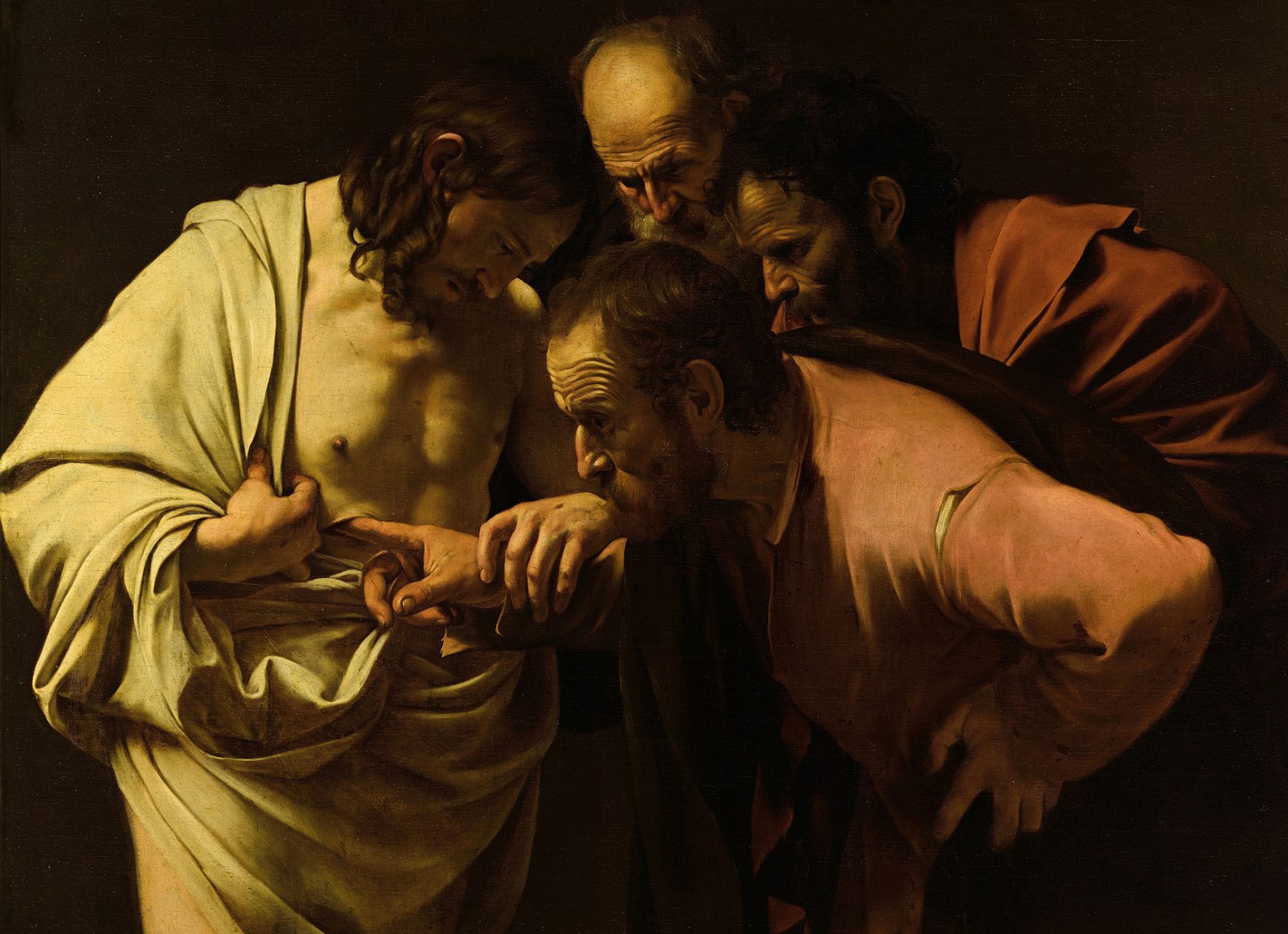
And of course, this is Thomas’s question. He doubts that any of what the other disciples are saying could possibly be true. What have they been smoking? Dead and buried, Jesus was. There’s no use in talking about it anymore.
When he appears in that upper room where Jesus followers were huddled in fear of the authorities, Thomas cannot comprehend the story they tell. He demands proof. “Unless I see the mark of the nails in his hands and put my finger in their mark and my hand in his side, I will not believe.”
A week later, Thomas receives his proof as Jesus again appears although the doors of the house are shut tight. Jesus’ parting words to Thomas – “Have you believed because you have seen me? Blessed are those who have not seen and yet have come to believe.”
Doubt is the proper order of the day. As Frederick Buechner said about religious doubt, “Doubt is the ants in the pants of faith; they keep it alive and moving.”
Unfortunately, the great growth of the church, beginning in the 50s after WWII was, by and large, the church of the “comfortable pew.” Sunday was the most segregated hour in America and what parishioners expected of the church was assurance. Velvety complacency was the order of the day.
Such a complacent and inoffensive Christianity was mocked by that song out of the 60s, “Plastic Jesus.” “I don’t care if it rains or freezes / Long as I got my plastic Jesus / Sittin’ on the dashboard of my car.”
Yet there lurked in the background of our mainline congregations a small group of radical folks whose souls had been infected by the gospels. A group yearning for more than pious platitudes and sappy hymns. They wanted a church that entered into the messiness of a wounded world. A church that would bear the burdens of Christ Crucified in the struggles for civil rights, racial reconciliation.
These folks would see Christ, would know him by his wounded body – the Church that bears the wounds of us all. This Sunday, in many churches is what is known as Thomas Sunday. Thomas wants to see Jesus before he will believe. And how will he know that the one he gazes upon is the real McCoy? By the wounds in his hands and feet. By the gash in his side where he was pierced by a Roman spear. He wants the real thing. By his wounds – that is exactly how he will know.
We will know the authentic representation of Christ – for the Church is the Body of Christ incarnate – when we see the wounds. Authentic Christianity enters into the struggle, the heartache of “the least of these.” It bears the wounds, the worry, of the homeless, the incarcerated, the addicted and the defeated.
Christ is the face of thousands.
The authentic, wounded Christ is yet among us still today. Christ is that despairing man in the pew beside you whose wife has just received a terminal diagnosis of cancer.
Do you now see, Thomas?
Christ is that immigrant who has been detained by ICE. Separated from his wife and one-year-old daughter. Picked up as he arrived at his required check-in under the DACA program.[1]
Do you now see, Thomas?
In the recent COVID-19 pandemic Christ was that nurse working 12-hour shifts, sometimes seven days a week to the point of exhaustion.
Do you now see, Thomas?
I recall a Facebook post I put up of a contemporary rendition of the Pietà. You remember the artist’s portrait of Mary receiving the tortured body of Christ from the Cross. The Wounded Christ of the Coronavirus Ward.
In this rendition the Christ of the Coronavirus Ward is portrayed as bearing the disfiguration of that disease. His virus-ravaged body is being lowered from a gurney by doctors, nurses and paramedics. Attached to his chest are still the leads of a heart monitor. He wears a face mask and little else to hide his nakedness.
Do you now see, Thomas?
This modern Pieta is not a pleasant picture. Not what you’d probably want hanging on your living room wall. Not the décor of a sanitized, inoffensive spirituality.
I remember also one woman writing back, not so much as in disgust or indignation – but what seemed an honest question, “Why did you post this?”
I explained that as followers of Jesus we need to enter into the hurt and pain of this world, just as Christ did. As Christ still does today.
For Christ takes on the wounded humanity yet today. In Lebanon where over 250 were killed in less than ten minutes by Israeli indiscriminate bombing of downtown Beirut. This Wounded Christ cries out from the ruins of destroyed homes, from the grief-stricken mother pawing through the remains for her dead children and husband.
Do you now see, Thomas?
Unless I see those wounds in the Church, the Body of Christ, I refuse to believe. Without those verifying wounds, it’s all Plastic Jesus.
When I hear Grandma’s question, “Was you there?” I strive to answer, yes, I was there. Yes, I am still there.
Thomas, here is your answer. In the nursing homes and in ICU wards. In ICE concentration camps. In the suffocating silence of a home ravaged by addiction. In the rubble of Gaza, Lebanon, and Iran.
Do you now see, Thomas?
Christ is in the face of that desperate family that has lost their medical insurance for a child with muscular dystrophy who needs around-the-clock care. Lost their insurance to pay for this senseless war of choice in Iran and Lebanon – a war of untold suffering now engulfing the entire Middle East.
Christ is that man languishing in an overcrowded jail simply because he could not afford competent legal advice or bail.
And Christ is the face of that Legal Aid worker toiling hours for little recompense to free him.
Christ is the face of those who blow their anti-ICE whistles, warning all that government thugs are about. At the risk of brutality, arrest or even death.
Christ is the face of that person who writes postcard after postcard urging infrequent voters to get to the polls. The face of millions in the No Kings Day demonstrations across our nation, from shore to shore. And up in Alaska, Hawaii and Puerto Rico. All advocating for a government that respects the dignity and rights of all its citizens.
This Sunday I ask the skeptic in all of us – that Doubting Thomas – might you, in a blind leap of faith, join those folks on the food distribution line, help in a homeless shelter or even greet an unhoused person on the sidewalk with a smile, and maybe a few greenbacks?
Might you now be the face of Christ, putting aside your niggling hesitations and lend a hand to receive his broken body?
Might you be the hands and feet, dare I say the wallet and sweat in our Garden of Hope and Food Bank?
In such generosity of Spirit there is the blessing to be found. Found beyond measure. A smidgen of life eternal.
Oh, Thomas, was I there? Yesterday, today and tomorrow, all of us — we of St. Francis’ and St John’s will be present – bearing the imprint of the wounds of Christ. Touch. Feel.
Do you now see, Thomas?
Amen.


April 12, 2026
2 Easter
“Was You There, Charlie?”
The Rev. Dr. John C. Forney
Acts 2:14a, 22-32; Psalm 16;
1 Peter 1:3-9; John 20:19-31
[1] Deferred Action for Childhood Arrivals. The program that protected undocumented persons brought to America when they were children and who have known no other country than the United States.


