


A Love that Mends the World

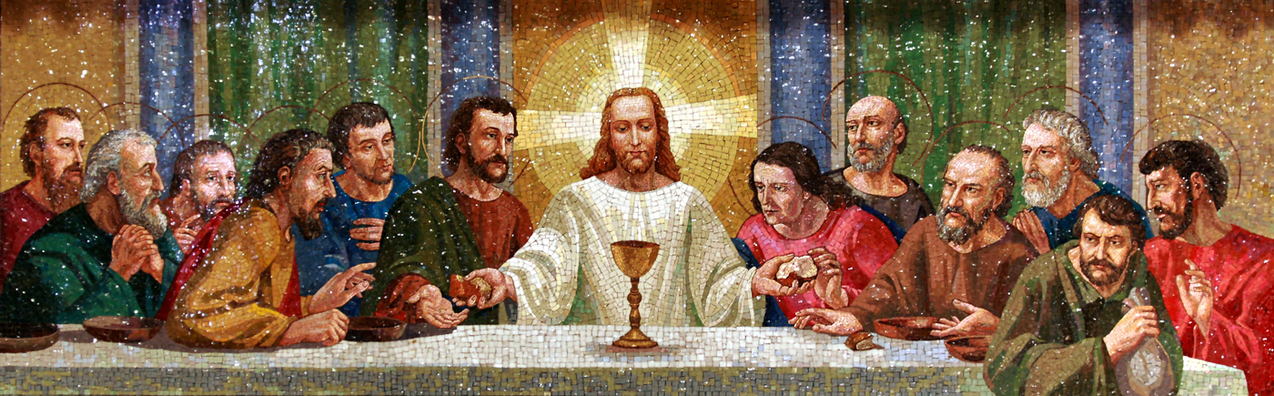
An air of gloom and anxiety pervades the room as Jesus’ friends began to situate themselves around the table. It was the Passover, the feast of liberation from slavery and oppression. Yet something more was at stake. They couldn’t quite grasp the backstory, couldn’t put their finger on the cause for dread.
It was not until Jesus said the liberating word when he explained the meaning. He was their true freedom as he offered up his physical self for the necessary healing. “This is my body. This is the cup of my blood poured out for the redemption of the world. As long as you break the bread and share this cup, remember. Remember me.” Remember what we are all about – tikkun olam, the mending of the world.
That sacrifice, that humility, opens the door to true liberation. In John’s gospel, the story gathers additional significance as Jesus gathers a sponge and kneels at a basin to wash the feet of his disciples. Of course, Peter will have none of it. He considers himself unworthy. Yet, Jesus insists, “Unless I wash you, you will have no share with me.” Such humility, such love indeed opens the door to eternity. To true liberation from all that enslaves. Especially for pompous egos and notions of self-importance, for false humility. “I am your liberation,” says the Master. Jesus, in actions proclaims, “My example is your true freedom.”
And so it is, as difficult, as impossible as it so often seems at the moment.
After the searing events that led to the Black Lives Matter in St. Louis, Missouri, the former rector of All Saints, Pasadena shares this story.
The Rev. Mike Kinman recalls entering the pain of St. Louis and being confronted by the anguish of Black Lives Matter movement. He relates an experience of five years ago, yet still as vivid in his mind as if it had happened yesterday.
“I feel you. Do you feel me?” That was the raised voice of Pastor Traci Blackmon as she grasped the shoulders of VonDerrit Meyers, Sr., the father of a young black youth who had been shot six times in the back on the streets of St. Louis on October 8, 2014. Mike continues the story:
I can still hear the Rev. Traci Blackmon’s voice ringing in my ears.
I can still see her face against his, hands on his shoulders, eyes piercing into his eyes.
It was near midnight on October 8, 2014, and a few hours before, 18-year old VonDerrit Myers, Jr. had been shot eight times – six in the back – and killed by an off-duty St. Louis City Police Officer. A crowd gathers at the scene and when they begin to move, the clergy who are there split up. Some go with the crowd. Others – Traci and I – we go with Vonderrit Myers, Sr. to the city morgue to be with him as he identifies the body of his son.
We stand outside for what seems like an eternity until the father emerges, the nightmare he had lived with since the day his son was born slowly becoming real. Head hanging to the ground, he almost whispers the words we already know:
“It’s him.”
And then… the pain begins to turn to rage. I could see it happen. He begins to fume … and tremble. What begins as a cry becomes a wail. What starts as a murmur grows into a shout as he says:
“It’s him. It’s my son. Somebody is going to pay for this. I’ve got a gun, and somebody is going to pay for him tonight!”
I am paralyzed. I cannot imagine his rage and know he has every right to it. I will not tell him to calm down. And… this is headed nowhere good. Not only do I not know what to do, I know whatever it is, I’m not the one who can do it.
And then Traci steps up to him. Traci steps up to him and grabs him by his shoulders, and puts her face right up to his face … her eyes to his eyes.
He is trembling. And she is trembling. And she holds him. And he looks at her and she says:
“I feel you. I feel you. I feel you. OK?”
He nods.
“Now I need you to feel me.”
His eyes are glued to hers.
“You have a job right now. You have to be a husband tonight. Your wife has lost her son, and she needs her husband. No one can do that but you. You have to go be with her. That’s where you have to be tonight. She needs you.”
“And tomorrow morning, I’m going to be at your house first thing. I’m going to be there and I’m going to stay there with you for as long as it takes.”
Tears fill the father’s eyes.
Tears fill Traci’s eyes.
And she says again.
“I feel you. Do you feel me?”
VonDerrit Myers, Sr. nods his head, and they embrace. And they cry. And then VonDerrit Myers, Sr. leaves the body of his son and goes to spend the longest night of his life at home with his wife.
And first thing the next morning, Traci is there. And she stays until they don’t need her to stay any more.[1]
To enter the anguish of St. Louis that night, to enter Gaza, to enter any Jerusalem on this planet is to enter into any of our distressed urban areas, and pray to God, pray, like Pastor Traci, to have the mind of Christ in you.
Such humility is the true nourishment of the meal we share this day. The liberating nourishment we share on any given Sunday. Liberation in the midst of the most excruciating pain and loss. He in us and we in him. Présenté.
In city after city, in village and in township, Christ is crucified anew. Crucified as an eighteen-year-old black kid gunned down on the streets of St. Louis, Missouri. Crucified in the deadened hopes of the homeless man who used to sleep on the back porch of our office in Claremont – or the lost hopes of those who used to sleep down the block from our church at the Del Rosa and Date Street encampment. Crucified in our hospital emergency rooms as doctors and nurses struggle to save the life of yet another overdose victim.
Yet, in the midst of such crucifying pain, in this simple meal of bread and wine, in the remembrance of a foot-washing, we have the audacity to assert that the world is mended back together. And in the participation, we also find our healing and true liberation. We are mended, knitted together in an eternal love. Amen.
[1]Mike Kinman, “The Power of Extravagant Love”, Sermon preached at All Saints, Pasadena, April 7, 2019.
April 17, 2025
Maundy Thursday
Exodus 12:1-4, 11-14; Psalm 116:1, 10-17
1 Corinthians 11:23-26; John 13:1-17, 31b-35
“A Love that Mends the World”
Dead Man Walking


Anyone should know that the verdict was fixed before the trial even began. Sham trial that it was. And while the charge was sedition, claiming a kingship over Cesar, the real problem was compassion. The minute Jesus was hauled before Pilate, he was a “dead man walking.” The fix was in.
How did we get here?
It might have been that fickle mob that gathered along the dusty road into Jerusalem. All the hoopla and waving of tree branches. A notorious rabbi and healer entering the city on a donkey with his followers in tow. Children running ahead, darting in and out of the procession. The crowd, hoping he would overthrow the Roman tyranny kept shouting, “Hosanna, Hosanna.” Treating him as if king.
It was all too much for the Roman authorities and their puppets, Herod and Pilate. It smacked of insurrection for sure. Not to be tolerated.
That fickle crowd was easily manipulated, as are folks today. They didn’t want any trouble. Go along to get along. And how quickly they turned.
Don’t ever trust the mob. With threats, bribes and propaganda they will sell your soul down the river in a New York minute.
It happened in Germany in 1933. It happened in Russia in 1918. It happened in Rwanda, in Srebrenica. It happened in America along the Trail of Tears. It happened throughout the 20th century in Jim Crow America. It’s happening now in Gaza and in Sudan. History is replete with massacre and genocide. Don’t trust the mob. For temporary security, they’ll toss away all their rights.
We in America now stand on the verge of a police state. And a good number of us would willingly have it so. People are snatched off the street by unidentified thugs in ski masks, soon to be deported to hell-hole prisons in far away countries. No due process. Not even the sham show-trial Jesus got. This is a Stalinesque nightmare beyond belief.
Masha Gessen[1] writes in their New York Times op-ed piece (an aside — being nonbinary, Masha uses the pronouns “they/them”):
“It is the catastrophic interruption of daily life, as when a Tufts University graduate student, Rümeysa Öztürk, was grabbed on a suburban street by half a dozen plainclothes agents, most of the them masked. The security camera video of that arrest shows Öztürk walking, looking at her phone, perhaps to check the address where she was supposed to meet her friends for dinner that night, when an agent appears in front of her. She says something – asks something – struggling to control her voice, and within seconds she is handcuffed and placed in an unmarked car.”
Folks are being “imprisoned indefinitely, without due process…It’s the growing irrelevance of the law and the helplessness of judges and lawyers.”[2] Though courts have issued rulings prohibiting the transfer of those arrested without warrant, without any process – even though a federal judge forbade the government to deport, without notice, Rasha Alawieh, a Brown University medical school professor – even though another judge prohibited moving Rümeysa Öztürk from Massachusetts without notice. The executive branch has ignored all these rulings. We now are in an extra-Constitutional order. There is no rule of law
The same as was justice in Stalinist Russia, the same as in that kangaroo trial in Jerusalem 2000 years ago. “The secret lists and student arrests are dreadfully familiar.”[3] Jesus betrayed in the dead of night with a kiss and hauled off to torture.
The psychiatrist-activist, Robert Jay Lifton, documents the pervasive PTSD caused by such calamities.[4] For days, maybe years, the victims of such catastrophes are stunned into inaction, into silence. As were the survivors of Hiroshima, Nagasaki and Hitler’s death camps and Jim Crow lynchings.
Stunned, as were those followers who witnessed Jesus’ torture and brutal crucifixion. Finally cowering in an Upper Room. As many of us might be, watching the impending death knell of our democracy here in America; witnessing the mass firings and destruction of our government. We all may be suffering some degree of PTSD – post traumatic stress disorder.
At the moment, we can only huddle in silence, as did those brave women who stayed behind near the cross. As did that brave doctor who had the courage to listen to the victims of such tragedies – the survivors of the atom bombs, the hibakusha (the explosion-affected persons). He had the courage to enter their pain and suffering, as did those women who stayed by Jesus.
We, at the moment, gather in silence, before the genocide committed in our name, and with our tax dollars in Gaza – grateful to a courageous Jew, Peter Beinart, having courage of steel to honestly reflect on that tragedy as a Jew.[5]
In solidarity with those who grieve, we, too, will gather. We will hold on to one another. And we will trust in God’s Grace to bring new life out of the “imprint of death.”[6]
Do not trust the wisdom of the crowd. The abiding Grace of God is that we have one another. And the Spirit of encouragement. Listen to her.
To quote Paul Tillich – at these moments of crucifixion, gulag and genocide, as we await, stunned to silence — all the while, God abides, obscured in the wings of mysterious darkness with an abounding Grace of New Life and Acceptance. Hear Tillich’s wisdom:
“You are accepted. You are accepted, accepted by that which is greater than you, and the name of which you do not know. Do not ask for the name now; perhaps you will find it later. Do not try to do anything now; perhaps later you will do much. Do not seek for anything; do not perform anything; do not intend anything. Simply accept the fact that you are accepted!”[7]
Let us patiently abide our time. Take the moments needed for the Holy Spirit to gather us together, to gather our courage into action.
That’s the glorious mystery that awaits after the three fraught days.
In time all shall be redeemed, yes, even if it does take three days to work the transformation from death to Life.
So, in our waiting, might we sing:
“Keep, O keep us, Savior dear, ever constant by thy side; that with thee we may appear at the eternal Eastertide.”[8] Amen.
[1] M. Gessen, “America’s Police State Has Arrived,” New York Times, “Columns & Commentary,” April 6, 2025.
[2] Ibid.
[3] Ibid.
[4] Robert Jay Lifton, Surviving our Catastrophes: Resilience and Renewal from Hiroshima to the Covid-19 Pandemic (New York: The New Press, 2023).
[5] Peter Beinart, Being Jewish After the Destruction of Gaza: A Reckoning (New York: Alfred P. Knopf, 2025).
[6] Lifton, op. cit., 27.
[7] Paul Tillich, The Shaking of the Foundations (New York: Charles Scribner’s Sons, 1948).
[8] George Hunt Smyttan (1822-1870). The Hymnal (New York, Church Publishing Co. 1985), #150, 5th verse.
April 13, 2025
Palm Sunday
Luke 19:28-40 (processional reading);
Isaiah 50:4-9a; Psalm 31:9-16;
Philippians 2:5-11; Luke 22:14-23:56
“Dead Man Walking”
A Divine Extravagance


A while back there was a news story about how to cook turkeys for Thanksgiving. This woman had a Butterball Turkey in her freezer and called the Butterball Talk-Line to find out how long to defrost it.
The fellow on the line asked her how long it had been in her freezer and she told him that the date on it was 1987 – it had been in the freezer some 16 years. There was a long pause on the other end of the line.
“Ahhh, just a minute. I think I need to consult my supervisor,” the fellow said. When he came back on the line, he told her that a turkey frozen this long – well, the company didn’t recommend serving it to anyone.
“Oh, that’s okay,” she said. “It’s just for the church.” Good enough for God! No extravagance here. Devoid of all compassion – just unloading an unwanted turkey (in both senses of the word).
Our lesson this morning is about the extravagance of divine compassion.
It takes place at a dinner, always symbolic of God’s bounty and also a Last Supper with the disciples. Among the guests is Lazarus, Mary’s brother whom Jesus raised from the dead, giving us the foreboding of more death to come.
Remember, that in the gospel of John no detail is by happenstance. All is freighted with meaning. The evening overflows with expectation and mystery.
Then, on the most extravagant impulse, pure compassion, Mary anoints Jesus’ feet with the costliest perfume, it’s scent soon filling the entire house. She ends this generosity by wiping his feet with her hair. There is a sumptuousness about the act as the scent continues to pervade the corners, nooks and crannies of the abode.
Of the acts to follow in the coming days, climaxing at Golgotha and following through three days later – it’s the culmination and sign of God’s extravagant compassion to all.
We now live in a nation run by a White House where compassion, empathy, are dirty words. America is suffering through a lack of empathy, devoid of compassion, from the Orange Felon on down. Empathy is a dirty word for Christian nationalists.
David French, in an opinion piece, reveals the new animus of Christian Nationalists to empathy.[1]
Once, the focus of Christian evangelicals was on the defense of liberty and the prerogatives of the faith community. Now it’s all about power, imposing their will, their specific ideology and theology on the rest of us.
A part of this is defunding faith organizations of which they disapprove, even if they are of the evangelical community. Catholic charities have received substantial cuts, especially to programs showing empathy and compassion to immigrants. Cuts that have been characterized as “catastrophic, ruthless and chaotic.”[2]
Often these unilateral decisions are taken unlawfully against Christian organizations serving the poor and marginalized.
In defunding, actually in destroying USAID, lifesaving aid worldwide has been cut off to the most vulnerable – the starving, the unsheltered, those with HIV/AIDS and other infectious diseases. Not a scintilla of empathy for these.
Sarah McCammon, in her “Weekend Edition” on religion reports on how “empathy” has become a bad word for one group of Christians.[3] The Ayn Rand crowd I suspect, with a few John Birchers thrown in.
A soundbite from the “Joe Rogan Experience,” podcast features Elon Musk on the danger of empathy, “The fundamental weakness of Western civilization is empathy.” Nice, for a multi-billionaire who has absolutely no idea on how ninety-nine percent of the rest of the world lives. Nice.
Musk continues, “There’s so much empathy that you actually suicide yourself” – to which Rogan responds, “Yeah.”
Musk: “So that – we’ve got civilizational suicidal empathy going on.”
In a soundbite of the podcast, “Stronger Men Nation,” the Evangelical pastor, John McPherson, asserts, “Empathy almost needs to be struck from the Christian vocabulary.” Whereupon two other pastors on the program join in, “It does.” “Yes.”
Pastor McPherson’s conclusion? “Empathy is dangerous. Empathy is toxic. Empathy will align you with hell.”
In his podcast, “Thinking in Public,” Joe Rigney asserts that empathy is harmful, and because it seems so nice, it is one of the most “destructive tactics” of the devil.
Yet, that is stuff of what God is ever about – compassion, empathy. Such is a life leading to the door of eternity. The scripture is full of such stories – the woman with the hemorrhage, the leprous man along a dusty highway, the woman caught in adultery. Jesus stoops and listens.
Listens even to his blockheaded disciples who often get it wrong. Understanding nothing. Yeah, stoops also to bless and heal us blockheaded disciples who so often screw up the message.
David Warbrick writes a most tender article in Christian Century about one of the best gifts he ever gave his father. A gift of pure compassion.
His father with Parkinson’s disease, now living apart from his wife due to being confined to a nursing home, had very few material needs. That Christmas, David gave his father a small bottle of fragrant bath essence.
The nursing home staff would occasionally “take him to the bathroom, lift his painfully thin frame into the warm water, and leave him and Mum in private so that she can help him bathe.”
Normally, given his illness, his father is mostly surrounded by noisy machines and many interruptions by medical staff.
As his father and mother were forced by Parkinson’s to live separately, bath time is one of the few, precious times they have alone.
David continues, “The bath time is the most intimate time and touch possible for them. After 50 years of marriage my dad’s hands—which once painted stunning pictures and caressed his wife—are so translucent that you can see all their workings. He draws in the air with them sometimes now. He has a tremor. Bath time allows him gentle, distant echoes of the power of his youthful touch. It’s my parents’ least mediated, least frustrating communication. It’s a place where Mum can be wife instead of caregiver.”[4]
It is their precious time together at bath, husband and wife, that is the extravagance of God’s grace.
While the world peddles a transactional economy based on greed, Mary’s economy is pure, unlimited extravagance as she breaks open the jar and lavishes precious ointment over Jesus’ feet.
That’s a sign of Jesus’ extravagant compassion for creation, bending near to touch hearts and minds of all he encounters. Something, Judas cannot comprehend. Something the Orange Felon, Musk and their minions seem not to comprehend.
Yet, as Pascal said, “The heart has reasons of its own which reason comprehendeth not.”
If empathy and compassion are sins, then with Luther I say, “Sin boldly.”
Someone said that Judas, in a way, was 100 percent right, but, without empathy, he ended up 100 percent alone. Not that Judas ever cared a wit about the poor.
In the end, I suspect, this self-serving administration will also, eventually, end up alone. Deserted by most all Americans, including many of those in the MAGA crowd.
So, back to Grace — Don’t be a turkey: Break out the ointment of generosity, break out your most precious gifts only you have to offer the world. Break out an attitude of pure, unmerited extravagance. Live dangerously in God’s Grace.
I close with Mother Teresa on Grace – Grace as embodied in the extravagance of Mary, Grace as in the extravagance of God:
People are often unreasonable, irrational, and self-centered. Forgive them anyway.
If you are kind, people may accuse you of selfish, ulterior motives. Be kind anyway.
If you are successful, you will win some unfaithful friends and some genuine enemies. Succeed anyway.
If you are honest and sincere, people may deceive you. Be honest and sincere anyway.
What you spend years creating, others could destroy overnight. Create anyway.
If you find serenity and happiness, some may be jealous. Be happy anyway.
The good you do today will often be forgotten. Do good anyway.
Give the best you have, and it will never be enough. Give your best anyway.
In the final analysis, it is between you and God. It was never between you and them anyway.
Amen.
[1] David French, “Behold the Strange Spectacle of Christians Against Empathy,” New York Times, February 13, 2025.
[2] Ibid.
[3] Sarah McCammon, NPR Weekend Edition, March 22, 2025.
[4] Ibid.
April 6, 2025
Lent 5
Isaiah 43:16-21; Psalm 126;
Philippians 3:4b-14; John 12:1-8
“A Divine Extravagance”
Welcome Home


Mothering Sunday is an English and Irish tradition that began in the 16th century. It was originally to honor and give thanks for the Virgin Mary — Mother Mary. It was a day for Christians to return to their “mother church,” a day of family celebration and giving thanks for our mothers.
Welcome Home is the spirit. Yes, “there’s no place like home.”
I remember a driving trip Jai and I took through Mexico. We drove down the east coast all the way to the Yucatan Peninsula, arriving in Chetumal shortly after a hurricane had torn most of the city apart. I wanted to drive to British Honduras, now known as Belize, but we didn’t have a multiple-entry permit for the car.
The guy at the border crossing said we could mail in our single-entry permit and wait for new papers. Remembering how it took a postcard four weeks to get to my mom, I decided to forego the offer.
When we finally got back to Mexico City a couple of weeks later, we were exhausted. We spied a Denny’s as we navigated our way along this huge nerve-wracking thoroughfare with seven or eight lanes in each direction. No one paying any attention to the lane markings. We were so homesick for some American food that we pulled right into that Denny’s parking lot. It was a big disappointment. Our hamburgers didn’t at all taste like what we got in Los Angeles. Definitely no place like home.
Jesus tells a parable to answer the objection of the religious authorities concerning his hobnobbing with notorious sinners. People who should be cast out of their common religious home.
You know it. About a father with two sons, one who thought life would be better on his own. So, he took his share of the inheritance and set off for a far country.
Things didn’t work out as he had hoped. Especially after he had wasted all his money on high living and loose women. He’s soon wished to be dining with the pigs, sharing their seed pods.
And you know the end of the story. As the father spies his returning, bedraggled son far down the road, he opens his arms, running to meet him. “My son was once lost but now is found!” Joy and merriment broke out that night. And of course, we remember how the elder, dutiful brother felt about this homecoming reception. But that’s another sermon.
Home, for most all of us, has special memories and significance. It’s a place of last refuge. As Robert Frost said, “Home is the place where, when you go there, they have to take you in.”
Unfortunately, many have found themselves far from home. Not of their own choice. Not due to their own wandering, but because they had never been fully admitted in the first place. Our history is replete with those locked out and shut out.
Recently, I stumbled upon a documentary of a group of people whose full personhood had never found a home in the American Dream – stewardesses. The documentary, Fly With Me, records the history of the first women cabin attendants in aviation.
This is the story of girls coming into full womanhood by dint of their own efforts. Every step a struggle against male, piggy exploitation.
It was a chronicle of the first ground-breaking women who opened the door for their sisters in aviation. It all began when Ellen Church convinced Boeing that having nurses aboard flights would put passengers at ease. As planes were not pressurized, they were limited to 10,000 feet. This resulted in a lot of turbulence, and most passengers were predisposed to be nervous about flying to begin with.
Soon, airlines began to realize that “sex sells.” Stewardesses’ uniforms became skimpier and skimpier, demeaning the women as sexpots and Barbie Dolls. Finally, degrading to “hot pants.” Really!
Glamor was the ticket. And a pleasing, compliant personality. The women must be petite – 100 to 118 pounds, max. They would be weighed at the bottom of the aircraft stairs every time they disembarked the plane. One pound over and you’re gone. You couldn’t have a waistline over 38 inches. This was just the start of the harsh employment guidelines.
You had to be 22 to 26 years-old to be considered. Couldn’t be married and must leave or be fired when you reached the age of 32, later 34. And you must be white. There were four physical exams required every year. Pregnancy was instant cause for dismissal.
Did the men have to abide by such standards? Heck, no.
Fly With Me is the film that records the struggles of a growing cadre of women in a most demanding profession to achieve, and be paid, for their invaluable contribution to the airline industry. You can see it on YouTube.
Soon, most major airlines were running training schools, lasting in the range of seven or eight weeks, sarcastically known as “Charm Farms” by the women.
Ann Hood, a stewardess – and later a writer, but more about that later – writes a wonderful memoir, Fly Girl: A Memoir[1], revealing all.
Ann notes that on her opening day at the TWA school, Breech Academy in Kansas City, they were tested mathematically, physically, mentally, given drug tests, and divided up into teams to test cooperative and personality skills.
On that first day, their instructor told the seated group, “It’s easier to get into Harvard than to sit in your seat.” Out of 14,000 applicants only 550 would be hired. Yes, they were special.
Not special enough to merit a decent salary and humane working conditions, however. As the country became socially aware in the activist 60s and 70s, these women, and soon a few men, discovered the power of unions. Through their collective organizing they finally did make a home for themselves in the American dream.
Many of the sexist standards fell by the wayside, replaced by decent pay, ability to work until retirement age, same as the pilots, and a pension. They could marry and have a family. Full womanhood in a profession most of them loved. They made a home for themselves.
Fly With Me is a heartwarming story, as is Ann’s book.
Oh yes, I mentioned “more about that later” referring to Ann Hood as a writer. Some sexist man on the board of one of these airlines expressed the sentiment of many of his colleagues when he opined, “These women have the looks but they have absolutely no brains.”
Au contraire. Many of these talented women went on to have second careers as authors, teachers, lawyers and highly-placed government workers. Many went into business or started their own businesses. No brains? Give me a break! Ann has written ten books. What? No brains?
No place like home. And that is our obligation as members of the Jesus Movement, to lay out the welcome mat of full inclusion for all. And shelter the shunned and those given no chance.
We are now told that ICE is going only after “the worst of the worst.” Not true.
In the Los Angeles Times there was an article on an Orange County couple who had been living peacefully in the U.S. for decades. They had three grown daughters, American citizens, living here.
ICE grabbed them up when they reported to their routine check- in as per their agreement to remain in the country. This happened on February 21, and within hours they were on a deportation flight to Columbia.
Yes, the couple had tried numerous times to gain citizenship, but ultimately the 9th Circuit Court denied them.
This couple was law-abiding, hard-working, raising a family and never missed a check-in appointment.
One of their daughters said that “This cruel and unjust situation has shattered our family emotionally and financially.”[2] Aren’t these exactly the sort of people we should be welcoming?
What happened to welcome the stranger, shelter the foreigner? All part of Torah Righteousness and Gospel Goodness.
By the way, how does one know when this administration is lying? Their lips are moving.
Like the Loving Father in Jesus’ story, through the prompting of the Spirit, we stretch our arms wide to welcome all home – the foreigner, the disparaged and locked out, the addicted and incarcerated, the shunned. Yes, even the sinner! And in the doing, there is more joy than in heaven. “Olly, olly oxen free, free, free.” All home.
Emma Lazarus on the Statue of Liberty nailed it — sentiments straight from this parable.
“Give me your tired, your poor, Your huddled masses yearning to breathe free, The wretched refuse of your teeming shore. Send these, the homeless, tempest-tossed to me, I lift my lamp beside the golden door!”
Can we all say a big AMEN?
[1] Ann Hood, Fly Girl: A Memoir (New York: Norton, 2022).
[2] Ruben Vives, “An O.C. Couple’s Sudden Deportation Sends Shock waves,” Los Angeles Times, March 26, 2025.
March 30, 2025
Lent 4 – Mothering Sunday
Joshua 5:9-12; Psalm 32;
2 Corinthians 5:16-21; Luke 15:1-3, 11b-32
“Welcome Home”
The Journey from Was to Is


One of my favorite passages of scripture opens with the words, “In the beginning…”
As a science major, and before that as a small boy, creation always fascinated me. Later as the astronomy coach for my physics teacher at Cerritos Community, on clear evenings I would roll out our telescope and train it on some cosmic delight, the object of that day’s lesson.
We could view Jupiter with its great red spot and the Galilean moons, the four largest moons being: Io, Europa, Ganymede, and Callisto. Later, many more would be discovered. We could easily see the rings around Saturn. Mars was a distant, fuzzy orange speck.
On trips out to the Mojave Desert, at night, the sky was spectacular with the Milky Way sparkling overhead with its millions of stars. We didn’t yet know that it was a monstrous black hole that kept it – and us – all in regular order slowly circling its gravitational pull.
Later, the James Webb Telescope would delight us with the fantastical images of far-off nebulae and pictures of millions of other galaxies in far off reaches of space. Because the light arriving from some had taken billions of years to reach us, what we were actually seeing was a glimpse into the early creation of everything. Almost all the way back in time to the Big Bang.
Just as an aside, go treat yourself to a planetarium show at the Griffith Observatory right here in Los Angeles. It is a spiritual experience.
The Creator is to be found in the splendors of the sky and the natural world. All around us — as close as that annoying mosquito keeping us awake at night, as bright as the sun and Sister Moon. It’s all dazzling to behold.
In Abram’s despair over a living inheritance, he complains to God concerning his childless existence.
The Lord God commands Abram to step outside. “Look toward heaven and count the stars, if you are able to count them…so will your descendants be.”
I can only imagine Abram staring open-mouthed, beholding the cosmic light show. Stars beyond measure.
And if he had lived in the northern reaches of Alaska and Canada, he would have beheld the Northern Lights dancing across the skies – pink, purple, magenta, dazzling white.
To seal the deal of a new beginning, God’s faithfulness is enshrined in a lasting Covenant. Abram, on his part, sacrifices a young goat, a turtledove and a young pigeon. That’s how the Art of the Deal was done back then.
After the sun had gone down and a deep sleep had fallen over Abram a “smoking fire pot and a flaming torch passed between the pieces.” God always works God’s wonders in “terrifying darkness.” The Covenant was sealed. Such a deal!
All this metaphorical language sounds very primitive and bazaar to us modern folks. Not unlike a children’s fairy tale or ghost story.
Yet, here is the truth wrapped up in this passage. However we moderns might understand this Covenant, the fact is that we are here. We live on a planet uniquely suited to our being present. The place is not only habitable (or at least it was not too long ago), but is a most delightful place.
I notice the splendor every morning as I go out to my car and see the flower stalk on the agave next to the driveway. It’s taller each day, now approaching ten feet. My neighbor Jim tells me the flowers on it should bloom sometime around April or May.
As it shoots towards the sky, I told my wife that actually that plant grew from some magic beans I bought with our life savings from a little boy out in the street.
Delightful, all of it. That is how I understand this promise from the salvation history of Deuteronomy. The hallmark of all this is the simple fact that I’m here. That we’re here.
Think of it – of all the impossible trillion possibilities of a certain egg meeting a certain sperm – well, the odds against it are astronomical. Replicated over billions of years – and here we are! Beyond quantum computation. Incomprehensible! Sheer grace. The same for the odds of you being here.
Sheer existence, messy as it is, is the primal seal of this Covenant, birds and goats aside.
In that Big Bang, was all the eventual ingredients for the “wonders of interstellar space, galaxies, suns, the planets in their courses, and this earth, our fragile home.” All released in a nanosecond of a nanosecond after the Big Bang. From aardvarks to zebras along the little creepy-crawlies we don’t like in our kitchens.
As hostile as the environment would seem at times – here we are. Alive, descendants of some Cro-Magnon Adam and Eve. Given an amazing ecosystem favorable to our continuing flourishing. Unless we totally mess it up.
This is what was, always moving towards what is and what will be. All the ingredients present.
But we haven’t been left without an instruction book and guidance. Wisdom and reason have been bequeathed us. Torah Righteousness instructed us as to our relationships with one another, as to our relationship to this our fragile “island home.”
Through the prophets, again and again, we have been given promptings on how to flourish and thrive. Jesus Christ being for us a living example, a spiritual mentor, opening the door to eternity. A vision bringing each one of us to the full Glory of God – women and men fully alive. Alive to ourselves, to one another and to the One who left us here. And, all this, too, out of the Big Bang.
We are not left adrift. The Spirit of Christ continues to move through conscience, thorough imagination, through inventiveness, through delight and creativity.
I have been fortunate to have a caregiver from the wonderfully named organization, “Motherly Comfort Care.” Most of us have been fortunate through part of our lives to have known a mother’s tender care. It is the first evidence most of us have as newborns of a hospitable universe.
Motherly comfort is a frequently used metaphor for God’s care and love.
Speaking of Jerusalem, the city that kills its prophets, the city doomed to disaster under Roman siege, Jesus laments. “Jerusalem, Jerusalem…How often have I desired to gather your children together as a hen gathers her brood under her wings…”
And yet, the universe till now has done just that, given us an out-of-the-way planet just the right distance from its sun – evolved through the eons with an atmosphere that supports life and with faithful rains providing life-giving water.
Barbara Brown Taylor, through a meditation on having an orphaned baby chick, brings flesh to this picture.
Barbara, I think, is sort of like our member Ellen who has a tender heart for all sorts of strays. The stray in this case was an orphaned guinea chick. Barbara had heard that one type of chicken tended to be good mothers, the white Silkie.
She shopped around, and through the Market Bulletin, found a person selling them over in Royston. After a bit bargaining, she had one rooster, two hens and four juveniles. As she was about to leave, she spotted a gray hen.
“What’s that one?” she asked. “A Blue Silkie,” the woman responded. “A cross between a black and a white.”
“How much for her?” For another six bucks she concluded her purchase and left for home with all her chickens.
“When the Silkies and I got home, I saved her, [the Blue Silkie], for the orphaned chick. First, I lay on the grass while she and the baby watched each other through the mesh of the cage. Then I placed her inside. Both she and the baby froze. The baby cheeped. The hen did not move a feather. The baby cheeped again. The hen stayed right where she was. The baby took a few steps toward her. I held my breath. The gray hen lifted her wings. The baby scooted right into that open door. When I checked on them an hour later, all I could see was a little guinea chick head poking out from under that gray hen’s wing. Six bucks. What a deal.”[1]
Like that Blue Silkie, you and I are meant to be the Motherly Comfort Care for one another and for this creation. And for this republic.
Here’s the altar call – a call to each of us as a citizen. How will you use your God-given “reason and skill” that we have been bequeathed in service of the covenant we share as Americans? Every day we move from what was to the “is” of our present obligation to one another and to the stranger seeking refuge here.
We are that Blue Silkie for the one another – providing tender shelter under her wing.
To begin…here is the necessary, opening question when arising from slumber, “How can I be part of the solution to the ills daily besetting our nation?” How can I fulfill my role in this covenant we have with one another? What one action can I take today? Will you take? Now, in your mind’s eye, lay it on God’s altar.
As an American and as a Citizen of our World? — how can I be God’s Motherly Comfort Care? For friend and stranger? For family and neighbor? I guarantee you this…the Spirit will answer. And you will be the better for it. Such a deal!
Every morning is the First Morning of what today is and what tomorrow will be.
“Sweet the rain’s new fall, sunlit from Heaven/Like the first dewfall on the first grass. Praise for the sweetness of the wet garden/sprung in completeness where his feet pass.”[2] Amen.
[1] Op. cit.
[2] Eleanor Farjeon, Songs of Praise, second edition, (published in 1931), to the tune “Bunessan“, composed in the Scottish Islands, 1938. Made popular by Cat Stevens and found in many hymnals.
March 16, 2025
Lent 2
Genesis 15:1-12, 17-18; Psalm 27;
Philippians 3:17-4:1; Luke 13:31-35
“The Journey from Was to Is”


