


Of Persimmon Pudding and Advent Joy


This time of year, unless we’ve got COVID-19 or have been served an eviction notice, our hearts turn to the delights of the season. It may be our favorite dishes, a fond Christmas memory, a special gift you gave someone. For me, one cherished holiday favorite is Jai’s persimmon pudding topped with lemon sauce. More about that later.
Memories flood in – the good, the bad and the ugly. We probably won’t have a tree this year for just the two of us, but one memorable tree stands out.
When I was in junior high, my mom got on this artsy-craftsy kick. We were informed that we would not be having our usual decorations and lights for the tree that year. From a holiday season designer magazine, she came upon some gaudy monstrosity to replace our cherished family decorations. Way too froufrou. I could see Christmas already going down the drain.
What had usurped the place of honor on our tree were these new creations she spent weeks making out of four-inch Styrofoam balls covered with gold netting and glitter. God-awful is what I called them. I was soon not on her favorite-person list. She spent weeks on end putting them together – must have been forty or fifty of these suckers. Boxes full. As we had just moved into a new house with a eighteen foot high ceiling in the entryway, we could have a really huge tree.
This brings me to the second disaster of the season. My dad was never one to pass up a bargain. He figured that if we waited until the very last moment to get a tree, we wouldn’t have to overpay for it. As time grew closer and closer to Christmas Eve, and my mom had finished her growing collection of these wretched glittery balls, my brother and I were increasingly fearful that all the trees were going to be sold out. Snarkily, I suggested that if we waited until Christmas Day, they’d probably PAY US to haul one away.
It was either Christmas Eve, or maybe the night before, when we drove from empty tree lot to empty tree lot. My brother and I were about in tears. This was shaping up to be the WORST CHRISTMAS EVER.
We finally found a lot with lights still on and one or two sales clerks. Not much of a selection left. And then my dad spied it. A tall, fifteen-foot, white, flocked tree. The price must have been right because Dad snapped it up in an instant. As we drove home, he went on and on about what a deal he’d gotten. “Let that be a lesson, boys.” Yeah, Grinch. A really memorable lesson on how to ruin Christmas for everybody.
It did have, though, more than enough space for Mom’s creations, and multiple strings of white lights. I still missed our old-fashioned colored ones. Especially the ones that bubbled up like little candles. This ersatz tree would have looked most handsome in some bank lobby or maybe a Sears department store. But I didn’t say that, as we set about distributing presents around it.
Ready or not, the time draws neigh. Our collect for this morning expresses the urgency. “STIR UP YOUR POWER, O Lord, and with great might come among us…” With Isaiah we proclaim, “…the Lord has anointed me; he has sent me to bring good news to the oppressed, to bind up the brokenhearted, to proclaim liberty to the captives, and release to the prisoners; to proclaim the year of the Lord’s favor.”
STIR UP YOUR POWER, INDEED! In England, this is called “Stir-Up Sunday” – the reminder for the women (I guess men don’t make the puddings) to stir up their Christmas puddings.
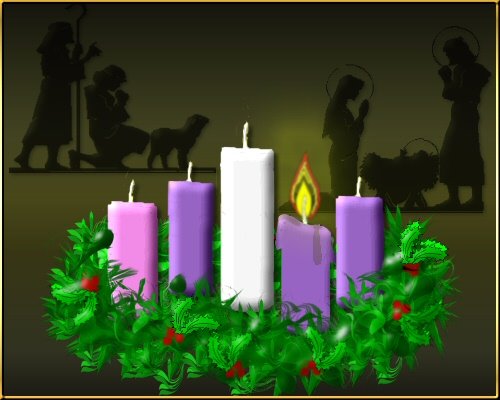
In our family, it’s about persimmon pudding and joy. We light the third candle. You notice, it’s pink. Actually, in your Zoom-isolated home you might not actually have a pink candle. But pretend. It’s pink. Got it?
It’s pink because the third Sunday in Advent is known as “Gaudete Sunday,” from the Latin first word of the ancient introit, “Gaudete in Domino semper: iterum dico, Gaudete — Rejoice in the Lord always: again, I say, rejoice.” – BE JOYFUL. Be of good cheer.
When I had asked my friend, Dick, how was it even possible, with our country in such a sad-sack state of affairs: a pandemic with Americans dying like flies, rampant conspiracy theories, homelessness, hunger, and the flat-out denial of electoral reality – how was it at all possible to have any good word to say this coming Sunday about JOY? I recalled my preaching professor Dr. K. Morgan Edwards admonishing us students, “In scripture it is said, ‘The word of the Lord was rare in those days,’…BUT you have to preach this Sunday anyway!”
I was beginning to wish it was Deacon Pat’s turn to preach again. Any word from me was going to sound like the really “FAKE NEWS.” Plastic Christmas brought to you by Fr. John.
And this is the advice from my friend. When things are looking pretty crappy — when there’s not much good news – look for the small moments of joy that break into your life. Look for small moments for gratitude. Great advice. I probably owe him a beer for that one.
As I said, Jai makes the most scrumptious persimmon pudding ever. To die for. Top that with her lemon sauce and it’s an express ticket straight to the Land of Bliss. As close that we’ll get in this lifetime to heaven. Well, maybe I exaggerate. But it’s really, really, really good. What wouldn’t be a cause for jumping-up-and-down joy?
Being cooped up has had some very good moments. There has been some excellent programming on television. It’s not all a wasteland.
If you can get it, watch “The Children of Windermere,” the story of some three hundred child interns rescued from Hitler’s death camps at the end of WWII. It follows these children from Czechoslovakia to a new home in Northeast England. There, under the guidance of enlightened professionals and others these children were restored to wholeness as best as was possible. By the time they were of high school age they went to live with individual families.. That they found fulfilling work, some entering the professions and academia…that they married and raised successful children – all of it was heartwarming testimony that sometimes humanity out does itself. We do the right thing and succeed wondrously well. That program was enough to bring gallons of joy to my heart. Advent joy. Watch it with your children. They need to know of such goodness that springs froth from the human heart. Find it on your PBS station. Or order it for Christmas from the PBS catalogue.
Another, most joyful event, was Kamilah Forbes’ adaptation of Ta-Nehisi Coates’ book, Between the World and Me, which builds on the 2018 Apollo Theater stage production. Showing on HBO, Direct TV and Amazon Prime. It is about “The Talk.” That’s the instruction that parents of color must give their children around their sixteenth birthday on how to survive an encounter with law enforcement. It’s that necessary talk that will allow them to survive such an encounter. It is not a talk that white parents need to give their children. Therein is the racial divide in this nation. It’s the talk that our son Christopher and Alexis, should they marry and have children, will need to give theirs – and give our grandchildren. It’s an existential concern. It is a moment of quiet joy that white families are presently being brought into this discussion.
What I found to be most joyful about such a depressing topic is that such a crucial national discussion could be held on TV. You know, that cultural “wasteland.” That some white parents might get a glimpse of what others with teenagers of color must endure.
As a white kid, I never received a talk like this from my parents. It wasn’t necessary. Being white and middle class, most any officer would have treated me with respect. And they did. Never once was I harassed, abused, or in fear for my life. The worst worry I had was how to explain the speeding ticket to my father. Sixty, in a thirty-five-mile-an-hour zone??? Never demeaned, even on that traffic stop –though, I did get quite a lecture from the officer. And the ticket.
What I find to be a cause for joy is that now, for the first time, white parents are learning right there in their living rooms, in their own gut, the racial disparities that so many others must endure. The film is beautifully done – doesn’t pull any punches – but it, in ANY decent heart, causes a surge of empathy to well up. Such understanding is the essential ingredient to any racial healing in our land. And that is a cause for the most profound Advent Joy. Right there on HBO, I think MSNBC also carried it. Order it from Amazon. It will leave you hopeful that, together, we can fix this. Racism need not have the last word.
To underscore the need, another black man was shot as he was entering his home in Columbus, Ohio. Carrying two Subway sandwiches, as his two toddlers and 72-year-old grandmother looked on in horror Casey Goodson, 23, was killed by a sheriff’s deputy, the shooting ruled a homicide by the coroner.
When hearts and consciences are aroused, even by such tragedy, I’m taken back to our first Advent candle – HOPE and, now, our third, JOY – all part of God’s PEACE, our second Advent candle. With a new administration committed to ending police violence, committed to dismantling Jim Crow — I choose to be hopeful.
Tears of grief, as flowing in a New Orleans funeral procession, God can turn to joy. Out of dirge, ragtime JOY can bust out…IF, AND ONLY IF, WE DO THE WORK. Only if we sing a new song. Only if we do the organizing, the voter registration and get the souls to the polls.
We can vote for a decent America – an America where #BlackLivesMatter – an America where all lives matter.
STIR UP YOUR POWER, O Lord and with great might come among us. We hunger for even the slightest smidgen of JOY.
Now that we’re on a Zoom schedule at St. Francis, the most profound joy these past weeks is just seeing your beautiful faces. We are Advent Joy to one another – a gift of the Lord.
Whether it’s small family gatherings, if only by Zoom gathering, or persimmon pudding with lemon sauce, whether it’s a documentary that stirs the soul and quickens the conscience, Advent Joy is creeping in “on little cat’s feet.” In ways big and small.
Let us light that pink candle on this Third Sunday of Advent. Light it, remembering Casey Goodson. And light it with hearts thirsting for God’s goodness. Light it with commitment to BE THE CHANGE you seek.
The Spirit of the Lord is abounding in the land with Good News to the oppressed, the poor, the hungry…not only those of whom we read of in the papers and see on TV, but also for folks right here, right now.
Light a candle for JOY. And stay away from tacky Christmas tree ornaments.
Amen.
December 13, 2020, Third Sunday of Advent
“Of Persimmon Pudding and Advent Joy”
The Rev. Dr. John C. Forney
Isaiah 61:1-4, 8-11; Canticle 3; 7; 1 Thessalonians 5:16-24;
John 1:6-8, 19-28
Wake Up

Many, many gone. Over seventeen thousand since election day alone. So many gone in this Dark Night of Despair. This Sunday we are summoned to wakefulness. We light the first Advent candle for HOPE. We are summoned to wakefulness. WAKE UP!
When I was in medic training in Fort Sam Houston, San Antonio, we learned all the various aspects of what would be required of us, whether we be out in the field or assigned to a hospital or dispensary stateside.
After lunch, in the hot, humid afternoon, we were marched to our training bungalow and shown old training films produced for the Army of WWII. No air conditioning. These were old scratchy, black and white films introduced with the sort of music that you may remember from the newsreels that were shown before the main feature. If you’re around my age, you remember that music.
One afternoon, the feature of the day was a film on “folding the forty-five-degree corner of the hospital bed sheet. The lights went off, the projector began grinding away. The narrator was droning on, “Notice how the corner of the sheet is folded back to make a forty-five-degree fold. Let’s look that again, this time in sloooow mooootion.”
The lights went on with no warning and Sarge was bellowing, “Wake that man up. Wake that man up!” He was assigned to KP duty for the next two decades and told to stand up against the wall.
The lights went off. Again, “Let’s see that one more time in sloooow mooootion.”
The actor in the film hadn’t even gotten the blankets pulled up before we heard a loud crash. Again, the lights flicked on. This poor slob against the wall had fallen asleep again – and had fallen to the floor. He was probably scrubbing pots and pans until Vietnam was over. Lord have mercy.
This Advent a stirring sound is heard. WAKE THAT MAN UP. WAKE THAT WOMAN UP.
If we don’t sing “O Come, O Come, Emmanuel,” it would be no First Sunday in Advent at all. Like a birthday with no cake and candles. The Fourth of July with no fireworks. “Rejoice! Rejoice! Emmanuel shall come to thee, O Israel!” Yes, indeed. Rejoice! Something’s happening.
In this dark age of COVID-19 the night is indeed long Yet’ God is ready to bust out doing a new thing. It’s Jessie Jackson’s chant raised to a cosmic level, “Keep Hope Alive.”
In Mark we get the wake-up call. No gentle, “Wakie, wakie, wakie. Here’s your coffee, dear. Time to rise and shine.” NO! It’s earthquakes, thunder, planets and stars falling out of the sky. All the powers of heaven shaken.
Mark doesn’t want anyone to sleep through the alarm. No snooze button here. And why all the ruckus?
“Christ has been strengthened among you—so that you are not lacking in any spiritual gift as you wait for the revealing of our Lord Jesus Christ. He will strengthen you to the end, so that you may be blameless on the day of the lord Jesus Christ.”
WAKE THAT WOMAN UP! WAKE THAT MAN UP!
This IS THE DAY OF THE LORD. ARISE, SHINE.
He is here in clouds of glory. His angels have been dispatched and are presently gathering among us. Folks WE are the angels appointed for this dissolute day. WE are the power and glory for this hour. WE are the ones elected. Called into tender fellowship with the Living God who now appears among us. Emmanuel. So…
WAKE UP. GET UP. GET ENGAGED. And don’t be attached to the results.” This was always the summons from my friend Ed Bacon every first Sunday in Advent. To whom else did you think the Lord was shouting?
And while the summons is dramatic and abrupt, so often the work seems mundane. In this time of pandemic, it seems a most modest request. Wear your mask. Keep social distance. Don’t have people over for the Thanksgiving and Christmas. Don’t sing. Don’t have indoor worship. Such common sense, but a great burden on the heart. Be awake to what will give life, to what will allow us to celebrate a most Merry Christmas together next year. After the vaccine.
We are summoned to lift up in prayer all essential workers whose health is at risk so we can minimally carry on. Grocery store clerks, nurses, therapists, tellers, police officers, pharmacy assistants. We lift up in prayer students struggling to master lessons from afar, across the internet. Teachers baffled by new technology. Something they never learned in their ed classes.
We lift up in prayer those who have lost everything: wives and husbands, homes and incomes. If you’re in the supermarket parking lot and hear the tinkle of that little bell. Do drop something in the Salvation Army kettle. They are Christ’s hands, heart and wallet. They serve those we probably don’t run across in communities like Claremont or Alamo Heights.
In this darkness drear, STAY AWAKE. You may be the only light about. Let it shine. COVID-19 will not have the last word. It may get some of us, but it will not subdue the full Body of Christ. Even in the midst of death, LOVE WILL PREVAIL. Do not despair. Hold on to each other and be of good courage.
In the early days of the Jesus Movement, in the midst of plague and death, followers of The Way, nursed the sick and dying. It was not so among the fearful, those not of the household of faith. Even their dearest — a child, a husband, a wife or beloved servant who took ill, would be cast out into the street. Left to die in the gutter. Not so with those of the Christians. Those who gave the last ministrations to the dying, were soon, in their turn, the recipients of the same care.
Even pagan philosophers were astounded and won over by such love.
Knowing much more about the spread of disease, we sophisticates, certainly, would do otherwise. You think? Walk down any city street and encounter the many wearing no mask. Look at last summer’s Sturgis Motorcycle Rally in South Dakota. Corona virus followed those cyclists home to communities all across the country, spreading the contagion.
Tell me how sophisticated we moderns are. Look at Trump’s Superspreader Rallies that left behind waves of illness and filled hospital ICU wards fourteen days afterwards. And morgue trailers. And now, mass graves. Speak to me of our modern enlightenment, and I say, “Lord have mercy.” Tell that to the exhausted medical staffs with nothing left to give.
STAY AWAKE.
Martin Luther King, Jr. reminds us, “It is always the right time to do the right thing.” Now is the RIGHT TIME. Today God gives us every good gift and a sound summons: Heal the sick. Feed the hungry. Shelter the homeless. Wear your mask. Write that letter to your congress critter. Demand relief for the destitute, the hungry. This illness IS a national emergency. We need to be on a war footing.
In earthquake, in sunset, in the exhausted face of a doctor, in the hopeful smile of a young girl, in the cup of coffee offered a homeless man, we discern the inbreaking of divine illumination, the urgency of the moment. The Call of Advent. However God gets our attention, it’s wakie, wakie time.
In this fragile body of Christ, yes, we the Church, in we who feebly struggle, Christ is here to shine. No matter how downcast we might be, Christ is come in our midst with great power and glory. WAKE UP.
Let us light that first candle for HOPE. WE are that HOPE. WE are the Light of the World. “Signed. Sealed. Delivered.” Reporting for duty.
Amen.
November 29, 2020, First Sunday of Advent
“Wake Up”
The Rev. Dr. John C. Forney
Isaiah 64:1-9a; Psalm 80:1-7; 1 Corinthians 1:1-9;
Mark 13:24-37
Christ in a Mask

When I would stay with my friend Artie for a sleepover – yeah, we probably didn’t sleep much – I can still see in my mind’s eye his picture of Jesus at the door knocking. The thing about this picture was it glowed in the dark. As Artie’s family was Roman Catholic, and he always asserted that his church was the “One True Church,” I thought it was fitting that his Jesus glowed in the dark. I didn’t even have a picture of Jesus on my wall.
In our Sunday School room was a picture of a blue-eyed, blond hair Jesus with Nordic features. Harmless as a small puppy. He certainly wouldn’t be whipping folks, yelling and screaming and turning their money tables over. In college I called it the Cocker Spaniel Jesus. Harmless as a sweet, adoring pet. AND of absolutely no consequence.
Throughout the years of Christendom, we have had many images of Jesus the Christ. Many versions of Christ Crucified, Christ Risen, Clean Cut Chamber of Commerce Capitalist Christ, Beatnik Poet Christ, Christ of the 1960s Jesus Freak. I found most intriguing that elusive figure of Flannery O’Connor in her stories of the Christ-haunted shadowed woods of the South darting from tree to tree.
In Matthew’s gospel, the Parable of the Last Judgement, we have a very different picture of the Christ, a portrait I find most compelling.
Those welcomed into the embrace of the Holy are the ones who have been in solidarity with those who suffer, those who hunger, those imprisoned, those abandoned. This Christ is one at heart with mercy, justice, forgiveness.
I remember visiting my son in New Haven, walking on Sunday morning to the Episcopal Church on the corner of the green. On the way to my church, I would pass two UCC churches, one next to the other. One always seemed so quiet that I wondered if it was even open for business. At the other I noticed a huge group of people in the back. They were serving up breakfast and engaging a bunch of folks in conversation, passing out lunches.
I asked my son about that church. He admitted that that is where he and his girlfriend had been attending. Yes, they had tried the Episcopal Church out of loyalty, but it had nothing for them, nor had it had much of anything for the community. It really was the House of the Frozen Chosen. If you weren’t already part of the tribe, there wasn’t much of a welcome mat. They were now at the church where Christ was visible, feeding the homeless, visiting the addicted, caring for the mentally challenged.
Though he didn’t say it exactly that way, what he was describing was the Compassionate Christ of Matthew 25. This is the Good Shepherd of Ezekiel, who gathers up the scattered and discouraged. The students of that congregation were in fact Christ to those who gathered each Sunday behind the Church. They were the only face of Christ some of those homeless would see.
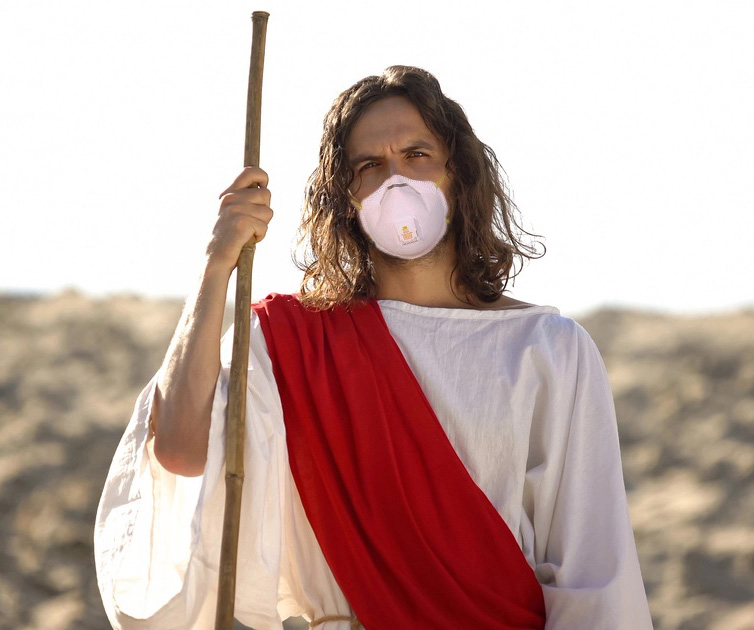
In our day of COVID-19, this is Christ in a Mask.
This Sunday we celebrate the Reign of Christ, the conclusion to the season of Pentecost. Featured up front this Sunday is the Risen Christ of Great Compassion let loose in the world. This Christ appears wherever those, driven by his power, embody the hallmarks in Matthew’s Parable of the Last Judgement – wherever that Shepherd of Ezekiel gathers up the fallen and lost.
Yes, we celebrate Christ in a Mask in these days of pandemic.
My friend Katy writes a response to a Facebook friend who had insisted on her freedom not to wear a mask. This “freedom” is American individualism run amok. In South Dakota the governor, confronted with overflowing hospital wards, exhausted staffs and filled morgues, has finally signed a mask order. BUT refused to include any enforcement mechanism.
You can’t tell us what to do. Born Free. Free to die like rats, coughing our lungs up having swallowed the strychnine. Yes, siree, you can’t tell me what to do.
It is out of her assertion of rugged individualism that Katy’s friend strenuously objects to her freedom being curtailed. It’s her life, and if she gets sick that’s her business. This friend has no thought of who she might spread it to. It’s all about her! Sound familiar?
A weeping Christ stands at the door of this friend’s heart, patiently knocking, asking that she might have a care for the rest of us.
Katy shared this touching Tlingit story from Southeast Alaska. It’s a story of a Christ her Facebook friend would not understand, but those native people of Southeast Alaska embodied to the fullest. Katy, admonishes her friend:
“I remember a heartfelt Tlingit story of a village that got sick from a disease brought by the Europeans. Many were sick and many were dying. One family was healthy and the tribal elder told them to get into their boats and leave before they got sick too. They did so, but it was hard.
“Others whose families were sick wanted to go too. The family that left in their canoes came upon another village, one that was happy to see them. But they didn’t go ashore. They communicated with their paddles that there was a sickness in their home village and they didn’t want to bring it to the ones on shore.
“So, the people on shore built big bonfires in their honor and they sang songs across the water to one another. There was much grieving. The next day the family in canoes left to find a new place to build a home and did not visit others until they knew the sickness was gone.
“They must have felt lonely, but they also wanted to keep the sickness from spreading.
Here is a fulsome portrait of Christ in a Mask.
When did we see you isolated and lonely, cut off from friends and family? You wore a mask, you visited us in a park and kept social distance. You would not risk spreading this contagion to us or our family. We sang songs to one another across the green. Christ in a Mask.
Being part of the Jesus Movement in this time of great national upheaval and contention is a true test of faith. As a political pugilist, I fear I often fail the test. I hear from afar the Lord of all Hopefulness saying, “Fifteen minutes in the penalty box, Forney.” For I was not the least bit hopeful, but a chastening rod.
After listening to our Presiding Bishop’s message to our diocese this week, I think I finally comprehended the enormity and the difficulty of the challenge. When asked how one remained true to one’s commitment to equity and inclusion, how did one answer an opponent who was a white supremacist? How did you relate to such a person as Christ might?
First, Bishop Michael said this was not an easy task. Most difficult, one at which he often fails.
Second, Bishop Curry remembered an admonishment from an elder early on in the first days of his ministry. You need to stand tall before that person with what you believed – stand tall but also humbly kneel at the same time before the image of God in that person. Most difficult. A superhuman request for many of us.
No matter the invective and racist innuendos, the slurs and the misogyny, without accepting that verdict and holding fast to the truth within yourself — realize that deep within this most wounded human being is the image of God. Though well hidden.
His wise council caused me to remember a day, late in the afternoon when I was working for then Candidate Obama in Akron, Ohio. I had been instructing high school students how to canvass a precinct.
The students had all left for home and I had just a couple of blocks remaining to finish that tract. As the sun had set behind the trees and shadows lengthened, I came to an old battered, yellow, wood-frame house with peeling paint. To step on the front porch was a broken leg waiting to happen, as it had mostly rotted out and was sinking into the front lawn. Above the door hung both a tattered Marine Corps flag along with a very faded and threadbare American flag. Not the hallmarks of what looked to be a progressive person, I thought. But who knows?
A sign next to the doorbell said, “Deliveries Around Back.” So, I trudged around the side of the house and up the driveway and knocked on a sliding glass door. I could hear the sounds of a televised sports event as an elderly woman in a faded housedress cracked it open just a bit.
What did I want? She could see my Obama T-shirt and cap. I told her I was from the campaign and would like to give her some information on Obama’s health plan. She hesitated, then turned to whomever was watching the game and yelled, “Honey, who we voting for?”
A voice came back, “The nigger.” For a moment I was speechless. That’s not how I was raised. Then it began to sink in. This was just how he was raised. Since he was willing to give Obama his vote, I guessed he didn’t mean anything offensive about it. As my pastoral counseling professor, Dr. Kemper used to say, “He’s just doing the best he can at this moment.” This fellow just didn’t realize, or want to acknowledge, how hurtful that word is, not just to black people, but to many of the rest of us
At this point, his wife was willing to take my literature and we talked a bit about where to vote and the hours of early voting.
When we encounter those who use vile, offensive language, who believe in the most bazaar conspiracy theories about Democrats drinking children’s blood in the basements of pizza parlors – while most disgusting and unbelievable — let us acknowledge that somewhere, most hidden in that soul, is the Image of Christ. How might we honor it while staying true to what we hold fast? The same for those crazy, lefty adherents of Antifa. Somewhere a wire gets crossed in too many of us. Lord have mercy.
Maybe the best we can do at the moment is to wish our interlocuter, “Have a nice day,” and admit to that person, that we presently have not enough in common for a civil conversation today. Maybe at some later time. But not now. And pray not only for them, but for patience and sufficient compassion to see beyond both our damaged exteriors. Pray for the insight to see this person, to see ourselves, as doing the best we can at the moment. And pray, trusting God to perfect the poor, pitiful results of that encounter, the bare surface the human eye presently sees
Christ is that Great and Good Shepherd who would gather all into the arms of Welcome, much as a mother hen gathers her chicks under her wings. Christ is that Power, living still today, leading the naive and hopeful to reach out to the homeless and hungry. Christ is the Perseverance to go through the mountain of paperwork to bring publicly supported housing into being, especially in fearful, exclusionary cities – to see beyond excuses for exclusion. “We have no homeless here.” Christ is the Foolishness to believe that we can actually make a difference. Christly love is not some vapid sentimentalism. It’s doing the right thing to keep our neighbors healthy, to save lives.
Christ in a Mask, moves us to put our neighbors first before our own prerogatives and rights. In our retirement community there’s a sign: “Behind every mask is a person who cares.”
Christ in a Mask inspires us, over the distance of time and political ideology, when this pestilence is over and done with, to sing songs back and forth to one another across the divide — to celebrate this Christ in a Mask who has shown us how to enter the eternal realm of LIFE ABUNDANT.
Amen.
November 22, 2020, Last Sunday in Pentecost
The Reign of Christ Proper 29
“Christ in a Mask”
The Rev. Dr. John C. Forney
Ezekiel 34:11-16, 20-24; Psalm 95:1-7a; Ephesians 1:15-23;
Matthew 25:31-46
A Terrible, Horrible, No Good, Very Bad Day

The election is over. Some may be gnashing their teeth. Some may be rejoicing. Whatever your political persuasion, it’s been a most frightful season. Is it possible that we can ever put America back together again?
I’m reminded of one of our boys’ favorite books. Alexander and the Terrible, Horrible, No Good, Very Bad Day.[1] Alexander knew it was going to be a terrible day when he woke up with his chewing gum in his hair. His best friend abandoned him. On top of that, his mom had forgotten to put dessert in with his lunch and, One disaster after another. Alexander knew partway through, it was going to be a “terrible, horrible, no good, very bad day.” And it didn’t get any better that evening. Yuck! There was kissing on TV. Alexander threatens to move to Australia, but nobody is listening. Australia is his favorite go-to place to escape to when the world is against him. I, myself, always consider France. They eat very well there.
As his day comes to an end, Judith Viorst concludes this sad saga:
“The cat wants to sleep with Anthony, not with me.
It has been a terrible, horrible, no good, very bad day.
My mom says some days are like that. Even in Australia.”
Much of Alexander’s terrible day is the scrapes and knocks a young boy goes through, especially the youngest of several siblings. Stuff happens, and when it does our immature reaction so often makes it worse.
Amos paints the picture of really bad stuff the self-satisfied, religious elite will endure. These are they who consider themselves most favored in the eyes of the Almighty, yet do not abide by the will of God when it comes to the poor and the socially marginal. The religious phonies will indeed endure some terrible, horrible, no good, very bad days, Amos predicts.
Through Amos’s thunderous excoriation, God breaks through smug self-delusion:
“Alas for you who desire the day of the Lord!
Why do you want the day of the Lord?
It is darkness, not light;
As if someone fled from a lion,
And was met by a bear;
Or went into the house and rested a hand against the wall,
And was bitten by a snake.”
And why all this grief for the favored and chosen? It is because the institutions of religion, divorced from the substance of mercy and honesty are nothing. It all rings hollow as pretense.
“I hate, I despise your festivals,
And take no delight in your solemn assemblies……
Take away from me the noise of your songs;
I will not listen to the melody of your harps.”
I come from the tribe of beautiful, stately worship. Incense and fine vestments. We have wonderful tracker organs and magnificent, chanting choirs. We worship in stately buildings. So why is God not pleased.
It is because too often, it’s only a Sunday morning show. And not just my tribe. When church becomes entertainment divorced from the needs of the “least of these,” it’s plastic, ersatz grace. Such self-congratulatory religious exercises are an offense to the One of the Holy Torah who commanded justice and equity in the land, the One who reminded the faithful settled in the land that at one time they were all foreigners, strangers. We are that caravan of dispossessed children at our southern border, though we don’t know it — though we dwell in fine houses and live fat on the land in splendid isolation from their desperation.
God, through Amos, promises the religiously smug a terrible, horrible, no good, very bad day. Many such days, for they are without vision or discernment Yeah, we’re all there sometimes.
And such will be the case for the nation that does not abide by the very same standards of loving kindness and righteousness. (Remember the Hebrew word – tsaddik – that which we translate “righteousness,” should best be translated as solidarity — as one who is in SOLIDARITY with one’s fellows. It refers to a complete human being, one whose life carries the weight of doing what is right and just in the eyes of both God and all humanity. It does NOT denote a pious goody-two-shoes demeanor. It carries the full intent of the command to love the “Lord your God with all your heart and soul and mind, and your neighbor as yourself.”
America, I believe, enfolds that commandment in our foundational documents. We know the watch-words: “Liberty and justice for all.” A “government of the people, by the people, for the people.” These intentions are the bedrock of who we are. Or who we wish to be. They are aspirational, not reality.
Unfortunately, we do not even come close to living up to that standards. For much of our history, our solemn national occasions have rung hollow. As Frederick Douglass, out of slavery in the 1800s, confronted the self-satisfied white establishment: “What is your Fourth of July to Me” is a speech Douglass was invited to give at a gathering of the well-to-do on the occasion of the anniversary of the signing of the Declaration of to the Independence in Rochester, New York, July 5th, 1852.
He gave this speech as one left out of the fine promises assumed for others. This is an address which echoes Amos’s denunciations of the elites of his day, the piously indifferent.
“What, to the American slave, is your 4th of July? I answer; a day that reveals to him, more than all other days in the year, the gross injustice and cruelty to which he is the constant victim. To him, your celebration is a sham; your boasted liberty, an unholy license; your national greatness, swelling vanity; your sound of rejoicing are empty and heartless; your denunciation of tyrants brass fronted impudence; your shout of liberty and equality, hollow mockery; your prayers and hymns, your sermons and thanks-givings, with all your religious parade and solemnity, are to him, mere bombast, fraud, deception, impiety, and hypocrisy — a thin veil to cover up crimes which would disgrace a nation of savages.”
Woe to that nation which does not live up to the simple standards of decency and fairness for ALL its citizens.
We have been through one of the most contentious elections since that of Jefferson and that of Lincoln. We are now at the politics of grievance and tribe. Personalities and program matter not a wit. The only determinant is, does the candidate have a “D” or a “R” following their name.
Too many throughout the land feel excluded from the high and lofty promises of our founders, whether they be a floor worker in a factory in the Midwest or a grocery checker in downtown East Los Angeles. They resent those who abuse their authority whether as police or as a city planning clerk.
They have had it with an economy that has loaded them up with massive student debt or cheated them in a house mortgage with fine print only a well- trained lawyer could understand.
Now, in the midst of a pandemic reminiscent of the plagues of Egypt, we, our loved ones and neighbors are dying like flies. The incompetence of our government in managing this disease staggers the mind.
Like those whom Amos addresses, like those to whom Frederick Douglas, James Madison, Jane Addams and Susan B. Anthony spoke, we have fallen far short. Lord, have mercy. Christ, have mercy. Lord, have mercy upon us.
What is the fine rhetoric or our anthem, its lofty vision — to the dejected family sitting at curbside with their worldly belongings piled up as trash? What is the vision to the mother and father with no food in the cupboard? What are the promises of this nation to that black family mourning the death of a son beaten by police at a traffic stop? What mean these promises to a mentally ill homeless person living on Wilshire Boulevard in Los Angeles?
We Americans on the conclusion of the election of 2020, find ourselves at each other’s throats. We vilify those we judge to be responsible. We seethe with anger and boil over with plots of conspiracy.
Someone has to be responsible for this pitiful state of affairs. Are we at the dead end of Sartre’s play, “No Exit”? Are we doomed to a Hobbesian war of “all against all?”
LISTEN UP! Amos does have a saving word, a restorative word. Those with ears to hear, let them hear:
“But let justice roll down like waters,
And righteousness (solidarity) like an ever-flowing stream.”
The cure is simple. This truth is not so far away, so high that we need send someone afar to bring it to us. It is right here, planted in the heart and mind of each of us.
We know what must be done. We need only take a deep breath, accept the reality of our condition and allow the Divine Wisdom to flow through us. We know how to treat neighbor as self. This truth is not hidden or so obscure that only the smartest can discern it. We know that when one suffers, all suffer — all are diminished. We know this. We learned it in Sunday School, in kindergarten. We learned it at a parent’s knee.
As the South African saying goes, “I cannot be who I am meant to be unless you are who you are meant to be.” That’s the principle of “Ubuntu.” Call it “solidarity.” We all rise together.
Let justice roll down like waters and solidarity like an ever-flowing stream.
What will get us there? Listening, to start.
As Joe and Kamala become our next president and vice-president, I would suggest the first order of business for them would be to pack suitcases, board the bus, and embark on a national “Listening Tour.” Get out into our cities and suburbs, into our prairies and the foothills of Stone Mountain. Talk with those who make the “amber waves of grain” happen. Speak to workers on shop floors and students in the classrooms of our nation. Simply listen. Not just to the words but to the sentiments. To the aspirations. And ask that toughest question: “What are you willing to do to make it better?” Of each of us — What am I willing to do? What are you willing to do? Today, we might have to do it all by Zoom instead of on the road.
If American does climb aboard, this train is bound for glory. The glory of a reborn people fully alive. Indeed, the glory of God!
At the end of it all, I want to be accounted among the tzaddikim — The Righteous. I want to be numbered as among those abiding in Divine Solidarity with all the others. Don’t you? What greater hope?
What are we willing to do to become grounded in the reality of global warming, to become grounded in our national plight of poverty and homelessness, mental illness, addiction?
Where might we make a difference for a child in a crap school deprived of the necessary resources and good teachers? Are we willing to share and demand fairness in our tax codes that we overcome present economic realities – where just thirty some families have as many marbles as one half the nation?
America, “I set before you the ways of life and death. Choose life that you and your descendants may live.” That you may enjoy the bounty of this land.
Are we, in the face of this pestilence, willing to do our part — to wear masks and social distance? Yes, it’s a pain. So was Valley Forge and the Edmund Pettis Bridge march. So were the beaches of Normandy and the killing fields of Vietnam. So is slogging through a chemistry textbook and learning all those Latin names in a zoology class. A total pain. Citizenship is hard, requires effort. Every single day.
Matthew reminds us that the reality of this holy vision is like unto an approaching bridegroom to the wedding feast. Our sole responsibility is to be ready to celebrate the feast. We are simply asked to rejoice in the happiness of the couple soon to be united as one.
We are summoned to embrace opportunity before us, lying fallow in fields of despair and anger. We but must ready hearts to greet it, like an approaching bridegroom. Like a bride anticipated at the altar as she approaches down the center aisle. Christ only enters the open door of the heart and mind. Love does not force.
Look at the promise, as the feast is ready and the band strikes up the beat.
“Give me the beat, boys, and free my soul. I want to get lost in your rock-n-roll and drift away, drift away.” Drift away into the delicious imagination of God’s glorious possibility. Set before us. Always approaching, never quite arriving.
Such a nation will flourish. Such a people so grounded are like a mighty tree planted by a living stream. Such a people will flourish and be a blessing to the nations. Such a nation will do its part.
Let our God’s honest truth and mercy flow through us. Today, tomorrow – we need it more than ever.
Yes, there are terrible, horrible, no good, very bad days. Even in Australia. Even in America. Sometimes an adder hidden on the wall.
But we are not left as orphans with no hope. Let God’s ever Loving-Kindness, God’s Justice, God’s Truth, God’s Liberty – a vision already implanted in our very being — flow through us. Amen.
[1] Judith Viorst, Alexander and the Terrible, Horrible, No Good, Very Bad Day (New York: Atheneum Books for Young Readers, 1987).
November 8, 2020, Pentecost 23
Proper 27
“A Terrible, Horrible, No Good, Very Bad Day”
The Rev. Dr. John C. Forney
Amos 5:18-24; Psalm 70; 1 Thessalonians 4:13-18;
Matthew 25:1-13
Sometimes We Do the Right Thing


Any number of quotes come to mind as we move towards All Saints Day, Halloween, and perhaps the most consequential election in a lifetime. All in the midst of the scourge of the greatest pandemic since the so-called Spanish Influenza of 1917-18.
While the White House declared that the virus has been defeated, that we have “turned the corner,” I’m remembering the favorite quips of my grandpa, “He’s gone round the bend.” “Mission Accomplished?” — when we’re spiking new infections at the rate of over 90,000 last Thursday? One sixth of these will end up needing hospitalization. I don’t think so. The cruel trick’s on us. And no treat.
One survivor of COVID-19 writes of her recent recovery. Heather Sellers, in The Sun, a literary magazine of essays, poetry, journaling and personal biography, narrates the onslaught of her infection:[1]
“March 28, 2020: This Afternoon, for the first time in what feels like a long time but has only been a week, I step outside my Florida home and into my garden, a small shady space ringed by a high wood fence. I’m hidden from the world. Barefoot in my damp nightgown, I walk slowly across the pavers. One step, one breath. I have one hand on my throat. I’m not sure why, but somehow this feels absolutely necessary.
“The virus is hidden inside of me. I feel its force and power. My body aches. Cold knots snarl in my calves and my thighs; my back feels frozen; shivers ripple up my arms. By the time I reach the birdbath, I’m sweating in the soft breeze.
“I close my eyes. The hardest part is taking the next breath. I must breathe very, very slowly, in a very specific way.
“Breathing has become like remaining steady on a balance beam over a dark pit.
“I’m stunned to find I cannot take another step. I don’t have the breath.
Thus, begins Heather’s nightmare odyssey through her infection. A month later she closes her journal, expressing gratitude in her trailing convalescence for the small gifts she does have – electricity, fresh water, cotton sheets, a car, a bottle of Tylenol, a washing machine.
‘I can’t see the virus, but feel its seeds in me. I can’t see my faith, but feel its seeds in me, too.
We Christians in the Episcopal tradition have tended to give the book of Revelation short shrift. It’s phantasmagorical imagery, looking like something out of a Halloween apocalypse, is too bizarre. It’s like a scene out of “Ghostbusters.” The symbols and metaphors are too distant from our time to be comprehended by us moderns.
But this is not a book of doom and destruction, though some churches use it as did Tim LaHaye to express their most twisted, distorted versions of the faith. Projecting the anxieties of their damaged souls onto the message of the life-affirming Jesus Movement, they do great harm.
Revelation, more than anything, is a message of hope. Hope for those who have endured great tribulation. The saints are those of the entire community of faith who have persisted in the face of enormous evil. These are they who stand in solidarity with one another, with all humanity, and with the natural world, to be the harbingers of a new, “Beloved Community.” The saints are those who have confessed the name of Jesus through deeds big and small. Acts of justice and mercy, knitting up the Church one halting stitch at a time.
“After this I looked, and there was a great multitude that no one could count, from every nation, from all tribes and peoples and languages, standing before the throne and before the Lamb, robed in white, with palm branches in their hands.”[2]
Today we celebrate the Saints of God, known and mostly known to God alone. These saints are the entire company of the faithful, and not-so-faithful, who look to Jesus as their Lord and Savior. The exemplar and head of the Jesus Movement. The chief Cornerstone of the “Blessed Community.”
We “little saints” – “we feebly struggle, they in glory shine; yet all are one in thee, for all are thine…” Revelation is a book of hope for those of us who strive to sometimes do the right thing. And trust the results to God.
In bearing witness, Heather Sellers is one in my compendium of that Blessed Company, one who inspires and fortifies the soul. She is a member of the Hallelujah Chorus boldly making her confession of faith.
One of my Facebook friends, looking with despair at the long lines of voters being suppressed by indifference and massive incompetence posted, “Jesus help us. Or someone help us. I don’t care.” To which I responded, “Jesus has already given us the power and the grace to help ourselves. We’re the ones we’ve been waiting for.”
Let me tell you about some of us others we’ve been waiting for.
In hours at bedsides and in sweeping floors, way beyond human endurance, in countless unselfish acts, unacknowledged saints confess the name of Jesus. Around the bedsides of the dying, they gather, as around the throne of God. Though their white lab coats and PPEs be stained with blood, they are spotless in the reckoning of all that is Holy.
Clasping the hand of the dying at the moment of death, nurses, orderlies and doctors fill in for missing family members not allowed to be present. The hand of that nurse, that doctor, that janitor – is indeed the Hand of God.
As even one patient is wheeled down the hallway to go home – surrounded by cheering staff lining both sides of their exit – that is the best Hallelujah Chorus ever. These “indispensable” workers have left nothing on the field.
Accompanying Heather are countless nurses, doctors, therapists and “essential workers” to tend the victims of this pandemic in overloaded hospitals across the land. These acts of solidarity, big and small are witness to the ethic of the Jesus Movement. These are the Saints of God we celebrate this day.
Mopping up filthy hospital floors and cleaning soiled linens, saints at work. Those who assist the navigation of mountains of paperwork – saints indeed. And those who prepare the dead for burial, they are counted among that holy assemblage.
This pandemic has brought out the worst, and also the best of who we are. This virus has dipped deep into ancient fears and concocted a toxic brew of the most bizarre conspiracy theories and magical thinking. It has brought out denial and complacency. We are not learning to “live with it, we are dying from it.”
But it has also brought out sacrifice and humility.
A favorite hymn[3] reminds us that the saints of God are just folks like you and me. You can see them at tea (read coffee, and over a beer). You can see them on trains or at sea. These days, you will find them on ICU wards and stocking shelves in grocery stores. They will be at computer screens teaching by Zoom. And they will be at home learning third grade history on the internet. They will be delivering the mail and answering calls at church offices.
Matthew’s “Beatitudes” is a window into the souls of these saints. We’re talking humility, patience, kindness, endurance, sacrifice. If ever there were cardinal virtues, we know those who show forth these in abundance. In ways big and small these gifts abound in the saints of God.
One man of such virtue is a politician. A politician! And a Muslim, to boot. Imagine that!
I tell you the story of Qasim Rashid, a Democrat (Alert! This is NOT intended as a partisan story) running for Congress in Stafford Virginia. He writes of a recent outdoor campaign event with about 30 supporters:[4]
“Today, Trump supporters crashed our event.
“With a large RASHID FOR CONGRESS sign behind me, it wasn’t long before Trump supporters began driving by, honking, and waving their flags.
“Soon a few Trump supporters showed up on foot, waving their flags. Perhaps it was an attempt to interrupt or intimidate, or, just to exercise their free speech. After all we respect the First Amendment. In any case, I had a decision to make. Do I ignore them or do I tell them to leave?
“I decided neither. Instead, I called them over.
“I had the mic and called out, “Hey y’all, you don’t have to stand over there waving that flag. You can come join us. Our events are open to all. We’re expanding our tent, not closing it down.”
“To their credit, they came and joined our group and listened in.
“What’s your name?” I asked one of the gentlemen. “Chad,” he responded.
“The Q/A continued with our supporters. Eventually, Chad asked about the Supreme Court and the claim that Democrats want to ‘Pack the Court.’
Qasim explained his view that, if they were to have an honest conversation about “packed” – that hundreds of appointees submitted by President Obama had been held up for no reason whatsoever; then, after the 2016 election, replacements were rushed through blindly by the new administration by a compliant Senate.
“You can’t accuse Democrats of a hypothetical event that never happened while ignoring the actual court packing done by Republicans.”
“Chad, the Trump supporter, was silent and finally responded, “Yeah, I agree that’s hypocritical.”
“I gave Chad credit for being honest and calling out the GOP hypocrisy and responded to Chad, ‘Thank you. Here’s the truth. I’m running as a Democrat because I believe the Democratic platform is more aligned with justice. But if you’re looking for me to say that Democrats can do no wrong, and Republicans can do no right, then you’ve found the wrong guy because I don’t believe that. I’m committed to upholding justice as the supreme standard. You have my word.’
“Chad responded, “I can agree with that.”
“The tone changed from one of hostility and distrust to one of recognizing that we as Americans truly want the same things—justice and fairness. Soon after Chad left the gathering on his own, but not before sharing with our host that he walked in viewing us as the enemy, and left realizing we actually have a lot in common in wanting to uplift our nation.
“But it’s what happened after all this that truly left me in awe.
“As the event ended, at least 5 of the (Trump) attendees walked up to me and shared that they’re life-long Republicans who have never voted Democrat before, and have always voted for my GOP opponent. But now, for the first time in their life they’re voting for a Democrat—Qasim Rashid—for US Congress.
“Why?
“They’re drawn to our campaign that refuses to respond to hate with hate. They’ve seen my opponent’s attacks on my faith and see us responding with compassion and justice.
That could have been any Republican, any Democrat, but regardless of who votes for whom, civility and respect won the day. E Pluibus Unum. Out of many kind and respectful conversations, the saints of God shine brightly, Red and Blue.
Neither Chad nor Qasim will forget that day, I suspect. Yes, there are a few saints, Republican and Democratic, to be found at political rallies. We differ on many issues, but the whole is stronger than the parts. Let’s work together on what unites us and save the rest for another day.
As we head to perhaps the most contentions election of any recent history, I offer up MLK’s watchword: “It is always the right time to do the right thing.” Let us remember that this whole election thing ought to be about making the American tent bigger.
And would that we Christians live out the virtues of our faith as well as a Muslim did on that day.
This Sunday, let us celebrate the Saints of God, both living and those having entered into Glory, all across the land. In ways big and small they confess the name of Jesus. Yes, there’s a Jesus Mosque in Amaan, Jordan. You can meet them most anywhere.
“And when the strife is fierce, the warfare long,
steals on the ear the distant triumph song,
and hearts are brave again, and arms are strong. Alleluia. Alleluia.”[5]
Now, get out there and VOTE. And do what you can to bring in the vote.
Amen
[1] Heather Sellers, “Just This Breath,” The Sun, June 2020, Issue # 534.
[2] Revelation 7:9-19. New Revised Standard Version, 1989, Division of Christian Education, National Council of Churches of Christ in the U.S.A.
[3] “I Sing a Song of the Saints of God,” The Hymnal 1982 (New York, The Church Hymnal Corp., 1985), p. 293
[4] I thank my friend Merrill Ring for passing this story along.
[5] “For all the Saints,” The Hymnal 1982, op.cit., p 287.
November 1, 2020, All Saints Day
“Sometimes We Do the Right Thing”
The Rev. Dr. John C. Forney
Revelation 7:9-17; Psalm 34:1-10, 22; I John 3:1-3;
Matthew 5:1-12


