


A Critical Mass of Courage


A few days ago, the streets of our communities were swarming with all sorts of goblins, witches and fairies. Halloween is arguably the most favorite holiday of children in America. Maybe even more beloved than Christmas.
It is an occasion to vanquish through the magic of pretend and make-believe the subterranean fears that haunt our days. Real fears. Not the monster under the bed. Though when I was a small child, I really, really knew that if I didn’t run fast enough to get to the bathroom and turn on the light, I would be a goner for sure.
I remember our boys’ first Halloween in the Bay Area, San Leandro. Christopher was going to be a ghost. But when we got the sheet over him and he looked out of the eye holes to see himself in the mirror, he decided that that was way too scary. He decided to go as just a little boy. Jonathan went as Coco Bunny in his jammies. When we got to a friendly neighbor’s house Jonathan grabbed Christopher and shoved him forward, mashing him into the screen door, “You say it, Kefu.” He couldn’t pronounce “Christopher” at the time. Through our years, fears, real and imaginary continue to haunt us all.
The real terrors that we adults face are many times more threatening: eviction, loss of job, children falling into drug addiction or being recruited into gangs. Don’t forget crippling student debt. Almost one half of our people now live in poverty or near poverty. Most of the families falling into medical bankruptcy actually had health insurance. Garbage policies. Many seniors worry about running out of retirement savings before they die. Some have little or none, or they cashed out their 401K to survive the Great Recession. These are the terrors that keep Americans awake at night.
Our selection from the Book of Daniel is an apocalyptic scene of terror. In Daniel’s dream of the Great Sea, what we moderns know as the Mediterranean Sea, — its waters are churned up by the “four winds of heaven.” This is a cataclysmic and cosmic earth-shaking scene of wonder and terror. That sea was believed to be the habitation to the worst sorts of foul creatures and monsters lurking in its depths. It is a sailor’s nightmare in a raging storm. And out of the towering waves of this tempest arise “four great beasts.”
I have images out of some Ghostbusters scene dancing in my imagination. A phantasmagorical swirl of witches, poltergeists and zombies, wreaking havoc amongst the living. It’s Mussorgsky’s “Dark-Night-on-Bald-Mountain time.” As the orchestra crescendos towards the climatic end and the quickening swirl of phantoms reaches towards the darkening sky…Okay…, I have a very vivid imagination.
Anyway, the beasts are revealed by an interpreter of Daniel’s dream are to be understood to be four kings. All of whom portend no good thing for him and his vulnerable community. Indeed, there are external threats that have the power to be our undoing and extinction. Threats that would scatter us each in our all-consuming fears. In childhood, it was the monster under the bed. Later on, it was a period of aimlessness and fear of failure. In young adulthood it was the draft and the ruinous conflict in Vietnam.
For a friend, the fearsome beast he battled was the fear of what he might have done the night before when he was totally blitzed – what he could not remember, but what became terrible reality when he went out to the street and discovered the grill of his Chevy all smashed in. What, or who, had he run into? He had absolutely no memory. For my friend, his monster was King Alcohol. It had taken complete and utter possession of his soul.
As a nation we presently sink into the black hole of impeachment. Night after night, headline after headline, comes the steady drumbeat of malfeasance and corruption. Witness after witness reveals a sordid story of electoral fraud and great danger to our national security. Yes, definitely, there was a quid pro quo. We would sell out the Ukrainians in a heartbeat. All for dirt on a potential opponent in the upcoming 2020 election. If a crime novelist had made this up, nobody would have believed it. It is fantasy run amok. This Halloween, the specter of civil strife stalks our land. No monster under the bed or small Frankenstein at our door gleefully chanting, “Trick or Treat.” A narcissistic King of Political Ambition and Hubris presently haunts our national psyche.
Out of the existential tempest of these days awesome creatures have arisen. Some of the worst are those which lurk in the inadequacies and failings that inhabit our imaginations. The fear that I’m not good enough. That I have awful misdeeds hanging over me. The fear that if anyone knew, they would not like me. These fears we bring from childhood – the fears that run rampant in our teenage years. The fear in adulthood that some screwup will grab us in the dark night of our wounded soul. We give the King of Inadequacy superhuman power. That little voice that whispers, “you’re a fraud and a fake – people will find out.”
Yes, after Daniel’s vision of cosmic terror comes reassurance, “But the holy ones of the Most High shall receive the kingdom and possess the kingdom forever—forever and ever.” Just wait a second, Daniel. Not so fast. That’s not my experience. This all sounds too glib, too easy. I’m not, by myself, capable of such happy endings. Yet isn’t this the promise? Isn’t this what the Beatitudes are all about? Blessed are the sorrowful, blessed are you hungry, and the persecuted. Blessed are you heaped up with student loans and no job – yes, definitely poor! In times of catastrophe, no one individual can endure such calamity. An individual alone sinks in desperation beneath the foamy brine. Isolation is the worst enemy.
Hillary was right, it does take a village. It takes a village to survive, especially in our time. It takes a village to be our best. I’ve been reading a book recently on the power of positive peer pressure. For instance, we find out that if one person paints his house it is not uncommon for a neighbor to likewise spruce up his house next door. We experienced this at our office. We had a terrible front yard of devil grass and unruly shrubbery. I had my friend Jaime and his crew from Greenland Landscaping come in and replace it all with drought tolerant planting. It now looks great. Within a month the State Farm Insurance office next door also redid their front yard, which had become as unkempt as ours. There’s something contageous about a good example.
And there’s something contagious about courage. Last Wednesday we at Pilgrim Place celebrated those no longer with us this year. For each of the dead, a friend or a spouse processed up the center aisle of our assembly room with a lighted candle. It was gently given to the officiant of the service and reverently placed on the altar. After several light bearers had made their way to the front, our community sang together, “Saints of God abiding in the arms of mercy – be with us.” Concluded by an affirmation of those in the struggle for workers rights, “Presente.”
One man who had lost his wife a couple of years ago gave a moving homily on the Twenty-third Psalm. As he spoke of the “valley of the shadow of death,” he acknowledged the fear of loneliness. But more than that, Dwight affirmed the hope of one living surrounded by community. His greeting to each new day as he prepares to take his Dachshund Sammy for her walk is, “Hello, Morning.” Hello, Morning indeed! “Each morning,” said Dwight, “I choose HOPE.”
The glorious affirmation of hope at last Wednesday’s service was not the affirmation of one but of many. It’s when the community gathers that “hearts are brave again and arms are strong.” That critical mass of courage resplendent is the Body of Christ assembled in bright array. Saints alive — those still with us and those, only in memory.
That was the gathered courage that moved an entire farm village in rural Germany to hide Jews from Hitler’s savage henchmen – at great risk to themselves. That is the gathered courage that has brought brave civil servants to testify recently behind closed doors to the sordid events they had witnessed. Gathered courage is what brought them at some personal peril and at great professional sacrifice. That is the courage we gather from those who love us to enter rehab and begin the journey towards sobriety. And if the physical visage of God-with-us is only in the form of a small wennie dog, it’s still God’s presence that yields up the courage to pull back the drapes, open the door, and lustily proclaim, “Hello, Morning.”
This past week a hearty band of folks from St. Francis presented our proposal to the Episcopal Enterprise Academy for House of Hope – San Bernardino, a proposed opioid recovery center. We had been working at this for some months as we were tutored by seasoned entrepreneurs in the basics of starting businesses — businesses that might be congruent with and undergird the work of small mission congregations – like St. Francis.
Those meetings have meant folks, especially the ones living in San Bernardino and nearby, getting up on Fridays at O’Dark Early and braving the traffic on the 210 Freeway for a couple of hours to drive all the way into Los Angeles. Left to our own devices, not a single one of us would have had the insanity to get out of a warm bed and make that trek. But together! As part of a Critical Mass of Courage – the Church – we prevailed.
This past Friday, such perseverance and courage were rewarded with success. St. Francis Episcopal Mission Outreach was chosen as one of three groups going through the Academy to present their project at our upcoming Diocesan Convention this November. As my friend George is ever wont to say, “Keep your eyes on the prize and celebrate the incremental victories along the way.”
Paul proclaims to his community at Ephesus a fierce strength that comes from unity in Christ, “In Christ we have also obtained an inheritance having been destined according to the purpose of him who accomplishes all things according to his counsel and will.” It is in and through this power alone that we go forth.
Goblins and ghosts be gone! It is as the Body of Christ assembled, this Critical Mass of Courage, that we proceed to do what any one of us would have dismissed as folly. With what the historian Stephen Ambrose called, “undaunted courage,” and with trepidation we at St. Francis venture forth in hope. Just as our early founders would have wanted us to. Just as Joyce Marx and her husband Gene, did — who persevered when the path was not clear ahead, when skies were overcast and the treasurer was reporting that the church was running on fumes. It was that Critical Mass of Courage, Christ Jesus himself being the chief cornerstone – it was that faith of our founders, that carried St. Francis along, even in years of decline. Those blessed saints have now passed the baton for us to run their race.
And now, folks, here we stand. As St. Paul writes of the Saints at Corinth:
“Ever dying, here we are alive. Called nobodies, yet we are ever in the public eye. Though we have nothing with which to bless ourselves, yet we bless many others with true riches. Called poor, yet we possess everything worth having.”[1]
On this glorious All Saints Sunday, we are bold
to proclaim, “And hearts are brave again and arms are strong. Alleluia.
Alleluia.” Please join with me —
Presente! Presente! Presente!
Amen.
[1] The New Testament in Modern English, J.B Phillips 1960, 1972 J. B. Phillips. Administered by The Archbishops’ Council of the Church of England. II Cor. 6:9-10.
Preached at St. Francis Episcopal Mission Outreach, San Bernardino
Daniel 7:1-3, 15-18; Psalm 149; Ephesians 1:11-23; Luke 6:20-31
All Saints Sunday, November 3, 2019
The Rev. Dr. John C. Forney
Persistence in Prayer


I hear that in the city of Chino, there has been a strong push from some groups of Christians to institute prayer in city council and school board meetings. However, those heading up this effort have in mind the right sort of prayers. They aren’t thinking of my friends in the Amadea Mosque or the Church of the Latter-Day Saints around the corner and down the street. They don’t seem overly enthusiastic about the folks from the Buddhist temple on Central Ave. Only the “right” prayers please.
We settled this issue early on in our nation’s history. The VI Article of the Constitution prohibits any religious test for office. The First Amendment in the Free Exercise Clause states that “Congress shall make no law respecting an establishment of religion, or prohibiting the free exercise thereof.”
We got to this understanding, not by virtue of any enlightened notion of tolerance or the magnanimous inclusion of all points of view. If we will remember our American history, we had a multitude of religious expressions in the several states. If we were to have a United States, we couldn’t be waging the religious wars that lead to the slaughter of millions in Europe. Yes, we burnt Quakers at the stake. We demonized Baptists. Catholics were anathema in many parts of the country. Episcopalians were suspect because of their origin in the Church of England. Expediency won in the end. In our wisdom, we decided not to kill one another over what might be the correct form of prayer.
Prayer, used to promote tribalism is not prayer at all but hypocrisy. The ludicrous supposition that God is compelled by pious utterances to impress in the halls of our public assemblies – well it turns the stomach. To paraphrase my mentor, Joe Wesley Matthews, such prayer is to religion as pigeons are to statues. Don’t take it from me, but from our Lord – Matthew 6:6.
Close your closet door, and in silence, open your heart to God. There, God has half a chance of getting hold of you. And listen. Do not bring your laundry list. Ask not what God can do for you, but what you might do for God – to paraphrase a famous quote. Ask how you might be a living blessing to your neighbor, which is in fact to be a blessing to God.
Will there be prayer in school? As long as there are tests, there will be prayer in school. When I taught junior high in Oakland, so many of my students were ill-equipped to do eighth grade work. They didn’t have any hope of passing even a simple quiz, much less the end of the chapter test. Of the kids in what was called a “normal” class, almost one half could not read the textbook. Of those who could, many had no idea of how to get any useful information out of it. The test was just one more assault on their fragile self-esteem. One more message that you are failing. You’re worthless in this school. I could almost hear the inward groans of the spirit as my students stared blankly at their exam papers. Many could not write a complete sentence. It was so painful to watch the body language of these defeated souls. Of course. there was prayer. Fervent prayer — prayer born out of defeat. An inward groaning that broke my heart.
Of course, I remember my feeble prayers before semester exams. I remember a prayer before my chemistry exam. And it was answered. Yes, answered loud and clear – “Forney, you really screwed up. Next time, open the textbook. Go over your notes.”
As a small child I wanted a pocket knife so badly, that desire was front and center of my bedtime prayers. Even when I was told that this was not a proper thing to pray for, that didn’t stop my silent add-on before the “amen.” I never got that pocket knife until much later when I purchased my own.
So, what is persistence in prayer? Prayer is an alignment of our spirit with what gives life. I would call that the will of God. It is the voiced or unvoiced desire of our hearts for goodness – a cry from the heart.
Rabbi Beerman used to say that his marching feet were his prayers. Now, this is something I resonate with. I find prayer most efficacious as I respond to the spirit within. If I allow my prayer to move not only my heart but also my feet. My wallet and credit cards. My datebook — those things I clutch most tightly to my chest. Good thoughts alone don’t go anywhere.
Engaged prayer has the power to fill my spirit and brings joy to my days. Such prayer connects me to my neighbor. The end result may only be a smidge deeper understanding on my part. A bit more compassion for one less fortunate and beat down. Such prayer, when I allow it to move me, results in listening that hears beyond words. To pray without ceasing opens up all of life to be a vision of wonder. And it opens me to the cries and moans those around me. It is spiritual persistence.
I have been as of late, especially sensitive to the cries of our Kurdish allies. This past Sunday I had a chance to speak with a friend who is married to a Kurd. Suzann’s husband, Fouad, is from northern Iraq, far from the disaster unfolding in Syria, yet they feel the pain as deeply as if they were next door to the carnage. Speaking with Suzanne, she shared the anguish of our betrayal. Her pain and that of her family was palpable. My prayers have led me to be in solidarity with her and Fouad, to reach out. I have spoken out. I have written to the editor to express my dismay. These are not people half way around the earth. They are dear friends, next to my heart.
Such is the sentiment I hear from members of our military who have fought shoulder to shoulder with the brave men and women of the Kurdish forces. Yes, they do have women in their military. Northern Kurdistan is perhaps the most democratic society in the Middle East. The pain of their betrayal on the whim of someone who knows nothing of the bond between our two peoples is incomprehensible. To see the pictures of Kurdish prisoners summarily executed on the side of the road by the Turkish army and their proxies is more than the heart can bear. To paraphrase Tom Paine in part, through the childish actions of one man, we have unleashed the “full contagion of hell” on these people. And they weren’t even invited to the negotiations that sealed their fate!
And as they are driven from their cities and villages, are we prepared to build them new habitations. Are we prepared to replant their olive orchards and pistachio trees? Will we restore their belongings or just leave them to freeze this coming winter? I doubt we will give them so much as a thought.
O Lord, may we be a powerful people of prayer – prayer that would move us to make restitution for this unbelievable act of folly. May the deep groans of prayer move us to reach out to the refugees already in our midst. May the deep groans and sighs of prayer, too deep for words, move us to “engaged compassion.”
Thank God for Senator Mitt Romney for having the rare courage to denounce this dereliction. Censure by Congress is prayer in action. May we persist as did that elderly woman in Jesus’ parable. Prayer without ceasing — groans and sighs too deep for words. Yes, they have the power to move people of prayer to action.
But before action, however, prayer, fervent prayer of the heart awakens us. Urgent prayer awakens us to what we are doing and what is going on around us.
Prayer is like my old training sergeant bellowing at the top of his lungs, “Wake that man up,” when one of us would fall asleep during a training film. It is through prayer we wrestle with God as did Jacob. Wakefulness is the blessing we receive. Matthew enjoins us to be alert. “Therefore, stay awake! For you do not know on which day your Lord will come.” For the person persistent in prayer, the Lord appears daily, like the light show that begins every dawn.
Prayer alerts us not only to life’s crises but also to the beauty and satisfaction to be had in this life. What welled up in my heart this past week along with my anguish over the devastation that had befallen the Kurds, was deep gratitude for the life of Elijah Cummings. My heart and that of our nation has been opened to the beautiful life of this man. Gratitude — that is what prayer can bring.
Representative Elijah Cummings was a kind man. His empathy for those who came before his House Committee on Oversight was legend. As a faithful member of New Psalmist Baptist Church in Baltimore, Maryland, Elijah was a man of tenacious prayer.
The grace he showed during Michael Cohen’s testimony, his overture to Republican congressman Mark Meadows, called a racist – that is what set Elijah apart. It was that ability for empathy, even towards those with whom he disagreed. He was the embodiment of “kindness, empathy, compassion, grace, dignity and love,” wrote Mika Brzezinski. That is why she and Joe Scarborough asked Elijah to officiate at their wedding.[1]
We looked to Representative Cummings for hope. He inspired in us what he embodied, grace, love, peace, patriotism. Elijah was the light in dark times. Nothing came easy for this son of a sharecropper. But his love and dedication to people and the truth, and his humanity, made him a force for good. His voice will be missed. We are heartbroken at his passing.[2]
It has been said that we only use a small portion our minds, maybe as little as forty percent, or even less. And how much more is lost to mindless activities? Game shows and mind-numbing television, boredom, fantasy, daydreaming, stewing over past slights, and the video games on our electronic devices, games that suck our brains right out of our skulls.
A life of prayer, of meditation, pulls us back into life, back into thankfulness. It pulls us into engagement on the streets and into personal renewal. Prayer pulls us back into our families and those who love us. It pulls us into beauty. It pulls us into resistance to the systemic forces of racism, consumerism and militarism.
Prayer is silence. Prayer is song and poetry. Prayer is deep meditation. Prayer is persistence. It is marching feet.
Out of a textile strike in Lawrence, Massachusetts, came one of the most beautiful prayers of the women’s movement. Helen Todd, in 1911, covered that labor action. She told her readers that not only did the women fight for fair wages, but decent conditions and life’s other amenities as well. Workers need “life’s Bread, which is home, shelter and security, and the Roses of life, music, education, nature and books…”[3]
That strike would later be known as the Bread and Roses Strike. It was to be memorialized later in poetry by James Oppenheim and then set to music, sung by Judy Collins in a lilting, heavenly voice. It’s is a prayer of the yearning of hearts for a just and decent society. In our time when three persons own as much as ninety percent of the rest of Americans, it is a prayer for our time. When workers are ground by the gig economy and living on the streets of our cities,
it is a prayer for our time. A most fitting prayer.
As we come marching, marching, in the beauty of the day,
A million darkened kitchens, a thousand
mill-lofts gray
Are touched with all the radiance that a sudden
sun discloses,
For the people hear us singing, “Bread and
Roses, Bread and Roses.”
As we come marching, marching, we battle, too,
for men—
For they are women’s children and we mother them
again.
Our days shall not be sweated from birth until
life closes—
Hearts starve as well as bodies: Give us Bread,
but give us Roses.
As we come marching, marching, unnumbered women
dead
Go crying through our singing their ancient song
of Bread;
Small art and love and beauty their trudging
spirits knew—
Yes, it is Bread we fight for—but we fight for
Roses, too.
As we come marching, marching, we bring the
Greater Days—
The rising of the women means the rising of the
race.
No more the drudge and idler—ten that toil where
one reposes—
But a sharing of life’s glories: Bread and
Roses, Bread and Roses.[4]
Luke concludes this
parable with the question, “When the Son of Man comes, will he find faith on
earth? Indeed, as long as “Bread and
Roses” is sung in our streets and on the commons – yes, he will find
faith. Bread and Roses — A most
glorious, and urgent prayer for our time.
Amen.
[1] https://www.nbcnews.com/know-your-value/feature/remembering-elijah-cummings-why-joe-i-asked-him-officiate-our-ncna1068331
[2] Ibid.
[3] Helen Todd, The American Magazine. Crowell-Collier Publishing Company. 1911. p. 619.
[4] James Oppenheim, American Magazine. December 1911, Colver Publishing House. p. 214.
Preached at St. Francis Episcopal Mission Outreach, San Bernardino
Genesis 32:22-31; Psalm 121; 2 Timothy 3:14-4:5; Luke 18:1-8
Proper 24, Year C, October 20, 2019
The Rev. Dr. John C. Forney
It’s Not About the Tuna (mostly)


Last week Science Times had a piece about cats. Now there are cat people and dog people. You know the difference. Dogs have masters and cats have servants. At times we have been both. Most recently we took care of our younger son’s two cats, Brian and Larry, while he was working on this dissertation in Spain and Morocco. My wife gave me for Christmas a door mat with a snarky cat glaring at you. The caption read, “It’s about TIME you got home.” Such attitude. Such impatience. And there would be Brian and Larry waiting for me to get in the house and acknowledge their presence. I looked forward to it.
If you’re wondering where this is going, just hang in there for a bit. Anyway, the piece about cats brought forth recent research showing that cats actually do bond with their human companions. It’s not just about the tuna. Or whatever is for dinner on any given night. Some cats even recognize their names.[1] Brian did. Larry did not. But both cats quickly became affectionate. When Christopher took them back to New Haven, I did indeed miss them.
One recent post by a woman pleaded for friends not to say, “It was just a pet,” when her beloved cat had died. No, the woman was devastated.
I bring this up because, between humans and their pets, true bonds of affection develop – a mutuality, a relationship of gratitude, one for the other. And that’s where this is going. Life reaches out to life. It’s the attitude of gratitude, even for stand-offish cats. Their insouciance is part of what we celebrate when we bless the animals today. Everything is connected.
My friend, Mike Kinman, rector at All Saints, explained how that community had changed the traditional greeting which begins community prayer in our tradition. You know it. “The Lord be with you.” And the response, “And also with you.” The radical change at All Saints is, “God dwells in you,” with the response, “And also in you.” Why the change? Mike says that it had happened at All Saints long before he had arrived. But the affirmation in the words, “God dwells in you,” is a statement of radical inclusion. It is the proclamation that God dwells in every human heart. Each of us is a sacred vessel for divine goodness. That is surely the heart of Franciscan spirituality. God – whatever reality we mean by that word – the divine spark, dwells in all life. Especially, in our furry companions waiting at the door to greet us. Yes, Brian and Larry, God dwells in you. (Though we didn’t appreciate how you scattered your cat sand all over the laundry room floor – definitely not pleasant for bare feet in the morning).
Luke, in this morning’s gospel, presents a story of ten lepers who have been cleansed by Jesus. He meets them at the edge of a village he and his disciples are entering. With upraised hands the ragged lepers beg, “Jesus, Master, have mercy on us.” Jesus tells them to go and show themselves to the priests. As they do, they are healed. When one returns out of gratitude, Jesus asks, “Were not ten cleaned?”
Yes, ten were cleansed. But the one who returned was the one who was truly healed. He, through his thankfulness, was restored to community. And that is what healing and wholeness is about. The circle of blessing was closed. In his gratitude he knew deep down that God dwelled in him, and in his healing.
The Lukan story parallels that of General Naaman, the Syrian. Though a great general, Naaman has leprosy. It is a little Hebrew servant girl, a slave, who implores her mistress to have her husband go to Israel, and ultimately to the prophet. And yes, after being healed, Naaman does return to the prophet Elisha with his entire retinue. God dwelled in this great general and gratitude welled up. I hope he also thanked that servant girl. Any life worth living is all about an attitude of gratitude. That’s how folks are healed day in and day out in twelve-step meetings. Twelve-steppers viscerally know that a Higher Power dwells in them. And in all others.
Today at St. Francis we celebrate our patron saint, Francis. Around this time, I dig out some of my material on Francis. It is good for the soul. And I usually come across a story for my sermon.
As I was perusing a large tome, Francis of Assisi: Early Documents, I came across a vignette of his life that exemplified his humanity and deep humility.[2]
The story of St. Francis hugging the leper is the better known of Francis’ exploits. But the story I came across about a pious fraud might be more instructive for our time.
Francis and his companions had heard of a most pious brother, a man of great renown, and set out to visit him. This brother could explicate the scripture with such enthusiasm and his message was so pleasing to the ears. “Everyone considered him holy three times over.”[3] This was surely a man of “great and unmatched wisdom.”
Upon encountering this pious one, this man considered, at least by himself — if not all, a “very stable genius,” a brother with “all the best words” — Francis was not fooled. Though his fame had spread across the land, upon encountering this pretender, Francis denounced him as a pious fraud. “You should know the truth. This is diabolical temptation, deception and fraud…And the fact that he won’t go to confession proves it.” Francis’ companions were aghast. “How can this be true?” they asked. “How can lies and such deception be disguised under all these signs of perfection?” After having been exposed, the man “left religion on his own, turned back to the world and returned to his vomit.”
His unwillingness to go to confession was the key to his unmasking. No need of contrition. No self-transcendence here. Just get over yourself, fellow. That would have been Francis’ guidance. Settle down and know that God dwells in you. It’s that simple.
We make it so difficult. I’m reminded of Nixon’s press secretary Ron Ziegler, who had famously remarked, “Contrition is bull___,” when Nixon contemplated acknowledging his responsibility for the entire, sorry Watergate mess. Just how far might an attitude of gratitude have gone for Nixon and his cronies? Poor old Tricky Dick, had he only known that God dwelled in him. And believed it.
This brother’s piety was all an act. Everything about him was pretend. This pious fraud cared not a wit about others, and his story ends with a warning. The leper in our gospel story displayed something this plastic saint would never know: gratitude. The joy of being at peace with himself and with those around. This little vignette in the life of St. Francis ends rather sadly, as such stories frequently do. “Finally, after doing even worse things, he was deprived of both repentance and life.” Had this brother’s life reflected the reality of an indwelling God, who knows?
Unfortunately, some of us have been so damaged that it’s hard to detect this divine essence. It’s so deeply buried. This past week I have been on jury duty. I ended up getting tossed from the panel. I suspect the reason had to do with the nature of the case. There, across from me sat a sullen defendant in a spouse abuse case. When the judge asked us if any of us had had any previous experience with such, I had to reveal that my wife and I had offered our house as a safe home in Alaska for women who needed to escape violence and abuse. We would put them up until the ferry came into port and they could flee our small town for the safety and anonymity of Seattle. I’m sure the defense attorney did not want me on the jury. Besides, being clergy. That, in some minds, equals being a “religious nut.” So, I got the rest of my afternoon free.
As I drove home, I reflected on this sad looking defendant. Of course, I have no presumption as to his guilt or innocence. I never heard any evidence. My experience with abusers is that they are inevitably passing along the violence to which they had been subjected in their formative years. While this is certainly no excuse, it helps me understand how violence is perpetrated from one generation to the next. As the prophet Jeremiah says, “The fathers have eaten sour grapes, and the children’s teeth are set on edge.” Because of the sins of the father, the children’s’ teeth are set on edge “even to the third and fourth generation.” While we may reject this theology, the prophet knew that dysfunction and criminality are often transmitted from one generation to the next as surely as night follows day. Passed right along like a winter head cold.
I wondered about this young fellow sitting in the dock of that courtroom. What sort of household did he grow up in? What abuse or neglect might he have suffered? How often did he witness his father beat his mother? Or beat him? What anger did he bottle up? From his demeanor, it seemed to be a most dark and dreary day. I’m sure that it didn’t help that his lawyer was such a grandstander he had to be shut up several times by the judge, even in the brief time I was there in the courtroom. Spare us all! Would that all lawyers know deep in their hearts, God dwells in you. No need for pompous puffery.
Those haunting questions stayed with me through my drive home on the 10 Freeway. Those questions are at the root of our work to build the House of Hope, an opioid addiction recovery center. Those questions are the nerve that connects our hope to action. As we put together the final touches of our business plan, I felt a profound sense of gratitude washing over me. Gratitude for all who have been part of this holy journey. For those in San Bernardino and in West Virginia who have gotten us to this point. Blessing filled my heart as I began to proofread our plan.
I’ve always figured that one is either part of the problem or part of the solution. We who claim to follow Jesus will be known by what my friend Dick calls “engaged compassion.” Francis alerted his followers to pious nonsense, what young climate activist Greta Thunberg called “empty words” as she excoriated the world’s leaders at the recent United Nations Climate Action Summit. Inaction is betrayal. To claim not to be informed is willful ignorance. No excuses. Read a science book!
Yes, God dwells in you, and in this young man awaiting his fate in a West Covina courthouse. He probably was not feeling that reality at the moment. And, if guilty, he sure had some accounting to do. But, regardless of any transgression, we hold out potential redemptive possibility. Yes, God dwells in him. Even if he is not yet aware of that truth, God dwells in him. I nurture the possibility that some day he will be able, in gratitude, to acknowledge the precious gift that he is. Make restitution for any wrong and get on with his life – see it as a blessing. Restoration is ever God’s will.
I am profoundly grateful for those like St. Francis. Francis is a window to God’s love for all creation. If the stories and legends are even only halfway true, Francis is a most wholesome spiritual guide. He got it right. Everything is connected. Let us delight in one another and give thanks for our animal companions.
When we lived in Anchorage, we shared our lives with the most enthusiastic Dachshund, Nevada. That is the name a previous owner had given him. He slept in the garage at night so he could use his doggie door when nature called. Most mornings Jai was up before me tending to our oldest. She would open the door from the garage to the dining room. I would hear her saying to Nevada, “Go get him. Go get him, Nevada.” And I would hear Nevada bounding through the hallway, his dog tags jingling. Into the bedroom in a flash, and before I could pull up the covers, Nevada would be up on the bed licking my face and hands. If I got the covers over my head, he would be burrowing under the sheet. No escape. And such tail-wagging enthusiasm! “Get up! Get up! Lick-lick-lick-lick-lick. I’m here. Aren’t you happy to see me? Let’s go have fun. I’m so happy, happy, happy to see you. Get up. Get up. Come on, time’s a wasting. Time to eat.”
Nevada was God’s summons to spring into a beautiful day. Indeed, morning has broken like that first morning. This is the memory I celebrate as we bless all the animals, great and small. Jonathan would later bring his tarantula to the blessing of the animals. Yes, God dwelled in it, too.
God dwells in all — Nevada, Brian and Larry. My furry friends, God dwells in you. The leprous man at the roadside so long ago — God dwells in you and all we marginalize and shove to the side. No matter the transgression that might have landed that young man in court, God does not judge any of us by our worst day ever. You, in the dock of justice, God dwells in you.
As we sing, “All creatures of our God and
King. Lift up your voice and with us
sing. O praise him, O praise him! Alleluia. Alleluia. Alleluia.” Amen.
[1] Rachel Nuwer, “Aloof? For Cats, It’s Just an Act,” New York Times, Science Times, October 1, 2019, p. 3
[2]Regis Armstrong et al, ed., Francis of Assisi: Early Documents (New York: New City Press, 2000) 264.
[3] Ibid.
Preached at St. Francis Episcopal Mission Outreach, San Bernardino
2 Kings 5:1-3, 7-15c); Psalm 111; 2 Timothy 2:8-15; Luke 17:11-19
Proper 23, Year C, October 13, 2019
The Rev. Dr. John C. Forney
Mustard Seed Faith

This past week we all received a just and well-deserved scolding from a sixteen-year-old girl from Sweden. Greta Thumberg at the United Nations Climate Action Summit.
This is all wrong. I shouldn’t be up here. I
should be back in school on the other side of the ocean. Yet you all come to us
young people for hope. How dare you?
You have stolen my dreams and my childhood with your empty words. And yet I’m
one of the lucky ones. People are suffering, people are dying, entire
ecosystems are collapsing. We are at the beginning of a mass extinction, and
you can only talk about money and fairy tales of eternal economic growth. How
dare you?[1]
Her warning is no different in kind than that of the prophet Habakkuk. He castigates a political leadership that has distorted justice and perpetrated violence upon the land. And for this reason the Chaldeans, the predatory nation to the north shall be God’s rod of chastisement. Swift and terrible, they descend on Israel.
Their horses are swifter than leopards, more fierce than the evening wolves; their horsemen press proudly on…They come for violence; terror of them goes before them. They gather captives like sand. At kings they scoff, and of rulers they make sport. (vv. 1:6-10).
Every bit as urgent and as terrible as Habakkuk’s warning, Greta does not mince words in her message to the leaders of our day.
You are failing us but the young people are starting to understand your betrayal. The eyes of all future generations are upon you. And if you choose to fail us, I say we will never forgive you. We will not let you get away with this. Right here and right now is where we draw the line.[2]
To reinforce Greta’s message, millions upon millions of young people and their friends and parents poured out into the streets in cities all around the globe. Here in Claremont many gathered on Foothill and Indian Hill to sound the alarm. To warn our politicians that the time for empty words and half measures is over.
The science is clear. More than clear, as we celebrated this past week the patron saint of Mother Earth – St. Francis. Already we are in the middle of the Sixth Extinction, as many scientists refer to the great die-off presently taking place around the world. America has lost one third of its birds. Some 2.9 billion birds.[3]
Our oceans are in peril. Acidification and ocean warming are proceeding at breakneck speed. We run the risk of killing off the very plankton that produces some fifty to seventy percent of all the earth’s oxygen — some current research estimates it at eighty percent. It’s not all trees that keep us alive, but little creatures in the trillions that we can’t even see with the naked eye.[4] That study is now almost ten years old. Has it gotten better in the meantime? I highly doubt it.
And on and on it goes. We have really fouled our nest.
So, what to do? We might dismiss and ridicule such folks like Greta Thunberg and the scientists. Fake news. Nothing to see here, folks. Just move along. Or try vituperation as did our president on Twitter: “disturbingly redolent of a victim of a Maoist ‘re-education’ camp.” Or like Laura Ingraham we can label Greta and her companions the pathetic victims of “climate hysteria.” But no amount of ridicule will make this problem go away.
Or we can resort to complacent, magical theology, throw up our hands and proclaim that it’s now all in God’s hands. There’s nothing we can do. That option reminds me of a story of a country preacher walking along a dirt road when he spotted a farmer out in his field. He hadn’t seen this guy in church since he’d been there. He motioned the farmer over and noted that this was a mighty fine farm the fellow had. “If I had a farm like that, I come to church and let God know how thankful I was.” “Well, Sonny,” drawled the farmer, “I want to tell you — it certainly didn’t look like this when God had it all by himself.”
When it comes to creation care, some stewardship activity is required on our part. Further, as God did not poison the oceans or heat up the place, why should God take the rap for it? God didn’t do this. No, it is not all in God’s hands.
Peter W. Marty proposes another consideration. Repentance and restitution.[5]
The other day he was surprised to receive a letter from his seventh-grade science teacher. He hadn’t thought about Mr. Erickson in almost fifty years. Included was an old photograph of the Amateur Radio Club with a few of its members. There were the club officers in the front row with Mr. Erickson and off to the side in the back was a kid named Eric. Eric was physically disabled with few social skills. He had halting speech and a definite limp. Needless to say, Eric was the laughing stock of his classmates. Enthusiastic, but just not fitting in.
Eric was on the receiving end of ridicule and insults. Classmates lobbed nasty names at him and pushed textbooks from his arms. They dumped his milk at lunch when he turned his back. A few kids were practiced at bumping into him as he carried his food tray. If he swatted back at those who teased him, they only bullied more. This wasn’t just a small group of hooligans; it was a whole cadre of outwardly pleasant middle schoolers.[6]
As memories came flooding back, the most painful of all was the recollection that he had done absolutely nothing to stand up for Eric. Yes, he sat with him occasionally and helped pick up the things the other boys knocked from his hands. But Peter did nothing to really include Eric. He never spoke up. He never admonished those cruel classmates. He never invited Eric to the cool kids table. As he admits, his moral compass was frozen. No compassion here.
Looking back on all those years, Peter realizes that there is no real way he can make his repentance meaningful in anyway to Eric. Too much time has past and he has no idea what ever became of Eric. So how does one make restitution at this late date?
Peter concludes that perhaps there is no real way to atone for past wrongs and shameful behavior. But that doesn’t mean we must just wallow in the sins of our past.
Confession can deepen compassion. It can instill a greater kindness and promote understanding and empathy. It can be the beginning of serious midcourse correction. And that is what Greta would urge up on us adults in the room.
I used to scoff at what I took to be small, half-way measures to environmental remediation. How could changing out lightbulbs be restitution for all the damage we have wrought? What difference did recycling really make? I derisively called it “eco-pietism.”
Then one day, I read that changing lightbulbs for more efficient versions really was important. Not in the small amount of electricity saved and the less coal burned to produce that electricity. No! Changing out lightbulbs and other small actions was often the beginning for most people of a serious midcourse correction. It led to other things – like walking more and riding one’s bike for local errands – taking the Metrolink into L.A. instead of sitting for hours in exhaust fumes on the 10 Freeway – joining a group like Citizens’ Climate Lobby or 350.org. Changing that lightbulb, for many people, was a first step to an environmental sensitivity that could build the political will for change. Repentance does not mean feeling sorry for past misdeeds. It means turning around and amending your ways.
Like the Chaldean horsemen with rapier edged swords, CLIMATE CATASTRPHE will soon be upon us. Few, if no prisoners will be taken. Just ask the Pacific Islanders or the farmers of Bangladesh. Devastation will be swift and complete.
In a past issue of Time magazine, Bill McKibben, the prominent writer on the threat that global warming portends, lays out a possible alternative future to impending disaster.[7] In his piece, Bill writes as if from the year 2050. He lays out a somewhat hopeful scenario. Yes, we will still have to take our lumps for our past foolishness and inaction. But he describes a future that, though tough, is livable.
My takeaway from his future world is that we will have survived by wising up and acting on what was easily done – the low hanging fruit. Doing a bit more of what many are already doing, only much, much more rapidly. We will have survived by educating ourselves and our children. We will have survived by electing leaders at all levels of government who understood the existential threat to our planet and who acted. No matter be they Republican or Democrat, the only qualification for office – were they willing to move on positive solutions. And do it quickly before it was too late.
Yes, Greta, there are sincere people in both parties willing to join forces. Citizens’ Climate Lobby has proved that. CCL’s tax — they call it a fee because politicians do not get to spend it — on carbon is a plan that both Republicans and Democrats have endorsed. It is a plan that reduces CO2, creates jobs, and does not grow the government. This fee is returned in its entirety back to the American people less a small fraction for administrative costs. Those at the bottom of the economic pile benefit the most – mainly because they consume less. No airplanes or yachts for them. No ten-thousand-square-foot McMansions for the destitute. So, of course, the poor will come out ahead. And if other nations cheat or refuse to tax their own carbon pollution, we can extract the tax at our shores. It can be calculated relatively easily. I’m sure Russia, China or India would rather collect the money themselves than have us do it – and keep it.
Mr. Habakkuk is correct in his warning of eminent danger. I do not believe that God sends invading armies to punish wayward nations – we’re perfectly capable of punishing ourselves. It’s called consequences. Warnings are a means of grace. They’re an opportunity to understand where our behavior is taking us, and to change. Bill McKibben is a hopeful prophet in that he lays out a plausible future.
Yes, we all have an impact on the planet. Every time we turn on the stove or fill up our gas tank, we impact the planet. Every time we board a plane. None of us is pure. Even Greta. But there are actions each one of us can each take. Change that lightbulb. But more than that, we can vote for political leadership that will allow us to take collective action on climate. Folks, the government is not some evil behemoth out there. It’s us. The “Deep State” is the Constitution.
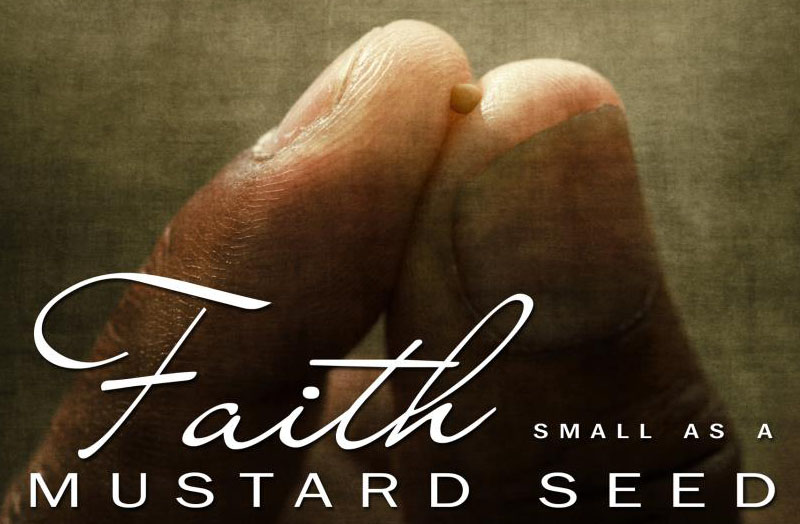
With faith as big
as a mustard seed, we can move the climate mountain. Maybe not move sycamore trees, but with mustard
seed faith, you might be like that proverbial tree planted by a clear, ever-flowing
stream. A tree that bears its fruit in
due season, a tree that prospers in all seasons. And this is how we will save this earth, “our
island home.” Only needed is the mustard
seed faith that I can make a difference.
That you can make a difference. That
we can make a difference. Add water,
sunshine and love. Amen.
[1] https://www.youtube.com/watch?v=haewHZ8ubKA
[2] Ibid.
[3] Carl Zimmer, “Birds are Vanishing from North America, New York Times, September 19, 2019.
4 Lauren Morello, “Phytoplankton Population Drops 40 Percent Since 1950,” Scientific American, July 29, 2010.
[5] Peter W Marty, “Dealing with Past Sins,” Christian Century, September 25, 2019, p. 3.
[6] Ibid.
[7] Bill McKibben, “How we Survived Climate Change,” Time, September 23, 2019.
Preached at St. Francis Episcopal Mission Outreach, San Bernardino
Habakkuk, 1:1-4, 2:1-4; Psalm 37:1-10; 2 Timothy 1:1-14; Luke 17:5-10
Proper 22, Year C, October 6, 2019
The Rev. Dr. John C. Forney
Jerusalem, We Have a Problem


We have here one of the most problematic parables that Jesus was ever said to have uttered. It would have not been surprising, upon listing to this parable, for one of the disciples to have muttered, “Jerusalem, we have a problem.” This teaching is unacceptable. Completely! This is not the ethic of the Beloved Community.
The Parable of the Unjust Steward is so morally reprehensible that the gospel writer concludes it with a number of possible interpretations in an attempt to clean it up. Many of which are contradictory. Taken together the parable and the following commentary looks like the word salad of some politician as to why they were caught for what they were caught doing – a bunch of words strung together without any sense or meaning. Just words with no connection. A refrigerator magnet poem put up by your second grader.
This parable would seem to counsel the sort of behavior that Reuters recently reported as getting several top FEMA presidential appointees indicted from criminal wrong doing. The ethics of the swamp seem to be slowly permeating throughout all the ooze. From top to bottom.
To wit, Reuters reports that a top FEMA official overseeing the rebuilding of Puerto Rico along with several others has been indicted by a grand jury for taking kickbacks to rebuild Puerto Rico’s electrical grid after Hurricane Maria. Ahsha Tribble, who oversaw the reconstruction work for FEMA allegedly accepted gifts, including a forty-foot long catamaran boat and sack loads of money, to pressure the government of Puerto Rico to steer business to Donald Ellison and her benefactor’s firm, Cobra Acquisitions.
This, after a contract was previously jerked from a small company with only two employees in Montana – a company that had been awarded the contract to rebuild Puerto Rico’s entire grid. Can you imagine, an outfit with only two employees getting this contract? That would be like our administrative assistant Verity and I, strapping on equipment belts and just the two of us heading off to the devastation of Puerto Rico with nothing but billions of dollar bills in our pockets and absolutely no idea of which end of the wire to stick into the outlet. Tell me, what’s that story about, if not massive corruption. Just who’s benefiting somewhere out there in Montana? Certainly not the people of Puerto Rico. They’re still waiting for power in many places. Is that the sort of business ethics Jesus is promoting in this parable? The ethics of Eden’s snake?
And today, we hear that the leader of Ukraine is being pressured to turn over dirt on a potential political opponent in our upcoming 2020 election.
Where does it end? In the mire of this cesspool it would seem that everything we Americans hold dear is for sale to the highest bidder. Any end justifies any means. Maybe the hope is that the American people will just tire of the so much corruption and simply tune out. Friends, we do that at the peril of our enduring values. We do that in betrayal of what Americans have lived and died for. I can’t believe that this is where Jesus’ teaching wants to take us. What??? Rot is good?
Listen to Amos’s counsel: Woe to those who ask when shall the Sabbath be over that we can make hay? When we can jigger the weights and tweak the scales. Make the ephah small and the shekel great? How soon can we deal deceitfully and grind the poor into dust? Money’s there for the making.
Amos warns that such a generation shall be cast adrift. They shall be utterly lost. To such a generation the Lord will send an intense hunger. “Behold, the days are coming,” says the Lord God, “When I will send a famine on the land; not a famine of bread, nor a thirst for water, but of hearing the words of the Lord. They shall wander from sea to sea, and from north to east; they shall run to and fro, to seek the word of the Lord, but they shall not find it.”[1]
The denizens of the swamp shall prevail. As Hobbs predicted, it will be a war of all against all. And Gordon Gekko rings the opening bell of Wall Street trading every single day, even on the Sabbath. That’s the dystopian future that derives from the business ethic of the Unjust Steward. Jesus, is this your counsel?
These are consequences for a generation that has lost its mooring, that has lost its soul. They are not like a tree planted by a living stream with deep roots, but like the chaff which the wind quickly blows to the four corners of the earth.
Is this the business ethic Jesus is recommending to his followers? If this is the course of action Jesus was suggesting through this story, it has certainly taken hold in our time with a vengeance. In such a society no institution is exempt from the seeping mire. A parent with a wad of cash can buy admittance to the most prestigious schools in the nation. Bankers cheat their customers with fake accounts they concoct out of thin air in the middle of the night. Even the church is not exempt. We, too, are a very human community not exempt from temptation and malfeasance. However, I can assure you that here at St. Francis we have no golden faucets or a huge bank account stashed away.
No wonder the gospel writer was so perplexed. No wonder Luke was hunting for any rational explanation for this parable.
It happened that I was sitting at lunch last Thursday at Pilgrim Place with a noted biblical scholar. I told Dennis what the upcoming lectionary selection from Luke was, and how on earth was the preacher to make any sense of the Parable of the Unjust Steward? Was Jesus commending the ethics of a snake like Bernie Madoff to his followers? Or was something else going on that I was missing? Please, Dennis, give the preacher some help here!
Dennis suggested that there was indeed another way of understanding this problematic story. Perhaps Jesus was telling his hearers that they should be just as wise and artful in doing good as those steeped in the corrupt ways of the world. We were not to do as the Unjust Steward but were to be just as clever as he in building the Beloved Community.
Lift each other up with the same determination and the same foresight. Not for evil, but to a different end. Be wickedly smart in doing good, just as smart as that crooked steward.
Well, that makes sense. Such sentiment warms the heart. Much better sense than that Jesus would be counseling us to loot, steal and cheat. And sink into the mire of the swamp.
Listen to the wisdom of our biblical heritage: “Choose life that you and your children may live.” And as the writer of 1 Timothy urges, we should commend all in prayer, even the vipers of the swamp, that “…we may lead a quiet and peaceable life, godly and respectful in every way.” Despite all evidence to the contrary, we must hold out for the possibility of redemption – even for ourselves.
Yes, let us be adroit and canny in doing good. Let us be persistent in such things as compassion. We’re talking about patience, kindness, generosity, faithfulness, gentleness – the fruit of the Spirit. The attitudes that make for life. It’s the “attitude of gratitude,” as they say in the twelve-step movement.
And where does such a moral compass lead? Here’s where such gifts of the Spirit lead us. It’s a story I came across scrolling down through the AOL news one morning last week. It is about a young, sixteen-year old high school girl named Whitney Kropp.
Whitney has always been a fairly quiet girl, usually sitting in the back. She wasn’t known for having many friends, and her family came from fairly modest means. They were certainly not among the movers and shakers in their Michigan community.
Well, some of the school bullies — girls of the so-called “in” clique, as a prank, decided to put forth Whitney’s name for homecoming queen. What a joke, they thought it would be, on such a nothing girl who wouldn’t have had a prayer for that honor. Yuck it up, ladies. Lots of fun at a nice person’s expense. Of course, no one told Whitney.
Well, it turned out, the joke was on them.
As you can imagine, Whitney was flattered. Flabbergasted, really. Could it be that, after all those years of being the quiet girl in the background, high school life was finally opening up for her? Maybe she wasn’t the ugly duckling after all.
Whitney soon became suspicious when, after the homecoming court was announced and she had heard her name over the speaker, that she happened to glance over at a group of kids laughing their heads off. She noticed the group of the soch girls – you know the ones – the snooty, moneyed girls who think they’re better than everyone else — giggling and pointing at her.
However, she decided to ignore this. Just pay no attention. They’re of no account. On the day of the announcement Whitney couldn’t wait to tell her family and friends. One of her friends posted the news on Facebook.
As Whitney didn’t fit in well with her classmates, it began to make sense to her when she discovered that her nomination had been a cruel joke. It was the work of this little group of school bullies. To make matters worse, she discovered that many in her school had been in on the joke.
Whitney was devastated, and her mind went to some very dark, destructive thoughts. In her depression she even contemplated suicide. She also discovered that one boy so did not want to be associated with her that he had rejected a nomination to homecoming court. You can imagine how the news hit this vulnerable, young girl! She began to feel like SHE was nothing but a big joke. She didn’t belong.
When she finally mustered the courage to tell her family, of course, they were devastated. But they encouraged their daughter to attend the homecoming game anyway. It wasn’t going to be easy for this fragile girl whose confidence had been completely shaken, but they would have her back. Myself? I think I would have hidden in my closet and never come out. But Whitney’s family was strong and Whitney discovered an inner strength from their support. They would show these bullies what real family strength was.
Whitney’s sister started a Facebook group to support Whitney and inform the wider community what had happened. In a flash this group exploded to thousands as the story spread. And as community businesses learned of the recent events, they offered all sorts of support: shoes and a new dress fit for a queen, a complete makeover by a local hairdresser, a homecoming dinner and a limousine for a ride in style to her coronation.
That night as Whitney walked across the field at halftime, under the glare of stadium lights, escorted by her proud father, she was still nervous. And then she looked up. She saw hundreds of folks in the stands cheering her as they stood in her honor. They held signs and wore orange tee shirts to match her stunning, new, orange dress. And there were the news teams. Whitney, who had thought she was a big nothing, was overwhelmed by the awesome embrace of so, so many strangers who come out to honor her that night.
When being interviewed that evening by reporters, Whitney had a message for every girl in America, “The kids that are bullying you, do not let them bring you down. Stand up for what you believe in and go with your heart and go with our gut.”
This is what happens when an entire community excels in doing good, when a family is wise in the ways of social media and reaching out, every bit as creative as those who had intended evil. Just as clever as that Unjust Steward. Every bit as cunning as that proverbial serpent. Just as adroit as that reptile in its serpentine deceit, but this time, for doing good. And in the doing, God was most highly honored that evening.
Gospel faithfulness is life indeed. Whitney, her family, and entire community chose life. What some self-absorbed and inconsiderate classmates intended for evil, they chose for good.
Friends, that’s my take on this most problematic of parables. That’s my story and I’m sticking to it.
St. Paul reminds us that the gifts of the Spirit are love, joy, peace, patience, kindness, generosity, faithfulness, gentleness and self-control. Against such things there is no law.”[2]
That night, at the coronation of a radiant girl in a small, mid-western American town, all the gifts of the Spirit were let loose. They gushed forth like an ever-flowing stream of righteousness. Whitney and her clever Beloved Community chose life. Life abundant. Brimful and overflowing.
As songster Jim Manley writes: “Did somebody
say that you’d never be queen? Send them
our way and we’ll paint their nose green.”
Amen.
[1] Amos 8:12, the RSV.
[2] Galatians 5:22-23. RSV.
Preached at St. Francis Episcopal Mission Outreach, San Bernardino
Amos 6:1a, 4-7; Psalm 113; 1 Timothy 2:1-7; Luke 16:1-13
Proper 19, Year C, September 22, 2019
The Rev. Dr. John C. Forney


