


At All Costs


My wife has a saying she came up with shortly after our first child was born, “When the going gets tough – lower your standards.”
She had kept our house immaculate. Everything in its place and a place for everything. EXCEPT IN MY OFFICE. She just closed the door and didn’t let visitors in there.
It was the sanity decision.
When the second child came along, it was the only decision.
Similarly, COVID-19 has forced most of us to hunker down, reassess priorities. That and inflation. I noticed that balancing my checkbook is a lot easier these days because I’m not going anywhere. I’m not buying stuff.
When Jai and I arrived back home from our trip East to meet prospective in-laws, (yes! Christopher and Alexis have set the date)….we both came back with COVID. The one good aspect of this experience is that nobody expects you to do much of anything. And I didn’t feel like doing much of anything. Life gets stripped to the essentials. Lower your standards. Plowing through at all costs is insanity.
But how often out of anxiety, out of fear, out of just plain greed do we strive after the wind? And as the title of Margaret Mitchell’s novel puts it, it’s all GONE WITH THE WIND.
The passages assigned this week all raise the question, What Makes for a Godly Life? What really counts? What is the taste of the eternal to be had in this life?
In the opening chapter of Ecclesiastes, we read of striving after things of no account.
“Vanity of vanities, says the Teacher, vanity of vanities! All is vanity.
“I, the Teacher, when king over Israel in Jerusalem, applied my mind to seek and to search out by wisdom all that is done under heaven; it is an unhappy business that God has given to human beings to be busy with.
“I saw all the deeds that are done under the sun; and see, all is vanity and a chasing after wind. I hated all my toil in which I had toiled under the sun, seeing that I must leave it to those who come after me.”
Remember the lesson of last week: The Good Life – Eternity if you will, is wrapped up in love of God and Neighbor. One and the same.
It’s not the bumper sticker: “He who dies with the most toys wins.” That’s a lie. Vanity, all that bunkum is vanity and a chasing after the wind. Material gain, political ambition, fame – pursued “At All Costs” is nothing but futility.
Martin E. Marty captured the excessive ethos of this age in a proposed alternative bumper sticker: “In case of rapture, I have dibs on your Bugatti.”[1]
The political thing pursued at all costs might actually get the Former Guy 20 years of government housing. The fame thing at all costs can get you on the Hollywood divorce roster or into drug rehab. And ask Bugsy Siegel or Michael Milken where the money thing pursued at all costs leads. And, we won’t go into the book thing.
It’s not hoarding up more and more and more stuff. This lesson hits close to home as the Forney’s have an over-active packrat gene.
Maybe I’ve mentioned my wife’s dream of defrosting the freezer. In her dream she opens the door only to find that it’s full of books.
That morning when she shared her Good Housekeeping nightmare, I told her that she was lucky to be married to a biblical scholar who could interpret the dream.
The interpretation? She needed to buy a new freezer — for the food.
Now, I admit, my library is a little over the top. I assuage my guilt by comparing it to Carnage’s library we visited in New York City. The ceilings were at least sixty feet high. There were three levels of books along the walls. It was huge!
This grand collection was housed in over-the-top opulence. Mine, not so much.
When I mentioned to Jai that, at least, my library wasn’t THAT out of control, she quipped something to the effect, “That’s only because you don’t have the billions Carnage had.” Touché!
Yes, we do have the Forney packrat gene. I can’t tell you how many cans of dried paint I cleaned out of my dad’s storage room. There must have been fifty or sixty cans. A lifetime accumulation. I’m sure some dated back sixty years to when we had lived in Compton and I was in the second grade. All as dry as a Cambrian fossil.
I remember a film we used to show at church camp on the stewardship of creation. The title was, “More.” In the opening minutes is a baby screaming, “More, more, more” as it grasps for everything around it. The film ends with the earth buried under mounds of stuff and more stuff.
That’s where we’re headed with our insatiable appetites. More, more, more. And the planet is getting buried under a toxic cloud of carbon dioxide, the “greenhouse gas.” To my friends in the Midwest – is it hot enough for you yet? Yeah, as the movie says, “Some Like it Hot,” but that was about Marilyn Monroe, not the planet!
So, where then might we better expend our effort? If it’s not building bigger and more barns to store our stuff. St. Paul frequently offers good counsel on what makes for a good, well-lived life. Godly counsel, if you will.
To paraphrase St. Paul, “Excel in doing good. meekness, self-control; against such there is no law. … Humility, endurance; the law is not set against these things.
The planet can handle such good works without burning up. Store up such charity in abundance. You won’t need a new barn or larger library. Toss those cans of desiccated paint.
Consider this path if you are driven at “All Costs” to excel at something. There is no law against such generosity of spirit. John Wesley said do all the good you can to as many as you can as long as you can. Jesus would second that. That’s what the Spirit inspires.
I think of my friend Nancy Mintie who founded Uncommon Good right here in the Pomona Valley after working in poverty law in downtown Los Angeles. Nancy Mintie is the best of Catholic social teaching in practice. She and Uncommon Good do a lot of good for kids. Against such generosity of Spirit there is no law.
Let me share one story from Uncommon Good’s latest newsletter. It’s about a young man already making a difference in his community.
Luis Limon Sr. came from Mexico and began supporting himself in the U.S. at the age of fifteen. A young woman from Mexico’s breadbasket Sinaloa came for a visit and stole his heart. In due course Luis Limon Jr. was born.
His parents brought young Luis to Uncommon Good, hoping that they could show him the way to get an education and make a life for himself in their adopted country.
Luis has taken advantage of all that Uncommon Good has had to offer. He was paired with a mentor from one of our Claremont Colleges. He joined the sister organization of Uncommon Good, Gente Organizada. After attending writing programs, and math camp he broadened his horizons.
He became a student leader, inspired by his parent’s journeys, he lobbied the Pomona City Council to establish a Youth Commission. In the face of withering, racist criticism by one of the council members – a Latino at that — Luis persisted. With the support of his friends at Uncommon Good, Luis then took on the issues of mental health in his community, creating a yearly conference, Healthy Young People – holding their conferences by Zoom after Covid hit.
Uncommon Good helped Luis apply for, and be accepted by a mentoring program at Pomona College, PAYS, the exclusive college preparation program at one of our top liberal arts colleges on the West Coast.
As a high school senior, Luis has been accepted at one of our more prestigious and selective colleges, Kalamazoo College in Michigan. Scholarship to boot! They have a 4.4% acceptance rate. Compare that with Harvard’s rate of 5%. Now that’s selective.
That’s the kind of GOOD that Nancy Mintie has excelled in. She certainly walks the talk of her church. Nothing wasted here.
So, to St. Paul in Colossians. Uncommon Good, its staff and volunteers embody the spirit of this teaching:
“So, if you have been raised with Christ, seek the things that are above, where Christ is, seated at the right hand of God.
“Set your minds on things that are above, not on things that are on earth, for you have died, and your life is hidden with Christ in God.
“When Christ who is your life is revealed, then you also will be revealed with him in glory.”[2]
Here’s Paul’s point — This same Spirit indwelling in Jesus has now been let loose in you, and inhabits all in the Jesus Movement. It is the same life-giving force that brings us “Frozen Chosen” to daring acts of justice and reconciliation. Through it, we are transfigured to joy incarnate, the Glory of the living God.
Yield to that summons – that’s LIFE ABUNDANT. Free for the asking. No barn’s required. No extra bookshelves needed.
Here we discover the true riches of life, where treasure is to be had.
Micheala Bruzzese sums it up: In and through such living we find that our “profound hunger to love and to be loved is satisfied.” We are enfolded into the “unconditional and all-consuming love of God. …this treasure does not trap us, but liberates us, giving us the strength and courage to be liberators in the world.”[3]
Amen.
[1]Martin E. Marty, “Wheels of Fortune: ‘In Case of Rapture, I Have Dibs on Your Bugatti,’” M.E.M.O, Christian Century, July 25, 2006.
[2] Colossians 3:1-11, New Revised Standard Version.
[3] Micheala Bruzzese, “Possessed by Love Alone,” Sojourners Magazine, May 1, 2004.
July 31, 2022, 8 Pentecost, Proper 13
“At All Costs”
The Rev. Dr. John C. Forney, St. Francis Episcopal Mission
Ecclesiastes 1:2, 12-14, 2:18-23; Psalm 49:1-12; Colossians 3:1-11
Luke 12:13-21
When you pray, say…


Friday night bright lights. The football team, their coaches and handlers trotted out onto the field of the stadium to the uproarious cheers of the hometown crowd. There they all paused on the fifty-yard line, assembled in a clump, with bowed heads as their coach led them in prayer.
Anne Lamott, hearing of this pious spectacle was horrified. She, a believer, considers such sanctimonious demonstrations of religiosity nothing short of blasphemy. They diminish and demean the faith when it is so trivialized. Not what Jesus had in mind.
She objects — when we consider the real problems of the world – the hellish difficulties women now face concerning their health care – the incineration of our natural world under the embers of global warming – the intolerable pain of places like Uvalde, Highland Park, the list goes on beyond remembering – when we read daily of the horrors in Ukraine, starvation and disease in Third World countries – when one takes all this into her soul, what the hell is a football game that God should be concerned?! That God, that we, believers and non-believers should be concerned? Such pious blather borders on blasphemy.
Here’s Anne’s rant:
“It offends me to see sanctimonious public prayer in any circumstance – but a coach holding his players hostage while an audience watches his piety makes my skin crawl.”[1]
And on such self-serving expressions of righteousness, remember Jesus’ story of the Pharisee and the Publican. “I thank God I am not like…”
I remember long ago; our congregation was involved in a church volleyball league. Before the opening game of the season, one of the pastors proceeded to lead us all in prayer. He muttered something to the effect of…”Lord, we know it’s only a little piece of metal at stake…Not much of any consequence…”
Now, all the while, in my mind, I’m subverting the pious thoughts of this sanctimonious prayer… “Yeah, pastor — just a little piece, just a scrap of metal this league trophy…Right! We’re going to go out there and KILL FOR IT. Egos, elbows…they’ll be out in full force in service of coming out “King of the Hill for this little, bitty inconsequential scrap.” And that’s pretty much how it went that evening. Not quite Marquis of Queensbury sportsmanship on display.
As Jesus was concluding his prayers, he was approached by one of his disciples. “Lord, teach us to pray, as John taught his disciples.” He said to them. “When you pray, say: Abba, Father – Daddy, really – (and here we recite this familiar prayer in the words and thought forms of the spirituality of New Zealand Anglicans, as heavily influenced by Māori and Polynesian culture):
Eternal Spirit,
Earth-maker, Pain-bearer, Life-giver,
Source of all that is and shall be,
Father and Mother of us all,
Loving God, in whom is heaven:
May the hallowing of your name echo through the
universe; the way of your justice be followed by the
peoples of the world; your heavenly will be done by all
created beings; and your commonwealth of peace and
freedom sustain our hope and come on earth.
With the bread that we need for today, feed us.
In the hurts we absorb from one another, forgive us.
In times of temptation and test, strengthen us.
From trials too great to endure, spare us.
From the grip of all that is evil, free us.
For you reign in the glory of the power that is love,
now and forever. Amen.
This essential prayer of the Christian faith is widely prayed throughout the world by almost all faithful followers of Jesus. And also, by many outside the faith. I associate it with the summons to attention by one of my first teachers:
“FOCUS, JOHN. FOCUS.”
This prayer directs us to what we need to sustain life, and invites us into the process – to what opens a window to eternity.
We need to acknowledge that life is not just about us. There’s an overarching summons beyond our limited cares and petty grievances. We need forgiveness because of the hurt we cause, and likewise we need to let go of the hurt others cause. We need daily sustenance. We need relationship with one another and the verities that make for a life worth living.
Without this life orientation, our existence is the slow circling of a Final Drain. Jesus is telling us in these brief few words – FOCUS ON WHAT MAKES IT ALL WORTHWHILE. What brings joy, what brings life abundant.
Don’t squander the splendor of it all in trivia. We only go around once. FOCUS, John!
Martin Buber, grasping at the idea of the unknowable divine, settled on an expression of that reality in relationship. In his work, I and Thou, he fleshes out how it is that we are drawn into relationship wherein we are valued, and value others.
When Moses asks for the Holy Name at Mt. Sinai, all that is revealed is: “I am who I am.” Or “I am becoming who I am becoming.”
We are, further, told that this reality is bound up with neighbor. “You shall love the Lord Your God with all your soul, and all your heart, and with all your strength, and with all your mind; and your neighbor as yourself.”
Neighbor and the Great Mystery – that’s about as close as any of us will get.
It is this simple prayer Jesus taught his followers that centers mind and heart on what is necessary for this love ethic – the final requirement of Torah.
Love of God, love of neighbor – one and the same. Do this and you are very near to the Reign of the Divine.
It was for this reason that I was so overjoyed when our son Christopher shared his new vocational direction. Being a PhD student at Yale, I always thought he’d end up a professor at some prestigious college. But lately he began drifting from that direction towards thinking he might want to teach high school or maybe community college. But then he surprised me with a revised vocational goal: He wanted to teach in a prison.
“Dad, these people really need the education, not some pampered, elite, rich kids.” I thought, maybe all that he got from home, from church has put down some very deep roots. Well, glory be!
Not far from what matters!
I told him that I had a friend who actually teaches college-level classes in prisons. Chris Hedges, a Presbyterian pastor and a Pulitzer-Prize-winning war correspondent for the New York Times, has seen some of the worst of the worst prisons in many far-off, war-torn lands. He’s taught classes for a number of years in a New Jersey prison.
“Would you like to me to call him? He certainly has some incredible experiences to share.” Our Chris said that would be great. I was surprised I still had Hedges on speed dial. He said he would love to talk with our son. Maybe our son should first read Chris’s recently published book, Our Class, a work about his classes behind bars which doesn’t sugar-coat prison life in the slightest.[2]
As these classes are college level, these students are bright and capable of difficult material. To enable them to draw from their life experiences, Hedges has introduced a number of playwrights that open up prison life, notably August Wilson. His play, Joe Turner’s Come and Gone, set in 1911 in a boarding house, refers to a song by W.C. Handy about “Joe Turner’s Blues.”[3]
Like prayer – the real thing – deep listening – Wilson’s plays draw these men into their interior lives. Into what most matters. Into “finding their song.”
“What is this song?” Hedges asks. “Like a prayer. Like memory,” another answers.
“It connects you to where you came from. It connects you with your ancestors. It connects you with your own history; your own story. It validates and lifts up your suffering, your dignity, your humanity, your resistance. It tells you that you will not be defeated by the troubles of this world. It affirms you and your people.”
Until we find our song, we are but dried bones. We only stand when we find our song, when we’re fully resurrected as free men and women, when we are able to shout out our song, when we can say who we are and where we came from.[4]
This brief prayer of the Jesus movement, if allowed to marinate over a lifetime, connects us with our song – the pain, the tragedy, the delight and the blessing.
“Our song is so difficult because of the pain,” one said. “Because it’s about loss, about suffering and death, about families ripped apart, about people not being treated as if they were real human beings, because that’s the story then, and it’s still the story.”[5]
Taken to heart, Jesus’ prayer becomes deep listening, not a laundry list like a superficial prayer on the fifty-yard line or at the volleyball net.
Deep listening — inspired by a hug, an unexpected kindness, the tranquility of a forest grove or the splendor of a stary night above in the desert sky.
To see both God and neighbor as an unfolding Thou, to be cherished, to be wrapped in care, to be honored. That is prayer. That is your song — your connection to the deepest Thou. It is the unfolding of heart and mind and strength. Without it, we’re just discarded bones.
“God is love, and whoever abides in love abides in God, and God in them,” is how John’s community understood the connection.[6]
Lord, teach us to pray. Simply…simply say:
“With the bread that we need for today, feed us.
In the hurts we absorb from one another, forgive us.
In times of temptation and test, strengthen us.
From trials too great to endure, spare us.
From the grip of all that is evil, free us.
FOCUS, John. FOCUS. Beyond and within all outward appearance is splendor, beyond and within daily routine, we each find our own song unto eternity. Yes, “Give us this day…” Amen
[1] Anne Lamott, “I Don’t Want to See a Football Coach Praying on the Field,” New York Times Opinion, Monday, July 11, 2022.
[2] Chris Hedges, Our Class: Trauma and Transformation in an American Prison (New York: Simon & Schuster, 2021).
[3] Ibid, 78-79.
[4] Ibid, paraphrasing Wilson’s character Loomis, Joe Turner’s Come and Gone.
[5] Ibid, 79.
[6] I John 4:16b.
July 24, 2022, 7 Pentecost, Proper 12
“When you pray, say…”
The Rev. Dr. John C. Forney, St. Francis Episcopal Mission
Genesis 18:20-32; Psalm 138; Colossians 2:6-15, [16-19];
Luke 11:1-13
Just Who is Neighbor?

Upon arriving home, I noticed a flyer that slipped out of our local Claremont newspaper. It concerned a proposed development to provide housing for the neediest amongst us. Larkin Place is to be a supervised residence providing housing for the unhoused. Of course, some of these folks will have problems with substance abuse. Many will have various degrees of mental illnesses. Some will be returning from incarceration.
When I saw this broadside, it was more like “Monsters on Maple Street.” Something out of Rod Sterling’s dark imagination. Or maybe “Zombie Apocalypse.”
Our peaceful community – read WHITE – would be invaded by the most distorted forms of humanity. Druggies, the insane – insane slashers?? – an unreformed criminal element setting to prey upon our nearby school children.
Yes, right “next to kids’ soccer fields, Joslyn Senior Center, El Roble Intermediate School, a preschool…” Right! Zombie Apocalypse!
And whoever these dregs of human society might be, we CERTAINLY DON’T WANT THEM AS NEIGHBORS! Not OUR neighbors.
Send them off to Pomona. Send them off to L.A. Just keep them out of Claremont.
This was a call to “Take Action.” “Save Claremont!”
The project developer, Jamboree Housing Corporation, has a track record of successfully providing low-income housing to seniors, veterans and the homeless. Their supervised “Permanent Supportive Housing” in Orange County is exemplary. Their efforts have brought hope and ended homelessness with solutions that work.
They’ve held a number of community-wide meetings here in Claremont, but to no avail. As the Good Book says, “Those with ears to hear, let them hear.” Well, the shouters and nay-sayers seem to have heard not much of those presentations. Still – Monsters on Elm Street.
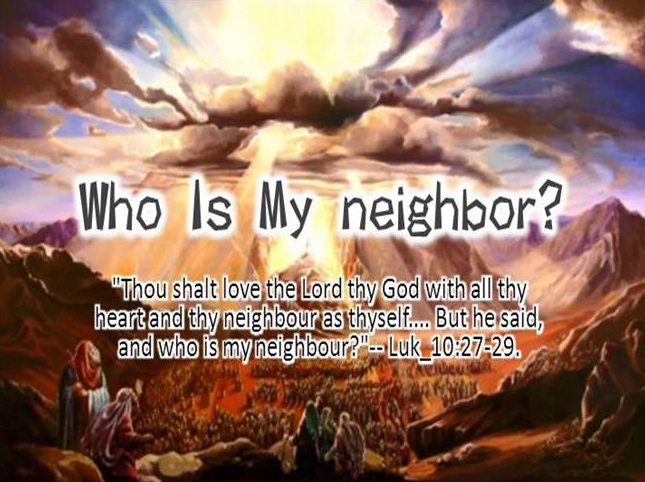
You know, we all know, the paradigmatic story of neighbors Jesus tells in Luke’s gospel. “Just then a lawyer (wouldn’t you know it – a lawyer — Had to be a lawyer!) stood up to test Jesus.” Wanting the quick and easy answer to salvation. So, what need he do to enter the Kingdom of God?
And when Jesus throws the question back at him, the man responds exactly as he had been taught in Sabbath School. “Love God and love Neighbor.”
Right. He gets an “A” from the rabbi. So, what’s the problem? Just do it.
Not wanting to look diminished in the eyes of the gathering crowd, the lawyer retorts, “Just who is neighbor?”
Whereupon Jesus launches into a story. So famous that the hero, the “Good Samaritan” lives on in legend and as moral exemplar down through the ages. Of course, it was the one who actually provided aid, who bandaged up the assaulted traveler and saw to his housing.
When folks protest the work of House of Hope to bring healing to those suffering addiction, to cries that we should locate somewhere else – anywhere else, this is my response.
These people are already here. You see them living in tents on the streets, on the bike trail, in empty lots. They’re already here.
Would you rather they be tucked safely in their beds at 9:00 o’clock at night in a supervised facility providing recovery, where they’re learning the work of sobriety? Or would you rather encounter them in your living room at 2:00 in the morning, or in a parking lot on the wrong end of a gun? They’re already here.
People, these are your neighbors. They’re here. They’re hurting. They’re desperate. Your choice.
Here’s today’s update of Jesus’ parable:
A group of city fathers and mothers on a stroll through the Village came upon a most unsightly scene. People sleeping on the sidewalks and in the parks. Actually, they noticed the smell before they saw the tents and sleeping bags and cardboard lean-tos.
Some, long established residents, fretted, “This is going to bring down property values. I worked hard for my home. This riffraff is ruining my investment. It’s unsightly. It smells. They smell.” These fine citizens called the city council demanding action.
Another group, a couple on the city council, were likewise aghast. “We aren’t going to get re-elected if these people swarm the city. We’ve got to get rid of them. Send the cops out to let them know in no uncertain terms that they’d better be gone by sundown. OR ELSE.”
“And forget that resolution the do-gooders are pushing for inclusionary housing. We definitely are NOT for including THESE people. Let’s pass an ordinance outlawing these deplorables and their shanties.” “Oughta be a Law!”
Finally, a sanitation worker and some police officers came by. “This is unsanitary. These people are using the alley and bushes for their bathroom. Their panhandling is driving away business. The crime rate is on the rise. Ship them off to Pomona. Anywhere, but not here. Definitely –“Oughta be a Law!”
Then along came some folks and when they saw the squalor, and listened to the pain and distress of those living on the sidewalks, their hearts were moved with pity. They provided shelter at a local church. When they realized that this was at best a temporary band-aid solution, they found an empty lot and convinced the owner to make it available for a more permanent solution – a solution that would address the underlying problems of addiction, mental illness, impoverishment, and flat-out bad luck.
They found a developer, drew up plans, talked and talked and talked to their neighbors. They attended meeting after meeting. They fought like hell to persuade the persuadable and rally allies. And they still are.
That’s because they recognized their neighbors as people like themselves. People deserving a break, people deserving healing, people with the same dreams, the same hopes — the same right to respect and a decent livelihood. Neighbors, in short.
As our nation is further polarized by recent political events and the rulings of our Supreme Court, the stress on national neighborliness is at the breaking poin — definitely at the fracture point. About the only thing still holding us together, the only thing we can agree on, this past Fourth of July, was the fireworks — in communities where we could actually shoot them off without fear of burning the place down.
As the January 6th Committee delves further into the potential criminality of the Former Guy, half the country is either not paying attention, or has dismissed it all as “Fake News.” Nothing to see here, folks, just move along.
So how do we put it back together? America is presently a pretty smashed-up Humpty Dumpty. Jon Mecham fears that if we break America, we won’t get it back.
If our nation is to survive, the definition of “neighbor” must be, in our global community, far more expansive than someone living up the street. Or across town.
As Hitler was marshalling his forces to subdue Europe, magazine empire oligarch — publisher of Time-Life — Henry Luce wrote an editorial destined to shape American foreign policy for the next one hundred years, “The American Century.”
Therein he assumed that America, in a unipolar world, would be the essential neighbor keeping the peace and creating a world safe for global capitalism and democracy.
We should … “accept wholeheartedly our duty and our opportunity as the most powerful and vital nation in the world and . . . exert upon the world the full impact of our influence, for such purposes as we see fit and by such means as we see fit.”[1]
Over the years, it hasn’t worked out that way. Through one intervention, one ruinous war after another, our misguided support of despots has only created more death than had we left well enough alone. The gospel of Matthew’s “City on a Hill” has morphed into an “Armed Metropolis.”[2] Such a neighbor!
The principles of this so called “liberal Internationalism,” as articulated by Woodrow Wilson, seem not to have made us any safer; only poorer and, under a despot like Trump, more isolated and feared.
Those promoting what has been called a more circumscribed foreign policy, the “Restrainers,” say it’s time for a lighter American footprint on the world’s stage. The evidence has not supported a foreign policy of robust intervention.
Daniel Bessner writes, “Since the late Seventies, Americans have been suffering the negative consequences of empire—a militarized political culture, racism and xenophobia, police forces armed to the teeth with military-grade weaponry, a bloated defense budget, and endless wars—without receiving much in return…”[3] What Chambers Johnson calls, the “Sorrows of Empire.”[4]
The historian Paul Thomas Chamberlin estimates that we have racked up over twenty million deaths in Cold War conflicts – the “equivalent of 1,200 deaths a day for forty-five years.”[5]
As pundits, in the days following the celebration of our nation’s birth, ponder our American legacy and what to make of it all, Jon Mecham and Joe Scarborough sufficiently nailed it for me. At least for the moment.
Joe, interviewing Jon, pondering the promise and hope of America, related a comment which answered his question, — on Twitter Joe had asked: “Even with all our flaws, why are you proud to be an American?” One of his favorite replies was by a Joe Reynolds: “When you’re some small person with your back against the wall – a natural disaster, a political prisoner, a pandemic, you don’t say, ‘maybe India will help us, or maybe China. You say maybe America will help.’ We don’t always live up to that, but we should.”
Joe then turned the question back to Jon who responded: “I’m proud to be an American for same reason [that] I’m proud to be a human being. I know that I am capable of great evil, and great shadow and great darkness. But I also know that there are days and moments when there’s light and life and love. If we can just get there fifty-one percent of time, then we’re having a good day.
What would be your answer? What’s your “good day?”
If we can come close to Jon’s humility, we just might become a good neighbor. And we just might recognize and treat those around with the God-given respect they deserve. On a good day — kneeling by the road’s edge at the side of the hungry, the diseased, the refugee — God’s very own.
The hymn by Lloyd Stone and Georgia Harkness, to the tune Finlandia, says all that needs to be said about being a proud American in this new era, one who wishes to walk humbly with God and neighbor:[6]
“…this is my home, the country where my heart is;
here are my hopes, my dreams, my holy shrine:
but other hearts in other lands are beating
with hopes and dreams as true and high as mine.
“My country’s skies are bluer than the ocean,
and sunlight beams on cloverleaf and pine;
but other lands have sunlight too, and clover…” Amen.
[1]Henry Luce,quoted in Daniel Bessner, “What Comes after the American Century?” Harpers Magazine, July 2022.
[2] Ibid.
[3] Ibid.
[4][4] Chambers Johnson, The Sorrows of Empire: Militarism, Secrecy, and the End of the Republic (New York: Metropolitan Books, 2004).
[5] Daniel Bessner, op. cit.
[6]“This is My song,” United Methodist Hymnal (Nashville, TN: The United Methodist Publishing House, 1964).
July 10, 2022, 5 Pentecost
“Just Who is Neighbor?”
The Rev. Dr. John C. Forney, St. Francis Episcopal Mission
Deuteronomy 30:9-14; Psalm 25:1-9; Colossians 1:1-14;
Luke 10:25-37
For the Beauty of the Earth


Well, this Monday Jai and I head off to the East Coast to meet our future in-laws. We have a couple of other stops on this excursion. Washington, D.C. to visit the National Museum of African American History and Culture, if we can get tickets, and one of my favorite bookstores, Politics and Prose. And that’s right next to two pretty good restaurants.
The other stop is New York City to see some plays, visit Strand Bookstore and some museums.
But, HOLD ON! I read in the NY Times this week that Las Vegas-style gambling might be coming to New York City. The paper announced that their legislators, in their infinite wisdom, had opened the path for three such casinos in the area of the city. What could possibly go wrong? Here’s the opening blurb:
“Before too long, New Yorkers and the millions of tourists who visit the city every year may have a new way to test their luck — and part with their money — amid the bright lights and skyscrapers of Midtowns…all the trappings of Las Vegas, down to the incessant ringing and fluorescent flashing of a sea of slot machines.”[1]
The part that got my attention was the bit: “—and part with their money.” Only a simpleton would believe that so-called “luck” is involved.
Trust your luck? Trust your luck??? NO! Hold on to your billfold. There is no luck.
As Christopher’s Tee-shirt says. “The lottery is a tax on people who are stupid at math.”
Repeat after me: THE HOUSE ALWAYS WINS. THE HOUSE ALWAYS WINS. THE HOUSE ALWAYS WINS. (Unless, that is, it’s one of Trump’s mismanaged and looted Atlantic City casinos). But like Rick Wilson says, “Everything Trump touches dies.” Pssst – hope you saw the January 6th Committee hearing on Thursday late afternoon.
So, now, we’re clear about “luck.” The house does not leave winning up to chance. It always wins (the Trump caveat taken as an exception and its BK).
That’s not the inalterable certainty is not the brand of theology we celebrate on Trinity Sunday. The Mystery we celebrate this Sunday is an expansive God. As the SciFi author Octavia Butler proclaimed, “God is Change.” It’s a love relationship writ large we affirm.
For that reason, we look for expansive metaphors to inform our hearts and minds. However, language ultimately fails. We speak in poetry and story. Yes, I know, we have the Nicene Creed attempting to button it up. However, if this attempt had succeeded, why is it that the Church went through a bunch more councils attempting to get it right.
And had we believed that we’d succeeded in nailing it down — that God wouldn’t have been an actual God – it would have been an idol. Pilot thought he’d nailed it down on Good Friday, but it was too elusive for Imperial Rome.
Our conceptions and intellectual constructs ARE NOT GOD. That’s why Jesus spoke in parables. Not in Greek syllogisms, which would not have saved anybody. Tillich got it right. The minute we say “God,” we have created in our mind THAT WHICH IS NOT GOD. The best we can do is point and repeat the ancient story.
So, what is this Trinity? Look about. The Psalmist points to God’s handiwork. For the beauty of the earth. Sing, o sing always. The writer of the Book of Proverbs instructs – handprint of the Holy is beheld in creation’s majesty. The Divine is given witness to in THE GREAT UNFOLDING.
“The Lord created me at the beginning of his work, the first of his acts of long ago. Ages ago I was set up, at the first before the beginning of the earth. When there were no depths I was brought forth, when there were no springs abounding with water. Before the mountains had been shaped, before the mountains had been shaped, before the hills, I was brought forth…then I was beside him, like a master worker; and I was daily his delight, rejoicing before him always, rejoicing in his inhabited world and delighting in the human race.” [2]
A GREAT UNFOLDING.
The beauty is infinite, only look at the snapshots from the James Webb Telescope. Just spend a few moments in your backyard with a majestic monarch butterfly as it rides the air currents, flitting from one flower to another.
My friend Dick Bunce told me a marvelous story that captures the infinite mystery of this Triune expression of the Divine. An understanding unfolding through the long-drawn-out experiences of the Holy by the People of the Word over the generations.
So, on with Dick’s story:
Upon high school graduation, a father asks his sons what his plans might be for going forward. “What’s next for you, son?” The lad hasn’t a clue. Finally, he blurts out something like, “I guess I’m just going to have to trust God.”
“Well, let me know how that works out for you, responds his skeptical father.”
No sooner has the father left the son’s room than the boy hears God speaking. God tells the boy to pack up clothes, get his car gassed up and drive to Las Vegas.
Now it’s the boy who is skeptical, but he does as God asks. He packs up and heads out to Vegas with a full tank.
Upon coming to the main drag, God directs him to park the car at one of the casinos he passes. Upon entering the main room, God directs the boy to go over to the cashier and empty out his wallet, buying as many chips as possible.
Then he is instructed to go over to the blackjack table and lay his bet down. He receives his five cards and God tells him to discard the one that doesn’t fit an inside straight. The boy objects, the odds being almost astronomical against making an inside straight; but he does as God instructs. Amazed, he wins that hand upon completing the straight.
After following God’s prompting for the next hour or so, this young lad is sitting on top of almost a million dollars of chips. At the next opportunity God tells him to bet the whole stack.
With his heart in his throat, the boy does as God tells him. Upon receiving his cards, God instructs him to discard one and take the next. As the other players and the dealer are finished with their bets, God tells the boy to begin to lay his hand down. The boy turns over one card, then another, finally coming to the last card God had instructed him to take.
The young fellow, to his shock and surprise discovers that that last card completed a winning hand. WOW!
WOW!!! God exclaims. “I’m as surprised as you.” WOW!
All of which is to say, that all created order is the revelation of delightful surprise. Contingency has no limits. And that includes the Divine.
The only guarantee we get is that GOD IS CHANGE, and will, along with creation unfold in the most beautiful, delightful, awful and unexpected ways.
This Trinity Sunday, we must concede that this formula is only our poor human attempt to wrap our hands around a mystery, to tell a story which can’t finally be explained.
We know experiences of this mystery: Creator, Redeemer and Sustainer – in more traditional language: Father, Son and Holy Spirit. But each of those words must be provisional as my friend Rosemary Radford Ruether would remind us. Had we been fortunate enough to have had women at the Council of Nicaea, we wouldn’t have been burdened with this excessively male, patriarchal mentality – but that’s another sermon. Fact is — the surprise is always in the last card. UNTIL THE NEXT IS DEALT.
Several weeks ago, I came across a new paleontological article in the NY Times. It was about an early limbed fish which struggled ashore out of the shallows.
The creative headline writer put it, “When the Troubles of the World Ambled From out of the Ooze.” All life moves towards ever more complexity. This three-to-nine-foot-long tetrapod with both gills and nostrils on top of its head, came ashore 374 million years ago. To escape a predator, to search for prey, to leave a drying lagoon? – we don’t know.[3]
Tiktaalik rosae was a wild impossibility that came ashore. It was the surprise of that last card. And from such, or a similar creature, came all reptiles, dinosaurs, mammals – and finally us – we, its descendants. The glory and the liabilities, from Mozart to stratospheric gas prices and global warming. For the beauty of the world, sing, o sing today.
Graduate student Ben Otoo, opines; “It’s a lot of galumphing, wriggling, slithering, huffing, flopping.” The Late Devonian could be called the “flop” era.[4]
“Tiktaalik’s flat head, with two eyes resting on top like blueberries on a pancake, made it perfectly suited for gazing above the water…’it looks like a muppet,’” quipped another researcher, Yara Hardy. All radical contingency. That’s what makes up the splendor of creation – all moving to new intended and unintended configurations. That freedom is the definition of divine love.
I close with a final story that comes out of the tragedy of the Vietnam War. Most of you know that iconic photo of a young, naked girl in great anguish, running down a dirt village road amidst other fleeing refugees.
That Pulitzer-Prize-winning photo, the “napalm girl,” taken on June 8, 1972, fifty years ago, became the defining image of the horrors of that war.
Thanks to the South Vietnamese photographer, Nick Ut, who dropped his camera, covered her with a blanket, and got her medical help – that story, fifty years later has unfolded in a beautiful, life-affirming way.
Ms. Phan Thi is not that terrified nine-year-old girl any longer but a stately, competent woman in her sixties. The picture of her reclining on her sofa radiates poise — both an outward and an inner beauty of character.
“I tried to hide my scars under my clothes. I had horrific anxiety and depression. Children in school recoiled from me. I was a figure of pity to neighbors and, to some extent, my parents. As I got older, I feared that no one would ever love me.”[5]
“I helped establish a foundation and began traveling to war-torn countries to provide medical and psychological assistance to children victimized by war, offering, I hope, a sense of possibilities.”
She knew what it was growing up among so much death, seeing friends and family members die and seeing neighbors laying mangled in the street. She knew utter devastation, losing her home and school.
It was only later, after defecting to Canada and supported by a husband and friends, that she began to blossom as she grew into her mission in life, her calling.
“I am grateful now for the power of that photograph of me as a 9-year-old, as I am of the journey I have taken as a person. My horror — which I barely remember — became universal. I’m proud that, in time, I have become a symbol of peace. It took me a long time to embrace that as a person. I can say, 50 years later, that I’m glad Nick captured that moment, even with all the difficulties that image created for me.”[6]
Nick’s picture so long ago, for Ms. Phan Thi, was the surprise of the last card, the WOW which would unfold into the majesty and glory of what would become her accomplished life. She in her mission over the years is indeed, the Glory of God, a woman fully alive!
As James Baldwin says of the splendor of this unfolding universe, “For nothing is fixed, forever and forever and forever, it is not fixed; the earth is always shifting, the light is always changing, the sea does not cease to grind down rock.”[7]
This marvelous and wondrous life is captured in one line of the hymn, “I Bind unto Myself Today,”
“I bind unto myself today the virtues of the starlit heaven, the glorious sun’s life- giving ray, the whiteness of the moon at even, the flashing of the lightning free, the whirling wind’s tempestuous shocks, the stable earth, the deep salt sea, around the old eternal rocks.”
What is this Trinity of Divine Rapturous Love? Take in the astonishing splendor of the unfolding handiwork of creation that fills our senses! There’s your clue. For the beauty of the earth — Sing, o sing today. Amen.
[1] Nicole Hong, “If New York City Gets Las Vegas-style Casinos, What Else Will It Get?” New York Times, June 4, 2022.
[2][2] Proverbs 8:22 ff., New Revised Standard Version.
[3] Sabrina Imbler, “Is Four-Footed Fish to Blame for World’s Woes? – When Trouble Ambled Out of the Ooze, New York Times, April 30, 2022.
[4] Ibid.
[5] By Kim Phuc Phan Thi, “It’s Been Fifty Years. I am Not ‘Napalm Girl’ Anymore,” New York Times, June 6, 2022.
[6] Ibid.
[7] James Baldwin, The Price of the Ticket “Nothing Personal” (New York: St. Martin’s Press, 1985), 393.
June 12, 2022, Trinity Sunday
“For the Beauty of the Earth”
The Rev. Dr. John C. Forney, St. Francis Episcopal Mission
Proverbs 8:1-4, 22-31; Canticle 2; Romans 5:1-5
John 16:12-15
No Barriers

One of the ads I so like is from a sponsor of the PBS Nightly News. It is from an old alma mater, California State University Long Beach. Filmed at a graduation ceremony, students come processing by a row of huge block letters proclaiming, “Go Beach.” As students exit the ceremony in their black academic gowns and mortarboards, one exuberant young woman does a twirl on one foot as she’s passing the camera. Her face is radiant, all aglow. Her gown broadly swirling with the movement. The motto then flashes across the screen: “N0 BARRIERS.” You just have to know that this young lady is off to an expansive future. No barriers, indeed!
Except, you have to study and keep your GPA up. That pesky little detail. For screw-ups, I discovered, that was a major barrier. However, after a couple of years in the Army as a medic, I had finally figured how to overcome that one, final impediment, and finally completed my degree at Cal State LA.
But I still tear up when I see that promo. NO BARRIERS and that wonderful, young woman. So much excitement ahead for her.
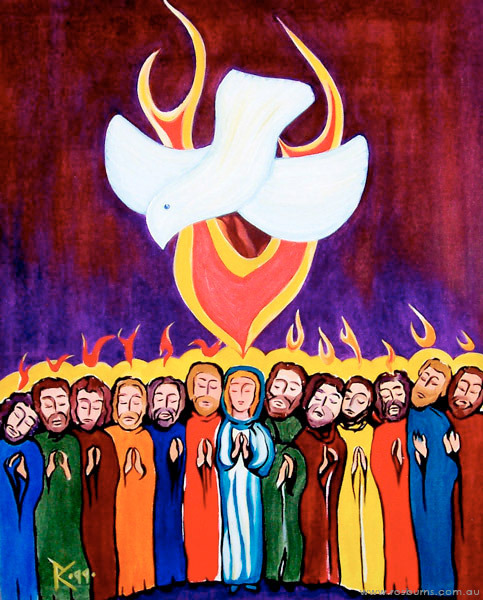
That’s the message of Pentecost. With the Spirit busting loose. With quiet reverence. Today we celebrate the birthday of the church.
We Episcopalians have always been chary of too much exuberance in worship. It is not our way.
I remember back in high school my girlfriend Barbara had been asked by her close friend, to attend Glenda’s church one Sunday afternoon. As boyfriend and protector, I was conscripted to accompany her. I didn’t know much about the Foursquare Church, only that their worship was more enthusiastic than that of the staid Presbyterian church Barbara and I attended.
To say “more enthusiastic” was an understatement. People were standing and murmuring, “Yes Jesus, Yes, Jesus.” Some were in the aisles loudly testifying or speaking in tongues.
Was I ever out of my comfort zone! If this was the rush of the Spirit – I’m sorry, but I’ll take the alternating Sunday. “When’s this over?” I whispered in Barbara’s ear.
Mercifully, there was some sort of intermission and it was announced that the main service was over. We quietly slid out the side door.
It has been said that it is through our imagination that the Spirit has the best chance of getting ahold of us. Through a moment of inspiration.
Lately, I’ve had a couple of hymns that have accompanied me through my days as they weave in and out of various moments.
I’m fond of saying that if you don’t have a song in your heart on waking, your day’s already in trouble. I believe it.
Brian Doyle in A Book of Uncommon Prayer, writes:
“Because you know and I know that a song can save your life. We know that and we don’t say it much, but it’s true. When you are dark and despairing a song comes and makes you weep as you think yes yes yes.”[1]
The “Battle Hymn of the Republic” by Julia Ward Howe bore up the spirits of those in that great struggle to preserve our union and end slavery.
Work songs kept gandy dancers in sync as they hammered in time to straighten the rails of this nation. Lifted their spirits and helped pass the toil of the day.
Union songs forged bonds of solidarity among those struggling for labor justice.
And when President Obama broke into “Amazing Grace” in his rich baritone at the close of his eulogy for The Rev. Clementa Pinckney, killed in yet another mass shooting at a Charleston church – that hymn alone redeemed the day.
To paraphrase Brian’s closing: If today, if haunted by a song that slid out of the radio, or out of memory, and lit up your heart, we pray in thanks that there are such fraught wild holy moments as this. And so: amen.
These songs bind us together. That is the message of Pentecost. It reunites where the Tower of Babel separated – each speaking a language the other didn’t understand.
Keri L. Day, Princeton professor of Constructive Theology and Ethics, reflects on why, as a young girl, she so loved the telling of the story in the Book of Acts. “’And they were gathered together in one accord.’ That line communicated what was held as sacred within our community: our togetherness, our unbreakable bond of living with and loving each other. We were in one accord. The joy of community was the gift of the Spirit.”[2]
“Are not all these who are speaking Galileans? And how is it that we hear, each of us, in our own native language? Parthians, Medes, Elamites, and residents of Mesopotamia, Judea and Cappadocia, Pontus and Asia. Phrygia and Pamphylia, Egypt and the parts of Libya belonging to Cyrene and visitors from Rome, both Jews and Proselytes, Cretans and Arabs—in our own languages we hear them speaking about God’s deeds of power.”[3]
This is the miracle of unity, of understanding.
Now, if your wont is to stand in the aisle and shout, to each their own. But the authentic miracle of Pentecost will lead you from that aisle into the city to include the poor and the dissolute. Into the cancer ward and onto the union picket line. Otherwise, what you thought to be a long-distance call was only a local. As close as your own ego.
My dearly departed friend George Regas frequently told the story of a man in an Episcopal Church who, in the middle of the sermon shouted out, “Amen. Amen.” Folks looked around to see who was causing the commotion, but soon didn’t pay him any further mind. A little while later he stood up and loudly encouraged the priest, shouting, “Preach it, brother. Preach it.” At which point an usher stepped beside him, and whispered, urging him to be quiet. After the third outburst, the usher admonished him more sternly that he’d have to restrain himself, to which the man responded that he couldn’t help it. He had the Spirit. “Well, you certainly didn’t get it here,” scolded the usher.
In our own, quiet way, we Episcopalians pray, “Come, Holy Ghost, our souls inspire, and lighten with celestial fire.”
And within the fertile recesses of imagination and of the heart — yes, even the “Frozen Chosen” are moved to deeds of service and sacrifice.
It was, in fact the Rector of All Saints Church, Pasadena, who went to the assembly point at the Santa Anita Race Track, where Japanese citizens were rounded up to be sent off to far-away concentration camps. This was in 1942, that their priest, Frank Scott, stood in front of trains to protest the removal of Japanese-Americans, American citizens, for God’s sake, hauled off to internment camps during World War II.
Not different in kind from what the Nazis were doing in Germany. And all quite legal, to be sure. There was a government order.
This, in a day when proper Episcopal priests from a well-to-do, prominent Pasadena parish did not do such unseemly things. Moved by the Holy Spirit, that’s exactly what Fr. Frank did! Moved by the Spirit, he was.
These were all Americans – we are all Americans. No barriers, No separation. We are one in the Spirit. That’s what Fr. Frank stood for.
The Spirit in service of unity brings courageous acts of aid on behalf of others. This about the one and true Spirit, not pious bliz-blaz. Or religious hype. Some might call it heroism.
Greater love hath no one than to lay down her life for another. That’s what Amerie Jo Garza did in her last moments, calling 911 in an attempt to save her classmates who were still alive as a shooter sprayed her classroom with automatic fire from a high-powered weapon of war. On May 24th just days away from when Amarie anticipated beginning her summer vacation.
“On Tuesday, the Girl Scouts announced that they posthumously awarded her one of its highest honors for risking, and ultimately giving, her life to save others.”[4]
“The organization gave 10-year-old Garza the Bronze Cross, which is awarded ‘for saving or attempting to save life at the risk of the Girl Scout’s own life.’” [5]
This “spunky” little girl, so full of life taken from us too soon. And how shall we honor her memory? What is asked of us, the living?
As consciousness slipped and darkness enfolded her, I wonder what song, if any, might have slipped into her fading awareness, what song might have escorted her home to God.
I’m willing to bet that the song which greeted her arrival had to have been “For All the Saints, Who from Their Labors Rest.”
No Barriers, Amerie Jo Garza. No Barriers. Amen.
[1] Brian Doyle, A Book of Uncommon Prayer (Notre Dame, IN: Sorin Books, 2014, 58.
[2] Keri L. Day, “We Need a Pentecost,” Christian Century, May 3, 2018.
[3] Acts 2:7-11, NRSV.
[4] Li Cohen, “Girl Scouts Posthumously Award Amarie Jo Garza for Doing ‘All She Could’ to Save Classmates, Teachers During Uvalde Shooting,’ CBS News, June 1, 2022.
[5] Ibid.
June 5, 2022, Day of Pentecost
“No Barriers”
The Rev. Dr. John C. Forney, St. Francis Episcopal Mission
Genesis 11:1-9; Psalm 104:25-35, 37; Acts 2:1-21;
John 14:8-17


